Green Clean ‘Art’ Scene

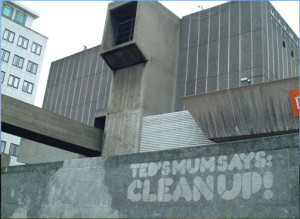
reverse_graffiti-w bigbrother_reversegraffiti-w Taking it’s cues from the ubiquitous ‘wash me’ signs hastily scribbled into the layer of exterior dirt on cars across the world, reverse graffiti (AKA green graffiti or clean tagging) is the act of marking a public space with street art or sponsored campaigns by selectively cleaning through urban grime.
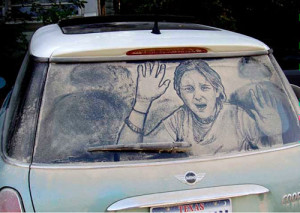
dirtycar3-wThe act is simple and well-worn, but somehow still innovative. While traditional graffiti is largely outlawed for its [arguably] negative effect on private property, few municipalities have laws against cleaning, thus allowing the movement to operate in a grey area, where nothing is added and no harm is done, yet images and text are clearly visible and [further] clean-up is still required for swift removal.

All of which brings to mind a series of questions:

  • • In an era where the lines between art, guerrilla marketing and ‘vandalism’ are being constantly blurred, where (if anywhere) do we now draw the distinctions?
  • • Can a non-destructive act still be considered vandalism?
  • • Is cleaning up areas to avoid artistic ‘cleaning’ ironic, environmentally beneficial or both?
  • • As advertising becomes increasingly ever-present are there still any spaces or methods that are considered off limits or taboo?
  • • What other untapped arenas can or will be opened up as ‘free space’?

Perhaps only time (and the subsequent impermanence of these works) will tell.

 

Words Hurt

A recent, windy day in Malibu, CA revealed, in more ways than one, a ‘dirty’ underside of the American experience.

The door to an enclosed area for garbage cans had swung open exposing a seemingly ‘private’ directive. This part of town has three trash cans for different types of refuse: green for vegetation, blue for recyclables and black for garbage. Undoubtedly the compartment captured in the above image housed the latter trash can. Yet, once a force of nature dragged the private realm into the public, these two simple words became arresting at least, and to some members of the population even assaultive.

In the public arena these words bring to mind our country’s dark history with African-Americans and hint that this chapter of American history, one fraught with racism and class warfare, may not be as distant as we like to believe. For a phrase that also comes to mind when viewing this ‘innocent’ plaque is its antipode: ‘white trash,’ an often humorously used but always derogatory phrase that assigns the label ‘trash’ to the poor and often uneducated portion of the white population which is perceived as not behaving ‘white’ enough; thus reinforcing the racist idea that these are inherent characteristics of anyone who isn’t white.

Maybe it’s time to retire both ‘black and white’ phrases altogether.

Regardless, one can’t help but wonder how much more money and effort it would have taken to add one more word to this contentious pair on a door that swings open to a popular beach-side street…

…the word ‘can.’


Pictorial signs

No Weapons Allowed

→√ΔØ! Pictorial Signs (also known as pictographs or ideograms depending on their form) are meant to relay ideas beyond the barrier of language, yet ironically, their simplified messages can sometimes create cultural and linguistic ambiguities.

Some signs can be considered reactionary as in the case of signs that popped up in a Los Angeles movie theater recently. (No guns?) (Were these here before?)(Why are guns representative of all weapons?) (Was this somehow permissible beforehand?)

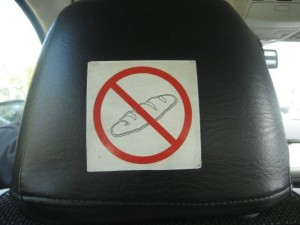
No Baguettes

While others may be reflective of cultural norms, as in the case of a sign in the backseat of a Parisian taxi cab. (No baguettes?) (Is bread symbolic of all food?) (Why bread?) (Is other food OK?) (Does this mean, “no eating”?)

It is here in these ambiguities that we find the possibilities to dive deeper into the cultures that surround them. Signs may be meant to instruct, warn, or inform us but sometimes they only lead to more questions…

The Mystery Spot: Bumper Sticker Semiology

Mystery Spot sticker

Like some of the most profound wisdom, “The Mystery Spot” manifested itself on the rear end of a car.

According to Sandlot Science, Mystery Spots are the product of the great depression, when the entertainment industry was trying to market strange phenomena.  Operating on optical illusions that are “driven by spatial distortion and misdirection,” half the fun of Mystery Spots seems to derive from the buying and selling (if only half-so) of the varied phenomenological explanations for these charmed locations.  Oh, and of course, there’s the bumper sticker.

vintage mystery spot photo

Like bumper stickers that keep you guessing, the allure of the ‘Mystery Spot’ is its low-culture charm, and despite knowing the truth or not, everyone shares the same delusory experience.