Posted on a billboard in the Institute’s neighborhood. We couldn’t help but notice the job-seeker’s name.
at the Institute of Cultural Inquiry

Posted on a billboard in the Institute’s neighborhood. We couldn’t help but notice the job-seeker’s name.
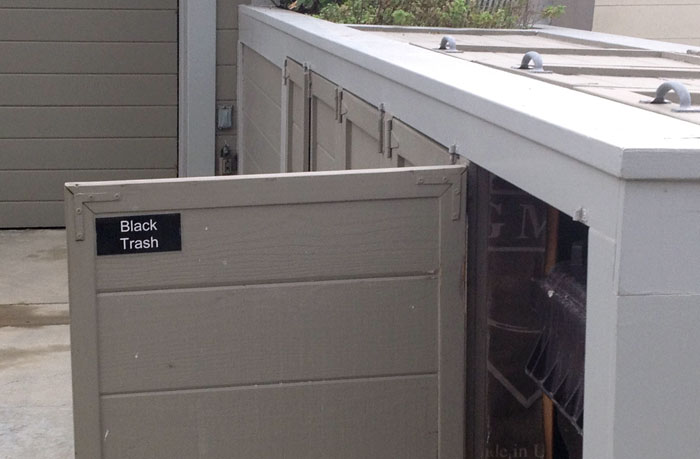
A recent, windy day in Malibu, CA revealed, in more ways than one, a ‘dirty’ underside of the American experience.
The door to an enclosed area for garbage cans had swung open exposing a seemingly ‘private’ directive. This part of town has three trash cans for different types of refuse: green for vegetation, blue for recyclables and black for garbage. Undoubtedly the compartment captured in the above image housed the latter trash can. Yet, once a force of nature dragged the private realm into the public, these two simple words became arresting at least, and to some members of the population even assaultive.
In the public arena these words bring to mind our country’s dark history with African-Americans and hint that this chapter of American history, one fraught with racism and class warfare, may not be as distant as we like to believe. For a phrase that also comes to mind when viewing this ‘innocent’ plaque is its antipode: ‘white trash,’ an often humorously used but always derogatory phrase that assigns the label ‘trash’ to the poor and often uneducated portion of the white population which is perceived as not behaving ‘white’ enough; thus reinforcing the racist idea that these are inherent characteristics of anyone who isn’t white.
Maybe it’s time to retire both ‘black and white’ phrases altogether.
Regardless, one can’t help but wonder how much more money and effort it would have taken to add one more word to this contentious pair on a door that swings open to a popular beach-side street…
…the word ‘can.’

Like some of the most profound wisdom, “The Mystery Spot” manifested itself on the rear end of a car.
According to Sandlot Science, Mystery Spots are the product of the great depression, when the entertainment industry was trying to market strange phenomena. Operating on optical illusions that are “driven by spatial distortion and misdirection,” half the fun of Mystery Spots seems to derive from the buying and selling (if only half-so) of the varied phenomenological explanations for these charmed locations. Oh, and of course, there’s the bumper sticker.

Like bumper stickers that keep you guessing, the allure of the ‘Mystery Spot’ is its low-culture charm, and despite knowing the truth or not, everyone shares the same delusory experience.
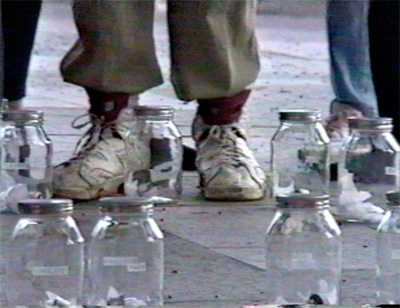
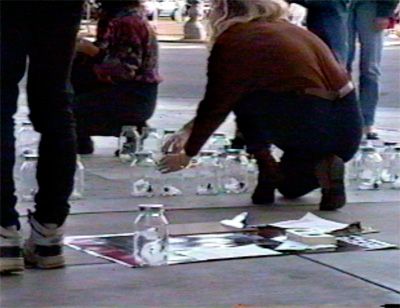
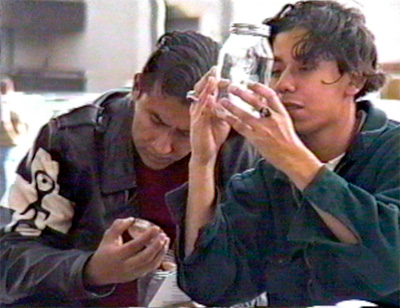
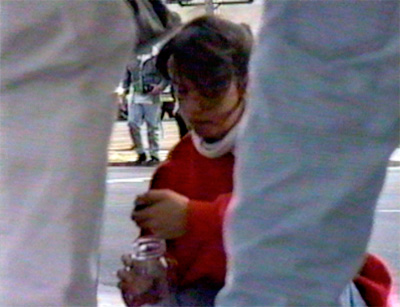
Data collection at Santa Monica Festival, Santa Monica, CA. (VIDEO EXCERPT)
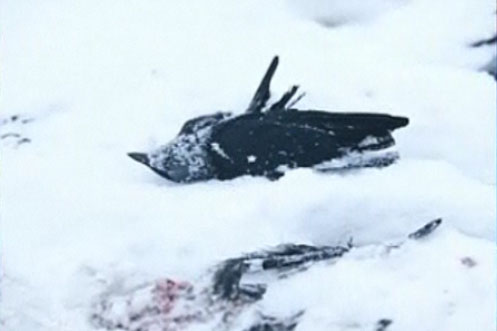
Since the first of the year, a steady stream of news stories regarding the death of creatures winged and gilled, close and far from home have made their way to the ICI Ephemera Kabinett.
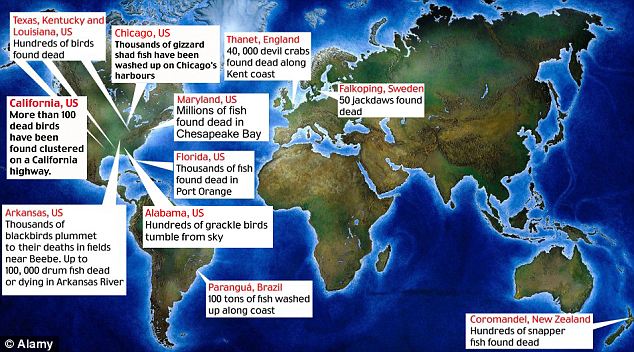
So many answers. The question (we should ask, are afraid to ask), like madness, lurks in the shadow waiting for its prey.
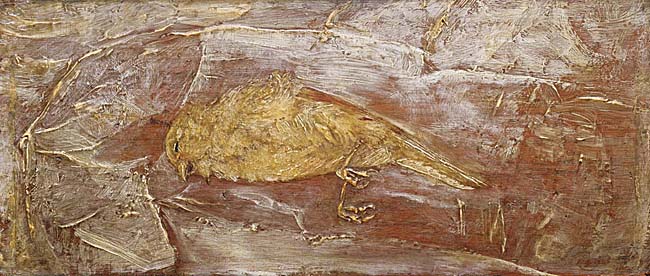
We’ve filed the stories next to a weathered postcard from the Phillip’s Collection in Washington, D. C. On the front is Dead Bird by Albert Pinkham Ryder (1890s.). On the back a handwritten note: “I didn’t know I had forgotten how to cry.”

We have just added Urÿonstelaii by Pablo Helguera to the ICI Library. Helguera contributed to our Searching for Sebald publication and the limited artist project associated with that book. His latest book recounts a tale about a mysterious sect of Dutch mystics who arrived to an island in the New World in 1660 with the objective to create a new society. Their governing principle revolved around the uninterrupted performance of a single dramatic work in seven tableaux vivants. Invoking alchemical imagery and hermetic thought, their goal was to arrive to a higher state of being by collectively embodying the symbolic representation of all of human and divine knowledge. Their experiment, which would last a century, would test the human boundaries of time, physical endurance, and the collective commitment toward an idea.
Uryonstelaii is a project consisting of two complementary components: a book published by Jorge Pinto Books,New York, and a one-time only series of performed prologue tours delivered by historical re-enactors as part of Helguera’s performance for The Sixth Borough, an exhibition at Governors Island in the summer of 2010 curated by Manon Slome and Julian Navarro for No Longer Empty.
Lise Patt, the director of the Institute of Cultural Inquiry, had the honor of reading the draft of the book and wrote this brief commentary (reprinted on the back cover): “Like a ‘lamb in wolf’s clothing,’ Pablo Helguera uses the exoteric mechanisms of historical erudition to lure us to his magical island of the Ourobourians. But right about the time we lose our footing on the land’s slippery shores—when we begin to wonder if the artist has gleaned an esoteric tradition for more than just source material for his island’s symbols and nomenclature, when we start to navigate his land with the non-verbal hunches of the alchemists’ score, and call into question the artifices we employ to gather the world around us—we realize Helguera has really taken us on a journey to another land altogether, the most forbidden of places–the self.”
Read more about this project at Pablo Helguera’s website.