
The Institute’s Library has generously been gifted a new book, Inventing the American Dream: A History of Curious, Extraordinary, & Just Plain Useful Patents by Stephen van Dulken.
at the Institute of Cultural Inquiry

The Institute’s Library has generously been gifted a new book, Inventing the American Dream: A History of Curious, Extraordinary, & Just Plain Useful Patents by Stephen van Dulken.
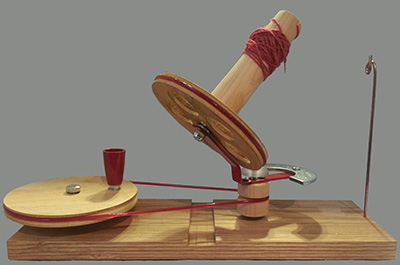
Thank you to Christel Dillbohner for donating a new and exciting tool to the Institute’s collection: a wooden ball winder.
As always, we are excited to see what potential uses and sparks of inspiration are brought about by our interactions with this piece in future projects.
 We are excited to announce a new acquisition to the ICI Ephemera Kabinett: a matchbox-sized case of black-tipped mourning pins, made in Germany for the American and English markets sometime during the nineteenth or early twentieth century. This artifact is in fair condition, with slight damage to the structure of the box. It contains 37 of the original 40 pins.
As part of the cultural and personal customs practiced around the era this was made, these straight mourning pins were often worn in accompaniment with other jewelry, garments, and accessories associated with mourning rituals and etiquette. As Martha Pike notes in her 1980 article “In Memory Of: Artifacts Relating to Mourning in Nineteenth Century America”, black mourning pins were purposed ‘for fastening one’s mourning veil’, assuring that even the tiny details of one’s dress would reflect the somberness that black evokes during periods of deep mourning (309).
As evidence of fading cultural practices around death, these mourning pins are an historically significant addition to the ever-growing collections housed within the Institute of Cultural Inquiry.

We have just added Urÿonstelaii by Pablo Helguera to the ICI Library. Helguera contributed to our Searching for Sebald publication and the limited artist project associated with that book. His latest book recounts a tale about a mysterious sect of Dutch mystics who arrived to an island in the New World in 1660 with the objective to create a new society. Their governing principle revolved around the uninterrupted performance of a single dramatic work in seven tableaux vivants. Invoking alchemical imagery and hermetic thought, their goal was to arrive to a higher state of being by collectively embodying the symbolic representation of all of human and divine knowledge. Their experiment, which would last a century, would test the human boundaries of time, physical endurance, and the collective commitment toward an idea.
Uryonstelaii is a project consisting of two complementary components: a book published by Jorge Pinto Books,New York, and a one-time only series of performed prologue tours delivered by historical re-enactors as part of Helguera’s performance for The Sixth Borough, an exhibition at Governors Island in the summer of 2010 curated by Manon Slome and Julian Navarro for No Longer Empty.
Lise Patt, the director of the Institute of Cultural Inquiry, had the honor of reading the draft of the book and wrote this brief commentary (reprinted on the back cover): “Like a ‘lamb in wolf’s clothing,’ Pablo Helguera uses the exoteric mechanisms of historical erudition to lure us to his magical island of the Ourobourians. But right about the time we lose our footing on the land’s slippery shores—when we begin to wonder if the artist has gleaned an esoteric tradition for more than just source material for his island’s symbols and nomenclature, when we start to navigate his land with the non-verbal hunches of the alchemists’ score, and call into question the artifices we employ to gather the world around us—we realize Helguera has really taken us on a journey to another land altogether, the most forbidden of places–the self.”
Read more about this project at Pablo Helguera’s website.