A Forger’s Life at the ICI

couverture-kaminsky-small-copy-w

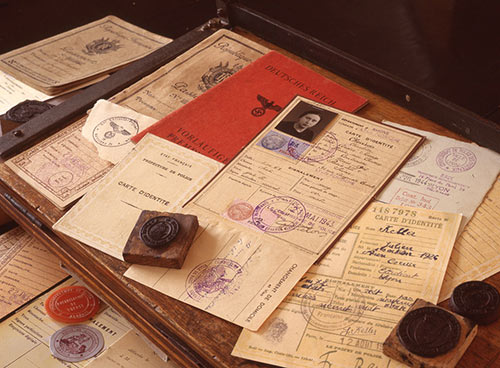
Adolfo Kaminsky, A Forger’s Life (DoppelHouse Press) is the gripping true story of the author’s father deemed “worthy of the best spy novels” (TED.com) and featured in the short documentary The Forger produced by The New York Times. The book traces Adolfo Kaminsky’s perilous double-life as a teenage forger for the French Resistance in World War II and, afterward, for numerous clandestine organizations. Adolfo Kaminsky helped save lives of people persecuted for their race, religion or beliefs for over 30 years, making documents to protect revolutionaries in Latin America, anti-colonial activists in Algeria and protesters in the May ’68 student rebellion. Because Adolfo Kaminsky worked professionally as a photographer, he was able to hide his forgery practice, and the book includes photos of his labs as well as artistic images from ‘40s–‘50s Paris.

On December 9, 2016 in the ICI Library, Sarah Kaminsky will read from the book and discuss art and forgery in a conversation led by Antoinette LaFarge and Lise Patt. The event begins at 6 pm with the conversation starting promptly at 6:30 pm. A book signing will immediately follow the discussion.

Please rsvp to the Institute at info@culturalinquiry.org.

Adolfo Kaminsky: A Forger’s Life is published by Doppelhouse Press. Please join us and show your support for this exciting new publisher based in Los Angeles, a city traditionally rich with talented writers and woefully poor when it comes to publishing houses.

AIDS Chronicles 1995

Status: COMPLETED

Cover artist and binder: Esteban Chavez S.

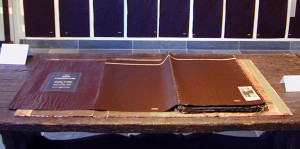
This edition comprises four portfolios each of which holds Chronicle pages that have been hand-sewn together in an accordion fashion. New York-based Chavez S. used a photogravure process to create the cover images of his four-volume set. Visually emphasizing the artistic heritages of East and West, the portfolio-style covers were printed on both the inside and outside. The Chronicle’s pages were hand-sewn to create 12 accordion-fold books, each containing one month of pages. Each volumes includes specially printed “name sheets” between the months that include all those listed in New York Times obituary pages as having died of HIV/AIDS during that year. The portfolios were printed at Robert Blackburn’s Printmaking Workshop in NYC.

ac-1995-half_opened-w  ici-aidsac1995-cover-alt-w

ac-1995-detail-cor-w     ici-ac95chavez_crop-w


Exhibition History:

dwa1  dwa5     dwa2

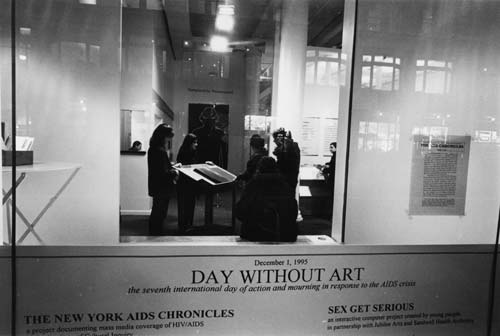
1995—New Museum of Contemporary Art in New York on December 1 of that year, the sixth Day Without Art. The Chronicle was displayed in the lobby and visitors to the museum turned its pages at a rate determined by the number of AIDS deaths that year with each turn of the page representing a person that had died. This interactive display was positioned to occupy the Museum’s street-level display window, thereby bringing its message to the thousands of people who passed by the window on a daily basis.

2003—Sam Francis Gallery at Crossroads School in Santa Monica, CA as part of a retrospective exhibit of the AIDS Chronicles.

AIDS-Chron1144   ICI-ACchron_samfrancis-w


ICI Director in Conference

ICI-IMAGE-1-w ICI Director, Lise Patt, will be participating in a career roundtable discussion as part of an upcoming one-day conference that “will explore how the human body and its experiences of illness are imagined and made visible in medical research, practice, and education.” You can RSVP to attend the event here.

MEDICINE AND THE IMAGE: THE VISIBLE HUMAN
Wednesday, November 5, 2014 | 8:30 AM – 7:00 PM
Roundtable on Careers in the Health Humanities & Arts 1:30 – 3:00pm , University of Southern California, Doheny Memorial Library, Room 240

PUBLIC GALLERY EXHIBIT
Monday, November 3 – Friday, November 7, 2014 | Von KleinSmid Center Courtyard


Craig Owens by John Galt

For most artists of a certain age they can remember the first time the public discourse on HIV suddenly became personal through the death of a loved one, a diagnosis of a friend or a long afternoon as an HIV test was being analyzed.  For ICI founder and director Lise Patt, that moment came in 1990 when the art critic Craig Owens died of AIDS. As she recounts it:

Owens wasn’t the first person I knew to die of AIDS and sadly he wasn’t the last one but I remember feeling like someone had punched me in the stomach when I heard of his passing. By 1990, the year of Owens death, AIDS was clearly robbing us of talented painters, photographers and other visual artists but up to that point I didn’t realize that it was also going to steal our voice – the people who talk for us, that contextualize our work, that write us into a history that is fickle at best and often unkind to those of us who create with our hands and not with words.

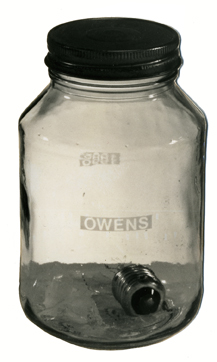
John Galt, a long-time associate of the ICI, gave Patt this bottle to help assuage her dis-ease. A recycled mayonnaise jar, on the outside surface he etched Owens name and the year of his death. Under the lid was a brief biography and inside the bottle he placed a shattered light bulb, an insider’s message from Galt to Patt, who had often spoke of Owen’s landmark essay “The Allegorical Impulse” as the light bulb that lit her art practice.

In the fall of the same year, Patt asked Galt if she could use his form for a project she was working on. On December 1, 1990 that project was born as the AIDS Bottle Project. Borrowing Galt’s form, 100 bottles representing 100 individuals in the arts who had died from AIDS were displayed at Los Angeles County Museum of Art.

ICI at San Francisco Art Institute

Lise Patt, Founder and Director of the ICI, & Deborah Cullen, our Board President, traveled north to lecture at the San Francisco Art Institute on March 25, 2011 as part of the school’s Graduate Lecture Series. The pair presented “Collective Camouflage: The Non-Profit Organization as a Tactical Artist Medium,” during which they argued that a non-profit organization can empower (not burden) small groups of like-minded artists. Utilizing the ICI’s trademark ‘performance lecture’ format, the hour presentation was a layered ‘enactment’ of an ICI laboratory brainstorming session. Patt’s planned but unrehearsed interventions into Cullen’s powerpoint presentation resulted in some unusual and sometimes humorous interpretations of the ICI’s long history. How else can you characterize the juxtaposition of  a powerpoint slide depicting a small cavalcade of L.A. policemen investigating our ‘guerilla’ presentation of the AIDS Bottle project at LACMA in the late 1990s with Cullen’s description of spitfire beetle larvae that group together to pass themselves off as bumble bees and Patt’s visual disruption of both these elements, enacted in the corner of the powerpoint slide with a live feed of her white gloved hands measuring a rock that bears an uncanny resemblance to a human penis.

The lecture was a perfect end to a stimulating and inspiring day spent in the studios of the SFAI graduate students, many of whom Patt and Cullen hoped to recruit as ICI ‘associates in training.’ Check out the SFAI Graduate Lecture series and visit the school’s website to see some of the exciting new programs at SFAI including their low residency MFA program.


Urÿonstelaii

We have just added Urÿonstelaii by Pablo Helguera to the ICI Library. Helguera contributed to our Searching for Sebald publication and the limited artist project associated with that book. His latest book recounts a tale about a mysterious sect of Dutch mystics who arrived to an island in the New World in 1660 with the objective to create a new society. Their governing principle revolved around the uninterrupted performance of a single dramatic work in seven tableaux vivants. Invoking alchemical imagery and hermetic thought, their goal was to arrive to a higher state of being by collectively embodying the symbolic representation of all of human and divine knowledge. Their experiment, which would last a century, would test the human boundaries of time, physical endurance, and the collective commitment toward an idea.

Uryonstelaii is a project consisting of two complementary components: a book published by Jorge Pinto Books,New York, and a one-time only series of performed prologue tours delivered by historical re-enactors as part of Helguera’s performance for The Sixth Borough, an exhibition at Governors Island in the summer of 2010 curated by Manon Slome and Julian Navarro for No Longer Empty.

Lise Patt, the director of the Institute of Cultural Inquiry, had the honor of reading the draft of the book and wrote this brief commentary (reprinted on the back cover): “Like a ‘lamb in wolf’s clothing,’ Pablo Helguera uses the exoteric mechanisms of historical erudition to lure us to his magical island of the Ourobourians. But right about the time we lose our footing on the land’s slippery shores—when we begin to wonder if the artist has gleaned an esoteric tradition for more than just source material for his island’s symbols and nomenclature, when we start to navigate his land with the non-verbal hunches of the alchemists’ score, and call into question the artifices we employ to gather the world around us—we realize Helguera has really taken us on a journey to another land altogether, the most forbidden of places–the self.”

Read more about this project at Pablo Helguera’s website.

Searching for Sebald: Photography After W. G. Sebald (2007)

Searching for Sebald: Photography After W. G. Sebald is a collection of original essays and visual projects inspired by the work of W. G. Sebald. The interest in Sebald has crossed disciplines, igniting passionate dialogue among and between scholars and practitioners. This unique project, with its intricate weave of image and text, captures this spirited conversation in both theory and praxis. Searching for Sebald is edited by Lise Patt with Christel Dillbohner.

ISBN: 978-1-889917-11-5 (Trade Edition)
600 pages; 300 illustrations, 100 color.

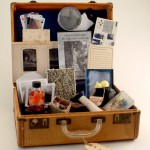
The book is also available in three special editions including a sleeved Reader’s Edition, a boxed Collector’s Edition, and a unique, limited Artist Edition of 100 ‘traveling suitcases.’ This special offering includes 20 original artworks by a roster of internationally recognized artists packaged with a hardcover copy of Searching for Sebald and a copy of Sebald’s four ‘prose fictions.’ Purchase the Reader’s Edition,  Collector’s Edition and the Artist Edition from the ICI Gift shop.

  ICIP-SFSreader_pcv-w               

Read more about the book.

Read what the critics are saying.