Status: COMPLETED Cover artist and binder: Martin Gantman
This edition is comprised of a single reliquary which houses all articles that mention HIV or AIDS along with the charred remains of the rest of the 2001 edition.
Exhibition history:
2016—Original pages were burnt during a public event at the ICI on December 1st, World AIDS Day
Status: COMPLETED Cover artist and binder: Gary H. Brown (artist) and John Balkwill/Lumino Press (Binder)
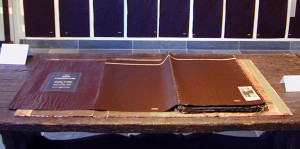
This edition is comprised of 4 volumes with hand-painted covers that correspond to the four seasons. California artist Brown took the four seasons as the theme for this Chronicle, each volume of which contains three months of pages. For example, Brown’s “winter” cover features a gold leaf outline drawing of the Archer constellation against the deep blue of a midnight sky. A professor of art at the University of California, Santa Barbara, Brown dedicated his cover project to his friend and fellow artist John Bommer Murphy II, who died from AIDS complications in 1986 at the age of 29.
Pertinent changes to NYT: As one of the last newspapers to adopt color photography, the New York Times printed its first color photograph on the front page on October 16, 1997.
Exhibition history:
1998—These volumes were shown on December 1, at the Institute of Cultural Inquiry
This edition comprises four portfolios each of which holds Chronicle pages that have been hand-sewn together in an accordion fashion. New York-based Chavez S. used a photogravure process to create the cover images of his four-volume set. Visually emphasizing the artistic heritages of East and West, the portfolio-style covers were printed on both the inside and outside. The Chronicle’s pages were hand-sewn to create 12 accordion-fold books, each containing one month of pages. Each volumes includes specially printed “name sheets” between the months that include all those listed in New York Times obituary pages as having died of HIV/AIDS during that year. The portfolios were printed at Robert Blackburn’s Printmaking Workshop in NYC.
Exhibition History:
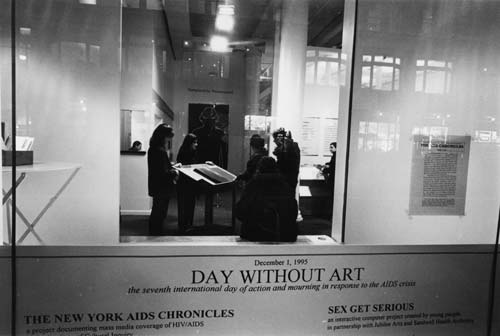
1995—New Museum of Contemporary Art in New York on December 1 of that year, the sixth Day Without Art. The Chronicle was displayed in the lobby and visitors to the museum turned its pages at a rate determined by the number of AIDS deaths that year with each turn of the page representing a person that had died. This interactive display was positioned to occupy the Museum’s street-level display window, thereby bringing its message to the thousands of people who passed by the window on a daily basis.
In addition to any articles mentioning AIDS or HIV, this year will also feature Ebola ‘ghost articles’ to emphasize this year’s extensive coverage of the Ebola health crisis relative to AIDS despite the statistically much higher rate of AIDS-related deaths each day.
The pages for this year have been made into ‘yarn’ and are being knitted into a large, unwieldy quilt to bring emphasis to that other memorial of AIDS that was shown in its entirety on the Washington, D.C. Mall for the last time in the same year as this AIDS Chronicle.
Artist: The ICI family of Associates, Interns, and Volunteers
The pages for this edition are currently being produced in NYC under the supervision of ICI Associate, Deborah Cullen-Morales. The cover art/’binding’ for the year will be designed and produced by Vladimir Cybil Charlier with special emphasis on the Haitian earthquake of January 2010.
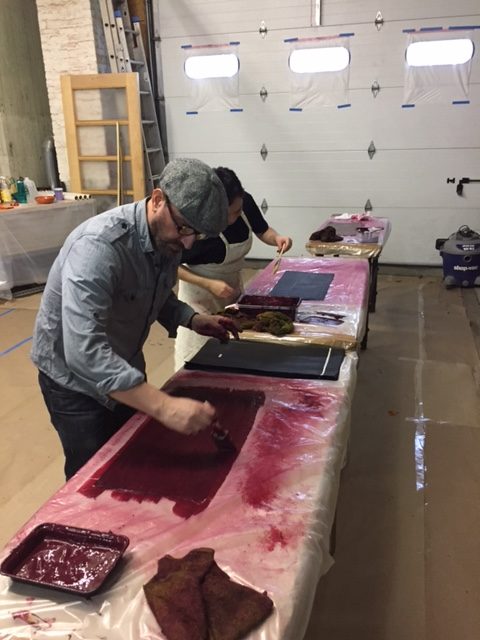
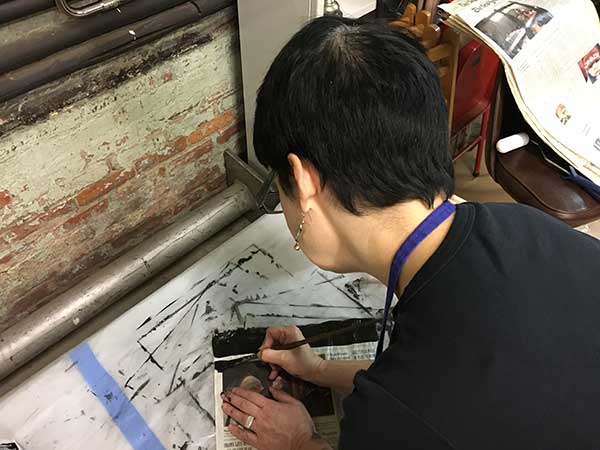
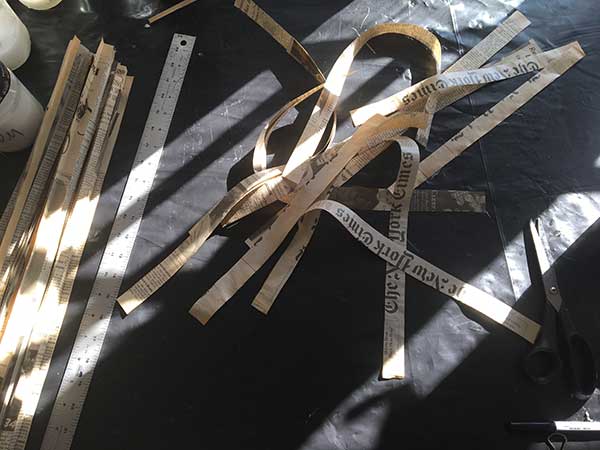
Images from the painting sessions used to complete this edition are seen below.
Portions of 1993, 1994, 1999, 2001, 2002, 2003, 2004 & 2005 editions displayed at Open House (Wunderkammer) event at the Institute of Cultural Inquiry, Los Angeles, CA.
2003
(10th Anniversary Exhibition of the AIDS Chronicles) 1995, 1997, 1998, 2000 & 2003 editions displayed atSam Francis Gallery at Crossroads School in Santa Monica, CA with a performance by J. Todd.
1998
1998 edition displayed in front of theNew York Public Library, New York. Funded in part by the Robert Farber Foundation and Visual AIDS; 1997 edition displayed at the Institute of Cultural Inquiry, Santa Monica, CA with a reading by J. Todd.
1996
Special Los Angeles Times 1996 edition displayed atMidnight Special Bookstore, Santa Monica, CA; 1995 edition displayed at the Institute of Cultural Inquiry in Santa Monica, CA.
An unfinished quilt project in the ICI Ephemera Kabinett will jumpstart the 1996 Chronicle. The abandoned project included some quilted panels displaying terms related to AIDS. Embroidered on canvas in 26 pairs — two for each letter of the alphabet — white panels spell out the public face of AIDS, while red panels counter with more personal responses. In its first imagining, the 1996 AIDS Chronicle would dialogue with the national AIDS quilt.
Fortuitously, 1996 turned out to be the last year the AIDS Quilt was shown in its entirety on the Washington D.C. Mall. The quilt’s display as a singular, political object — always an important function for the quilt — is often overshadowed by the attention given to the mourning function of the blanket’s individual panels. In it’s revised plan, the 1996 AIDS Chronicle aims to revive some of the discussions surrounding the AIDS Quilt’s dual role as a public and private document. In doing so, it offers a template by which the ICI can examine the dichotomies of its own AIDS project.
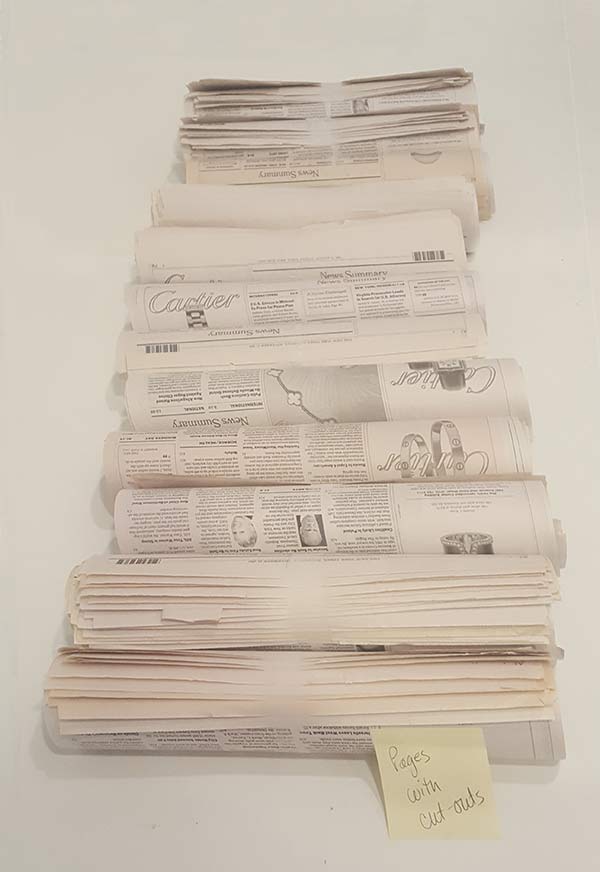
After the AIDS/HIV articles are isolated, the remaining newsprint will be used to create strips of newsprint ‘yarn.’ The yarn will be knitted into a large unwieldy blanket. Its ‘inconvenient’ size points to both the immensity of the pandemic and our inability to ‘hide’ its unbounded consequences. The Canvas panels will be used to create a storage pouch for the finished blanket.
This edition was first published online on December 1, 2015, (World AIDS Day). A special Limited Edition, printed box set is currently being produced by ICI Press.
The Institute of Cultural Inquiry (ICI) is pleased to announce the online publication of the 2013 AIDS Chronicle, the first digital edition of their longest ongoing project, the AIDS Chronicles, which brings attention to the AIDS pandemic through targeted, art-based activism.
The AIDS Chronicles were initiated in 1993, at the height of the AIDS pandemic in the United States, to create a record of the day-to-day discourse on AIDS and HIV in what is often referred to as the US “newspaper of record,” the New York Times. The goal of the project is simple—to subvert the newspaper’s usual hierarchy of focus in a way that narrows the reader’s attention to just one issue – the newspaper’s (lack of) reporting about the spread of the HIV virus and the global AIDS pandemic.
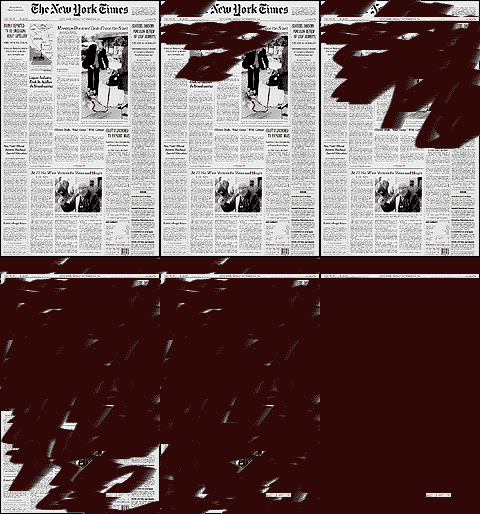
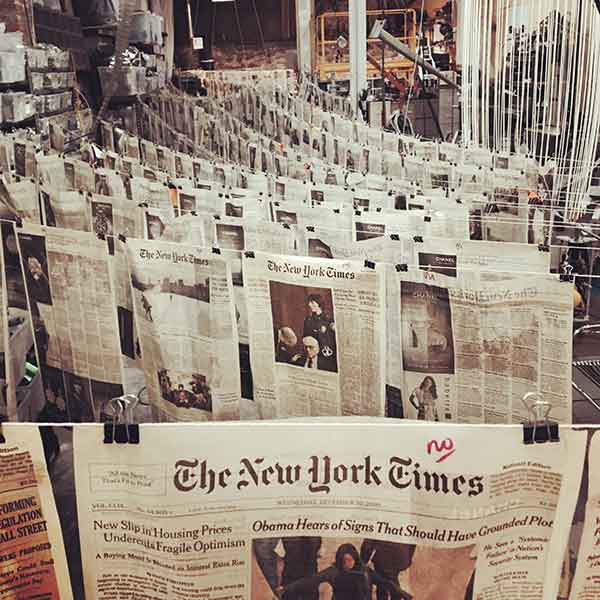
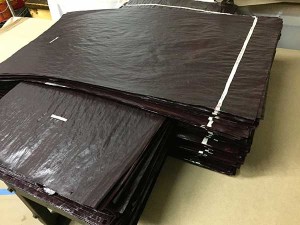
Each yearly AIDS Chronicle consists of 365 front pages from the New York Times, collected from December 1 (World AIDS Day) to November 30 (of the following year) that have been treated on both sides with three layers of acrylic paint to produce tangible, blood-red sheets that leave visible only images or articles that mention AIDS or HIV, along with the folio showing the date of publication, and the ‘obituaries’ (or in their absence a blank box) in the newspaper’s index as a direct reference to the listing of AIDS-related deaths deep inside the newspaper. The various artist ‘bound’ editions of the AIDS Chronicles are on permanent display in the ICI Library and are often shown publicly on December 1st to commemorate World AIDS Day and the Day With[out] Art.
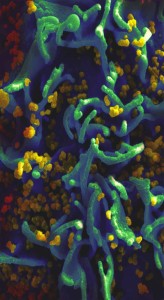
This year the ICI is publishing the 2013 AIDS Chronicle as a digital document, a virtual edition made possible after the New York Times began to offer high-resolution, downloadable PDFs of their daily front page in the summer of 2012. The digital publication, produced by the ICI’s Assistant Director and independent curator, Sue-Na Gay, will be divided into three volumes to facilitate download and interaction with cover images that capture both the horror and beauty of the HIV virus. The covers present the viewer with an up close and personal look at the HIV virus on a microscopic scale, shedding light on the virus’s destructive biological implications, while at the same time aesthetically blurring it into abstraction. Here, the disease is at once wholly present and yet still ‘flying under the radar’ to the untrained eye thus mirroring the coverage of the disease process in the media.
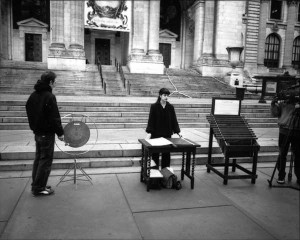
New York Public Library, 1998 Sam Francis Gallery at Crossroads School, 2003
Over the years, pages of the AIDS Chronicles have been displayed in a variety of forms. As unbound, loose sheets, they have been shown covering walls or windows as an expansive and overwhelming document. In book form, the Chronicles have been displayed on a lectern or pedestal where volunteers from the community turn the pages to the sound of a gong that is hit at the rate of worldwide AIDS deaths for the year preceding the display. Each presentation has allowed viewers to study the information published by this prominent U.S. newspaper and encouraged them to reflect on the types of articles and the kind of attention and information the continuing pandemic is given. At the same time, the display of the pages in their repetitive, minimalist simplicity has allowed for quiet contemplation in order to remember those individuals who have been lost to the disease.
Since its inception, the Chronicles have quietly and self-reflectively ‘indexed’ the New York Times‘ reports on the spread of the HIV virus. The painted pages have endured to bear witness to the long decades when the virus jumped to Africa and Southeast Asia, when drug companies found financial opportunities in drugs meant to treat (but not cure) HIV, and when the virus turned into a cause célèbre fashion statement. The Chronicles continue to keep vigil to this day as nations push for -0- infection rates, reminding us that even though the Times has chosen to minimize its reporting on the AIDS virus, a choice evidenced by their daily, front page coverage of the 2014 Ebola epidemic in Africa, the newspaper did once report on hopes for a real cure and a real vaccine not just on expensive treatments that promise a life with the virus.
After twenty-two years, the AIDS Chronicles has met the ICI’s goal to produce a historical record of AIDS reporting in the New York Times but it has also created another unanticipated record, a collective document drawn from a different kind of AIDS reporting. That document is forged in the areas of pages that hold no AIDS/HIV articles; in the weight of those pages as they sit in silent tomes; in the residue left by human hands that touch their skin-like surfaces; in the small rips and tears that result from their ritualized turning; and especially in their seemingly unending supply. Their blood-red, cockled surfaces speak of the blood that carries the virus, of the fear of that blood, of passion, of pain over the loss of passion, of anger, of a rage that ‘sees red,’ and of the shame of having blood on one’s hands—of being caught red handed. The language of this other AIDS record comes not from the printed press but from the private, lived experience of loss, of anger, of shame.
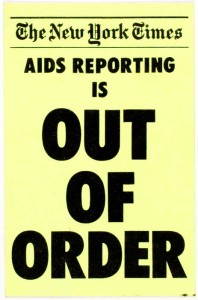
With its dual ability to operate as a record of public notice and as a document of private experience, the AIDS Chronicles project enters a new chapter as one of its tomes becomes an ambassador of AIDS activism on the Internet, albeit with new and different forms. Given that the digital publication of the 2013 AIDS Chronicle is a weightless document entering the timeless datascape of the Internet, it will have to find its power in other news-gathering traditions, its activism through other unnoticed trap doors. Online, the document will not be restricted to the United States and Europe, (to date the only locations the AIDS Chronicles have been shown); it will potentially reach a global audience that includes those populations that continue to be most affected by the AIDS pandemic. With a publication url that includes a fragment of the New York Times own digital address, the 2013 Chronicle will shadow the digital pages of the 2013 Times as it travels through Google search pages, like a talkative hitchhiker that is always ‘going wherever you’re going.’ The small box on each page that wraps around the word obituary, or blankly represents it, will become more than an abstract symbol of loss and shame. Online, the deaths the obituary boxes represent will be linked to ‘tags’ that carry the names of actual individuals whose obituaries were once printed inside the newspaper even as the Times kept the front page free of any mention of the virus that killed them. Widgets and SEO options give context and history to the Times‘ engagement with HIV and AIDS as ‘digital stowaways’ that help ‘right’ the pages that ACT-UP once said, when it came to AIDS reporting, were ‘out of order.’
On December 1, 2015, the 2013AIDS Chronicle will be published as a digital three-volume tome. At the same time, the 365 pages will become raw material in the virtual space of the unfinished, the unrepaired, and the unretrieved where, instead of collecting dust and silverfish in the ICI Library, they can help draw new hypotheses for a yet unknowable future.
# # #
Sue-Na Gay also designed the archive box that will hold the original 2013 newsprint documents and a specially designed jump drive that will carry the data information and documentation of the digital publication. This archive box will be deposited in the ICI Library with other versions of the AIDS Chronicles and will be available to the public by appointment throughout the year. All three digital volumes of the 2013 AIDS Chronicles will remain on display via the Institute’s multi-faceted online presence.
A downloadable pdf version of the press release can be found here.
(1.2 mb; updated 02/22/2017)
























 document entering the timeless datascape of the Internet, it will have to find its power in other news-gathering traditions, its activism through other unnoticed trap doors. Online, the document will not be restricted to the United States and Europe, (to date the only locations the AIDS Chronicles have been shown); it will potentially reach a global audience that includes those populations that continue to be most affected by the AIDS pandemic. With a publication url that includes a fragment of the New York Times own digital address, the 2013 Chronicle will shadow the digital pages of the 2013 Times as it travels through Google search pages, like a talkative hitchhiker that is always ‘going wherever you’re going.’ The small box on each page that wraps around the word obituary, or blankly represents it, will become more than an abstract symbol of loss and shame. Online, the deaths the obituary boxes represent will be linked to ‘tags’ that carry the names of actual individuals whose obituaries were once printed inside the newspaper even as the Times kept the front page free of any mention of the virus that killed them. Widgets and SEO options give context and history to the Times‘ engagement with HIV and AIDS as ‘digital stowaways’ that help ‘right’ the pages that ACT-UP once said, when it came to AIDS reporting, were ‘out of order.’