With Everything but the Monkey Head: Theorizing Art’s Untheorizable Practices
Iteration VIII: Amy Kaczur (June 26 – July 1) Finissage: Saturday, July 1, 2017, 6 – 8 pm
The Institute of Cultural Inquiry (ICI) is pleased to announce the launch of With Everything but the Monkey Head: Theorizing Art’s Untheorizable Practices, a major project centered on the burgeoning field of studio-based research in the visual arts. This project will be a long-term collaboration with a host of diverse participants including nine researchers who have participated in some sort of visual research at the ICI; a set of specially selected interlocutors whose questions will help construct and strengthen the ideas central to each researcher’s project; and the curious spectators who bring discussion and debate to public exchanges.
The eighth iteration of the project will feature Amy Kaczur, a 2015 participant in the ICI’s Visualist-in-Residence (VIR) project. Kaczur returns to the ICI for a one week mini-residency during which time she’ll share her thoughts about her own research practices while collaborating with the ICI to build a treatise on the organization’s visual research endeavors. Building off her VIR project, the artist will continue to work on Stitching Julia: installation for an imagined life and the persistence of inquiry, as she attempts to mine and imagine the life and cultural shaping of Juliska Alt Kaczur through a singular photographic portrait. Her stay will culminate in a finissage on July 1, 2017 during which time she’ll share her ideas with the public.
Each iteration of With Everything but the Monkey Head will be accompanied with a unique laboratory workbook created by the researcher over the course of their short residency. In addition, each researcher will contribute to the project’s catalog, which is being produced to emulate late 19th century ‘sample’ books used by traveling salesmen, books whose form lends itself to an idea that is still unfolding.
All parts of the project can be followed on the ICI’s website. The construction of the lab books and the catalog will be charted on ISSUU where finished publications will be offered to the public through the print on demand service of ICI Press.
A PDF version of the press release for this iteration of the projects can be downloaded here.
The Institute of Cultural Inquiry (ICI) is pleased to announce the launch of With Everything but the Monkey Head: Theorizing Art’s Untheorizable Practices, a major project centered on the burgeoning field of studio-based research in the visual arts. This project will be a long-term collaboration with a host of diverse participants including nine researchers who have participated in some sort of visual research at the ICI; a set of specially selected interlocutors whose questions will help construct and strengthen the ideas central to each researcher’s project; and the curious spectators who bring discussion and debate to public exchanges.
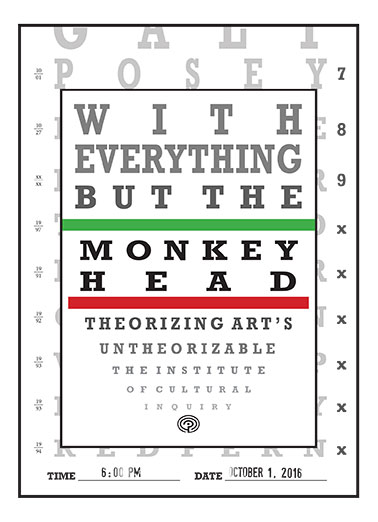
The seventh iteration of the project will feature Pam Posey, a 2011 participant in the ICI’s 100/10 project. Posey returns to the ICI for a three week residency during which time she’ll share her thoughts about her own research practices while collaborating with the ICI to build a treatise on the organization’s visual research endeavors. Her stay will culminate in a finissage on October 1, 2016 during which time she’ll share her ideas with the public.
During her residency, Posey utilizes field data gathered on multiple trips to Iceland, interludes of analog observational techniques (drawing, printing, tracing), and an interest in hermeneutics to expand and “complicate” the simplifying and reductive tendencies of scientific classification systems.
Each iteration of With Everything but the Monkey Head will be accompanied with a unique laboratory workbook created by the researcher over the course of their short residency. In addition, each researcher will contribute to the project’s catalog, which is being produced to emulate late 19th century ‘sample’ books used by traveling salesmen, books whose form lends itself to an idea that is still unfolding.
All parts of the project can be followed on the ICI’s website. The construction of the lab books and the catalog will be charted on ISSUU where finished publications will be offered to the public through the print on demand service of ICI Press.
A PDF version of the press release for this iteration of the projects can be downloaded here.
The Institute of Cultural Inquiry (ICI) is pleased to announce the launch of With Everything but the Monkey Head: Theorizing Art’s Untheorizable Practices, a major project centered on the burgeoning field of studio-based research in the visual arts. This project will be a long-term collaboration with a host of diverse participants including nine researchers who have participated in some sort of visual research at the ICI; a set of specially selected interlocutors whose questions will help construct and strengthen the ideas central to each researcher’s project; and the curious spectators who bring discussion and debate to public exchanges.
The sixth iteration of the project will feature Christel Dillbohner, a 2013 participant in the ICI’s Visualist-in-Residence (VIR) project. Dillbohner returns to the ICI for an intense one-week mini residency during which time she’ll share her thoughts about her own research practices while collaborating with the ICI to build a treatise on the organization’s own visual research endeavors. Her stay will culminate in a finissage on August 13, 2016 during which time she’ll share her ideas with the public.
During her residency, Dillbohner will examine the roles of coincidence and serendipity, to render the (seemingly) invisible connection between these two phenomena into visibility and generate new possibilities for seeing and being in the world—ones which demand the conscientiousness of open eyes and an emptied mind to observe things “mit dem anderen Blick”.
Each iteration of With Everything but the Monkey Head will be accompanied with a unique laboratory workbook created by the researcher over the course of their short residency. In addition, each researcher will contribute to the project’s catalog, which is being produced to emulate late 19th century ‘sample’ books used by traveling salesmen, books whose form lends itself to an idea that is still unfolding.
All parts of the project can be followed on the ICI’s website. The construction of the lab books and the catalog will be charted on ISSUU where finished publications will be offered to the public through the print on demand service of ICI Press.
A PDF version of the press release for this iteration of the projects can be downloaded here.
With Everything but the Monkey Head: Theorizing Art’s Untheorizable Practices
Iteration V: Christian Smith (August 1 – 6, 2016) Finissage: Saturday, August 6, 2016, 6 – 8 pm
The Institute of Cultural Inquiry (ICI) is pleased to announce the launch of With Everything but the Monkey Head: Theorizing Art’s Untheorizable Practices, a major project centered on the burgeoning field of studio-based research in the visual arts. This project will be a long-term collaboration with a host of diverse participants including nine researchers who have participated in some sort of visual research at the ICI; a set of specially selected interlocutors whose questions will help construct and strengthen the ideas central to each researcher’s project; and the curious spectators who bring discussion and debate to public exchanges.
The fifth iteration of the project will feature Christian Smith, a 2011 participant in the ICI’s 100/10 project. Smith returns to the ICI for an intense one-week mini residency during which time he’ll share his thoughts about his own research practices while collaborating with the ICI to build a treatise on the organization’s own visual research endeavors. His stay will culminate in a finissage on August 6, 2016 during which time he’ll share his ideas with the public.
During his residency, Smith will explore the role of materials and technique when setting research parameters. Utilizing antiquated wet-plate photography processes in a portable darkroom he’s built for this project, Smith aims to capture new environments in old ways as he continues to build his experimental, alternative map of Los Angeles.
Each iteration of With Everything but the Monkey Head will be accompanied with a unique laboratory workbook created by the researcher over the course of their short residency. In addition, each researcher will contribute to the project’s catalog, which is being produced to emulate late 19th century ‘sample’ books used by traveling salesmen, books whose form lends itself to an idea that is still unfolding.
All parts of the project can be followed on the ICI’s website. The construction of the lab books and the catalog will be charted on ISSUU where finished publications will be offered to the public through the print on demand service of ICI Press.
A PDF version of the press release for this iteration of the projects can be downloaded here.
With Everything but the Monkey Head: Theorizing Art’s Untheorizable Practices
Iteration IV: Greg Cohen (July 12 – August 1) Finissage: Saturday, July 30, 2016, 6 – 8 pm
The Institute of Cultural Inquiry (ICI) is pleased to announce the launch of With Everything but the Monkey Head: Theorizing Art’s Untheorizable Practices, a major project centered on the burgeoning field of studio-based research in the visual arts. This project will be a long-term collaboration with a host of diverse participants including nine researchers who have participated in some sort of visual research at the ICI; a set of specially selected interlocutors whose questions will help construct and strengthen the ideas central to each researcher’s project; and the curious spectators who bring discussion and debate to public exchanges.
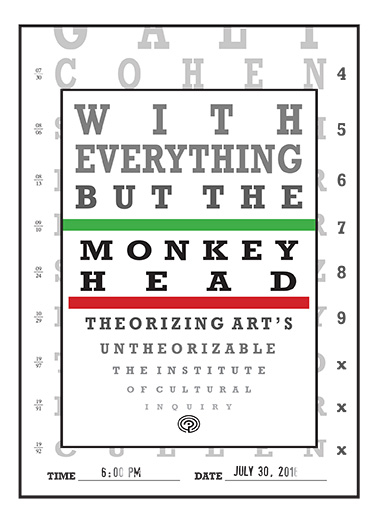
The fourth iteration of the project will feature Greg Cohen, a 2012 participant in the ICI’s Visualist-in-Residence (VIR) project. Cohen returns to the ICI for a three-week residency during which time he’ll share his thoughts about his own research practices while collaborating with the ICI to build a treatise on the organization’s own visual research endeavors. His stay will culminate in a finissage on July 30, 2016 during which time he’ll share his ideas with the public.
For Cohen, whose 2012 VIR project at the ICI was focused on the (re-)creation of a speculative archive, research stems from investigation of the unknown. During this short residency he will employ modes of self-portraiture to explore the interplay of appropriation and fictive constructions, pondering how such acts of ‘borrowing’ and ‘making’ contribute to a speculative research practice.
Each iteration of With Everything but the Monkey Head will be accompanied with a unique laboratory workbook created by the researcher over the course of their short residency. In addition, each researcher will contribute to the project’s catalog, which is being produced to emulate late 19th century ‘sample’ books used by traveling salesmen, books whose form lends itself to an idea that is still unfolding.
All parts of the project can be followed on the ICI’s website. The construction of the lab books and the catalog will be charted on ISSUU where finished publications will be offered to the public through the print on demand service of ICI Press.
A PDF version of the press release for this iteration of the projects can be downloaded here.
With Everything but the Monkey Head: Theorizing Art’s Untheorizable Practices
Iteration III: Antoinette LaFarge (June 20 – July 9) Finissage: Saturday, July 9, 2016, 6 – 8 pm
The Institute of Cultural Inquiry (ICI) is pleased to announce the continuation of With Everything but the Monkey Head: Theorizing Art’s Untheorizable Practices, a major project centered on the burgeoning field of studio-based research in the visual arts. This project is a long-term collaboration with a host of diverse participants including nine researchers who have participated in some sort of visual research at the ICI during the last 5 years; a set of specially selected interlocutors whose questions will help construct and strengthen the ideas central to each researcher’s project; and the curious spectators who have always enriched ICI projects with their thoughtful discussion and debate during public exchanges.
The third iteration of the project will feature Antoinette LaFarge, a 2011 participant in the ICI’s 100/10/10 project (100 days/10 curators/10 artists). LaFarge returns to the ICI for a three-week residency during which time she’ll share her thoughts about her own research practices while collaborating with the ICI to build a treatise on the organization’s own visual research endeavors. Her stay will culminate in a finissage on July 9, 2016 during which time she’ll share her ideas with the public.
Studio-based research, also known as practice-based research, research in the visual arts, and at times, visual research, as it has been called at the ICI, has quickly become a catch-all term used to describe many contemporary art practices, some but not all of which are anchored by the ‘new materialism.’ Many of those who advocate for this designation believe the imaginative and intellectual work undertaken by almost all artists is a form of research that can be equated with ‘laboratory work’ in other disciplines. Other supporters of studio-based research feel that be it an interpretation, a critique, or an art object, the work produced under this banner must result in ‘new knowledge,’ thereby equating the work of artists who achieve this goal with a somewhat antiquated model of the research scientist.
A small, provocative group of thinkers have rejected both these models pointing to their self-serving role in the service of an ‘academy’ that seeks to grow both the number of PhD programs in studio art and the bills in their pockets under the studio-based research banner. These provocateurs have pushed for a theory of art-based research that better reflects what is actually being done in some (but not all) artists’ studios. They have challenged the art world to seek a theory (not the theory) that is focused more on processes than outcomes and that has no a priori “image” to which it aspires. With Everything but the Monkey Head answers their clarion call. With this project, the ICI does not aspire to build a theory of studio-based research as its practiced right now but to consider what theory’s potential for transformation might be in response to the issues studio-based research brings to the table.
The most challenging of these issues is one that underlies the entire project. That is, that any theory about ‘art as research’ is, by definition, untheorizable since, as James Elkins points out, ‘thinking through the visual’ is a type of inquiry that is outside language. How do we, then, theorize something that is untheorizable? The ICI believes the artist researchers at the center of this burgeoning field might have an advantage in this regard. Art is thought, not theory and most visual researchers postpone theory, judgments, opinions, and conclusions about their own art, often delaying these considerations indefinitely but certainly while they work in the studio. It is to these researchers that the ICI has turned asking them to participate while they are actively engaged in their own visual inquiry in a manner that links back to the original meaning of ‘research’ – to circle around and around. The ICI will encourage the researchers of With Everything but the Monkey Head to circle around a potential theory of studio-based research as it might exist in the studio through the slips, stutters and spasms of each researcher’s agrammatical process.
This time around, the roles of happenstance, coincidence and serendipitous tangents within the research process take center stage as Antoinette LaFarge engages with the newly realized (yet wholly) unconscious influence of the letter ‘W’ throughout her practice as an artist, writer, and scholar. For LaFarge, whose 2011 Wikipedia-based project at the ICI was focused on Louise Brigham, a forgotten 20th century furniture designer who the researcher stumbled upon in a 100 year-old magazine in the ICI Ephemera collection, visual research breeds unexpected avenues of knowledge production. During this short residency she will conjure new ways of researching, writing, and building a virtual knowledge space into existence.
Each iteration of With Everything but the Monkey Head will be accompanied with a unique laboratory workbook created by the researcher over the course of their short residency. Part journal, workbook, recipe book, and itinerary, this chronicle will provide a snapshot of the project at each stage of its unfolding. In addition, each researcher will also contribute to the project’s catalog, which is being produced to emulate late 19th century ‘sample’ books used by traveling salesmen. These books offered the best parts of the finished book while under its cover snippets of alternate bindings, long lists of illustrations, complete indices, and ‘notes to readers’ on loosely inserted pieces of yellow paper pointed to the uncharted territories of thought the book might occupy. The catalog for With Everything but the Monkey Head, like the books whose form it borrows, lends itself to an idea that is still unfolding.
All parts of the project can be followed on the ICI’s website. The construction of the lab books and the catalog will be charted on ISSUU where finished publications will be offered to the public through the print on demand service of ICI Press.
A PDF version of the press release for this iteration of the projects can be downloaded here.
With Everything but the Monkey Head: Theorizing Art’s Untheorizable Practices
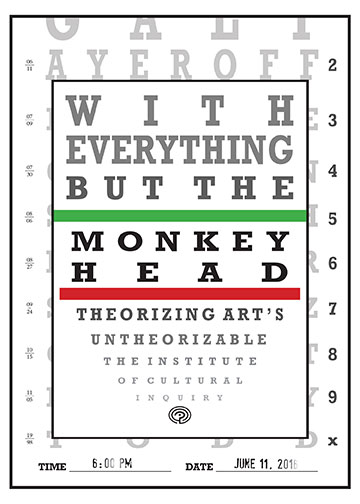
Iteration II: Anna Ayeroff (May 24 – June 12) Finissage: Saturday, June 11, 2016, 6 – 8 pm
The Institute of Cultural Inquiry (ICI) is pleased to announce the launch of With Everything but the Monkey Head: Theorizing Art’s Untheorizable Practices, a major project centered on the burgeoning field of studio-based research in the visual arts. This project will be a long-term collaboration with a host of diverse participants including nine researchers who have participated in some sort of visual research at the ICI during the last 5 years; a set of specially selected interlocutors whose questions will help construct and strengthen the ideas central to each researcher’s project; and the curious spectators who have always enriched ICI projects with their thoughtful discussion and debate during public exchanges.
The second iteration of the project will feature Anna Ayeroff, a 2014 participant in the ICI’s Visualist-in-Residence (VIR) project. Ayeroff returns to the ICI for a three-week residency during which time she’ll share her thoughts about her own research practices while collaborating with the ICI to build a treatise on the organization’s own visual research endeavors. Her stay will culminate in a finissage on June 11, 2016 during which time she’ll share her ideas with the public.
The term studio-based research, also called practice-based research, research in the visual arts, and at times, visual research, as it has been known at the ICI, has quickly become a catch-all term used to describe many contemporary art practices, some but not all of which are anchored by the ‘new materialism.’ Many of those who advocate for this designation believe the imaginative and intellectual work undertaken by almost all artists is a form of research that can be equated with work (and research) in other disciplines. Other supporters of studio-based research feel that be it an interpretation, a critique, or an art object, the work produced under this banner must result in ‘new knowledge,’ thereby equating the work of artists who achieve this goal with a somewhat antiquated model of the research scientist.
A small, provocative group of thinkers have rejected both these models pointing to their self-serving role in the service of an ‘academy’ that seeks to grow both the number of PhD programs in studio art and the bills in their pockets under the studio-based research banner. These provocateurs have pushed for a theory of art-based research that better reflects what is actually being done in some (but not all) artists’ studios. They have challenged the art world to seek a theory (not the theory) that is focused more on processes than outcomes and that has no a priori “image” to which it aspires. With Everything but the Monkey Head answers their clarion call. With this project, the ICI does not aspire to build a theory of studio-based research as its practiced right now but to consider what theory’s potential for transformation might be in response to the issues studio-based research brings to the table.
The most challenging of these issues is one that underlies the entire project. That is, that any theory about ‘art as research’ is, by definition, untheorizable since, as James Elkins points out, ‘thinking through the visual,’ is a type of inquiry that is outside language. How do we, then, theorize something that is untheorizable? The ICI believes the artist researchers at the center of this burgeoning field might have an advantage in this regard. Art is thought, not theory and most visual researchers resist those aspects of their process that hinge on language; they postpone theory, judgments, opinions, and conclusions, often delaying their consideration indefinitely but certainly while they work in the studio. It is to these researchers that the ICI has turned asking them to participate in a form of inquiry based on their own visual inquiry in a manner that links back to the original meaning of ‘research’ – to circle around and around. The ICI will encourage the researchers of With Everything but the Monkey Head to circle around a theory of studio-based research created in the studio with and through the slips, stutters and spasms of their agrammatical processes.
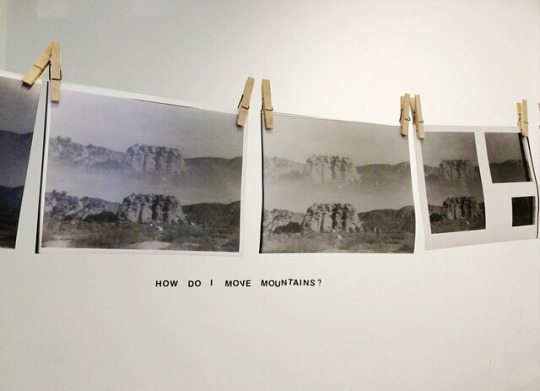
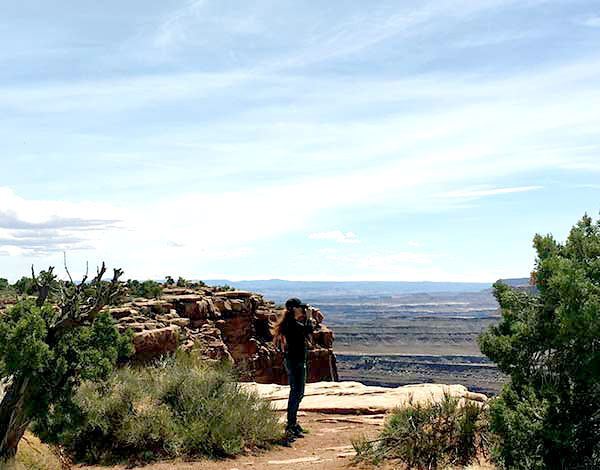
For the second iteration, Anna Ayeroff, enacts her research in a nomadic studio, aided by a set of photographic processes whose force lies in action and engagement rather than capture and production. For Ayeroff, whose 2014 Visualist-in-Residence project at the ICI, On Moving Mountains, was centered on an exploration of film’s place in imagined worlds, the researcher and the photographic document do not stand apart but are constantly in a mutual state of flux. Here, the photographic operates in relation to rather than in production of the places she visits. In this practice-based research model, the photograph is not simply a tool used to document research but is active, embodied, and performative within a changing space that is research – research that is capable of rupturing our way of seeing and thinking.
Each iteration of With Everything but the Monkey Head will be accompanied with a unique laboratory workbook created by the researcher over the course of their short residency. Part journal, workbook, recipe book, and itinerary, this chronicle will provide a snapshot of the project at each stage of its unfolding. In addition, each researcher will also contribute to the project’s catalog, which is being produced to emulate late 19th century ‘sample’ books used by traveling salesmen. These books offered the best parts of the finished book while under its cover snippets of alternate bindings, long lists of illustrations, complete indices, and ‘notes to readers’ on loosely inserted pieces of yellow paper pointed to the uncharted territories of thought the book might occupy. The catalog for With Everything but the Monkey Head, like the books whose form it borrows, lends itself to an idea that is still unfolding.
All parts of the project can be followed on the ICI’s website. The construction of the lab books and the catalog will be charted on ISSUU where finished publications will be offered to the public through the print on demand service of ICI Press.
A PDF version of the press release for this iteration of the projects can be downloaded here.
With Everything but the Monkey Head: Theorizing Art’s Untheorizable Practices
Iteration I: Martin Gantman (April 12 – May 8) Finissage: Saturday, May 7, 2016, 7 – 9 pm
The Institute of Cultural Inquiry (ICI) is pleased to announce the launch of With Everything but the Monkey Head: Theorizing Art’s Untheorizable Practices, a major project centered on the burgeoning field of studio-based research in the visual arts. This project will be a long-term collaboration with a host of diverse participants including nine researchers who have participated in some sort of visual research at the ICI during the last 5 years; a set of specially selected interlocutors whose questions will help construct and strengthen the ideas central to each researcher’s project; and the curious spectators who have always enriched ICI projects with their thoughtful discussion and debate during public exchanges.
The first iteration of the project will feature Martin Gantman, a 2013 participant in the ICI’s Visualist-in-Residence (VIR) project. Gantman returns to the ICI for a three-week residency during which time he’ll share his thoughts about his own research practices while collaborating with the ICI to build a treatise on the organization’s own visual research endeavors. His stay will culminate in a finissage on May 7, 2016 during which time he’ll share his ideas with the public.
The term studio-based research, also called practice-based research, research in the visual arts, and at times, visual research, as it has been known at the ICI, has quickly become a catch-all term used to describe many contemporary art practices, some but not all of which are anchored by the ‘new materialism.’ Many of those who advocate for this designation believe the imaginative and intellectual work undertaken by almost all artists is a form of research that can be equated with work (and research) in other disciplines. Other supporters of studio-based research feel that be it an interpretation, a critique, or an art object, the work produced under this banner must result in ‘new knowledge,’ thereby equating the work of artists who achieve this goal with a somewhat antiquated model of the research scientist.
A small, provocative group of thinkers have rejected both these models pointing to their self-serving role in the service of an ‘academy’ that seeks to grow both the number of PhD programs in studio art and the bills in their pockets under the studio-based research banner. These provocateurs have pushed for a theory of art-based research that better reflects what is actually being done in some (but not all) artists’ studios. They have challenged the art world to seek a theory (not the theory) that is focused more on processes than outcomes and that has no a priori “image” to which it aspires. With Everything but the Monkey Head answers their clarion call. With this project, the ICI does not aspire to build a theory of studio-based research as its practiced right now but to consider what theory’s potential for transformation might be in response to the issues studio-based research brings to the table.
The most challenging of these issues is one that underlies the entire project. That is, that any theory about ‘art as research’ is, by definition, untheorizable since, as James Elkins points out, ‘thinking through the visual,’ is a type of inquiry that is outside language. How do we, then, theorize something that is untheorizable? The ICI believes the artist researchers at the center of this burgeoning field might have an advantage in this regard. Art is thought, not theory and most visual researchers resist those aspects of their process that hinge on language; they postpone theory, judgments, opinions, and conclusions, often delaying their consideration indefinitely but certainly while they work in the studio. It is to these researchers that the ICI has turned asking them to participate in a form of inquiry based on their own visual inquiry in a manner that links back to the original meaning of ‘research’ – to circle around and around. The ICI will encourage the researchers of With Everything but the Monkey Head to circle around a theory of studio-based research created in the studio with and through the slips, stutters and spasms of their agrammatical processes.
For the first iteration, Martin Gantman, asserts that any theory-making, including one centered on artist praxis, must first interrogate the terms used to set up that activity. He asks, what is theory, what is research, or practice, and what is an activity or event that is ‘something-based?’ For Gantman, whose 2014 Visualist-in-Residence project at the ICI was centered on a critique of the institutional archive, this uncomfortable but necessary questioning can emerge in ‘zones of awkward engagement’ to borrow Anna Tsing’s term. Whether in a museum, a studio, a Farmer’s market, or back street alley full of third world vendors, these zones refuse art world rituals that work to silence or obscure issues of social or political importance.
Each iteration of With Everything but the Monkey Head will be accompanied with a unique laboratory workbook created by the researcher over the course of their short residency. Part journal, workbook, recipe book, and itinerary, this chronicle will provide a snapshot of the project at each stage of its unfolding. In addition, each researcher will also contribute to the project’s catalog, which is being produced to emulate late 19th century ‘sample’ books used by traveling salesmen. These books offered the best parts of the finished book while under its cover snippets of alternate bindings, long lists of illustrations, complete indices, and ‘notes to readers’ on loosely inserted pieces of yellow paper pointed to the uncharted territories of thought the book might occupy. The catalog for With Everything but the Monkey Head, like the books whose form it borrows, lends itself to an idea that is still unfolding.
All parts of the project can be followed on the ICI’s website. The construction of the lab books and the catalog will be charted on ISSUU where finished publications will be offered to the public through the print on demand service of ICI Press.
*Visitors are welcome by appointment Tuesday and Thursday afternoons throughout each residency. ICI programming and events are free unless otherwise noted.*
The Institute of Cultural Inquiry (ICI) is pleased to announce the online publication of the 2013 AIDS Chronicle, the first digital edition of their longest ongoing project, the AIDS Chronicles, which brings attention to the AIDS pandemic through targeted, art-based activism.
The AIDS Chronicles were initiated in 1993, at the height of the AIDS pandemic in the United States, to create a record of the day-to-day discourse on AIDS and HIV in what is often referred to as the US “newspaper of record,” the New York Times. The goal of the project is simple—to subvert the newspaper’s usual hierarchy of focus in a way that narrows the reader’s attention to just one issue – the newspaper’s (lack of) reporting about the spread of the HIV virus and the global AIDS pandemic.
Each yearly AIDS Chronicle consists of 365 front pages from the New York Times, collected from December 1 (World AIDS Day) to November 30 (of the following year) that have been treated on both sides with three layers of acrylic paint to produce tangible, blood-red sheets that leave visible only images or articles that mention AIDS or HIV, along with the folio showing the date of publication, and the ‘obituaries’ (or in their absence a blank box) in the newspaper’s index as a direct reference to the listing of AIDS-related deaths deep inside the newspaper. The various artist ‘bound’ editions of the AIDS Chronicles are on permanent display in the ICI Library and are often shown publicly on December 1st to commemorate World AIDS Day and the Day With[out] Art.
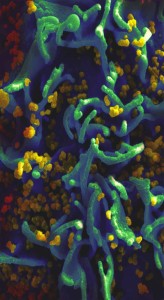
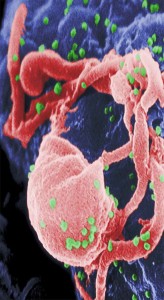
This year the ICI is publishing the 2013 AIDS Chronicle as a digital document, a virtual edition made possible after the New York Times began to offer high-resolution, downloadable PDFs of their daily front page in the summer of 2012. The digital publication, produced by the ICI’s Assistant Director and independent curator, Sue-Na Gay, will be divided into three volumes to facilitate download and interaction with cover images that capture both the horror and beauty of the HIV virus. The covers present the viewer with an up close and personal look at the HIV virus on a microscopic scale, shedding light on the virus’s destructive biological implications, while at the same time aesthetically blurring it into abstraction. Here, the disease is at once wholly present and yet still ‘flying under the radar’ to the untrained eye thus mirroring the coverage of the disease process in the media.
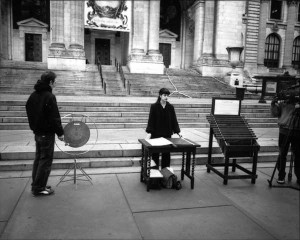
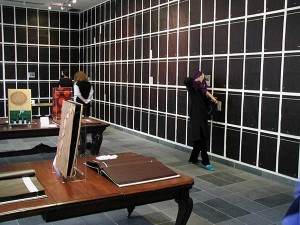
New York Public Library, 1998 Sam Francis Gallery at Crossroads School, 2003
Over the years, pages of the AIDS Chronicles have been displayed in a variety of forms. As unbound, loose sheets, they have been shown covering walls or windows as an expansive and overwhelming document. In book form, the Chronicles have been displayed on a lectern or pedestal where volunteers from the community turn the pages to the sound of a gong that is hit at the rate of worldwide AIDS deaths for the year preceding the display. Each presentation has allowed viewers to study the information published by this prominent U.S. newspaper and encouraged them to reflect on the types of articles and the kind of attention and information the continuing pandemic is given. At the same time, the display of the pages in their repetitive, minimalist simplicity has allowed for quiet contemplation in order to remember those individuals who have been lost to the disease.
Since its inception, the Chronicles have quietly and self-reflectively ‘indexed’ the New York Times‘ reports on the spread of the HIV virus. The painted pages have endured to bear witness to the long decades when the virus jumped to Africa and Southeast Asia, when drug companies found financial opportunities in drugs meant to treat (but not cure) HIV, and when the virus turned into a cause célèbre fashion statement. The Chronicles continue to keep vigil to this day as nations push for -0- infection rates, reminding us that even though the Times has chosen to minimize its reporting on the AIDS virus, a choice evidenced by their daily, front page coverage of the 2014 Ebola epidemic in Africa, the newspaper did once report on hopes for a real cure and a real vaccine not just on expensive treatments that promise a life with the virus.
After twenty-two years, the AIDS Chronicles has met the ICI’s goal to produce a historical record of AIDS reporting in the New York Times but it has also created another unanticipated record, a collective document drawn from a different kind of AIDS reporting. That document is forged in the areas of pages that hold no AIDS/HIV articles; in the weight of those pages as they sit in silent tomes; in the residue left by human hands that touch their skin-like surfaces; in the small rips and tears that result from their ritualized turning; and especially in their seemingly unending supply. Their blood-red, cockled surfaces speak of the blood that carries the virus, of the fear of that blood, of passion, of pain over the loss of passion, of anger, of a rage that ‘sees red,’ and of the shame of having blood on one’s hands—of being caught red handed. The language of this other AIDS record comes not from the printed press but from the private, lived experience of loss, of anger, of shame.
With its dual ability to operate as a record of public notice and as a document of private experience, the AIDS Chronicles project enters a new chapter as one of its tomes becomes an ambassador of AIDS activism on the Internet, albeit with new and different forms. Given that the digital publication of the 2013 AIDS Chronicle is a weightless document entering the timeless datascape of the Internet, it will have to find its power in other news-gathering traditions, its activism through other unnoticed trap doors. Online, the document will not be restricted to the United States and Europe, (to date the only locations the AIDS Chronicles have been shown); it will potentially reach a global audience that includes those populations that continue to be most affected by the AIDS pandemic. With a publication url that includes a fragment of the New York Times own digital address, the 2013 Chronicle will shadow the digital pages of the 2013 Times as it travels through Google search pages, like a talkative hitchhiker that is always ‘going wherever you’re going.’ The small box on each page that wraps around the word obituary, or blankly represents it, will become more than an abstract symbol of loss and shame. Online, the deaths the obituary boxes represent will be linked to ‘tags’ that carry the names of actual individuals whose obituaries were once printed inside the newspaper even as the Times kept the front page free of any mention of the virus that killed them. Widgets and SEO options give context and history to the Times‘ engagement with HIV and AIDS as ‘digital stowaways’ that help ‘right’ the pages that ACT-UP once said, when it came to AIDS reporting, were ‘out of order.’
On December 1, 2015, the 2013AIDS Chronicle will be published as a digital three-volume tome. At the same time, the 365 pages will become raw material in the virtual space of the unfinished, the unrepaired, and the unretrieved where, instead of collecting dust and silverfish in the ICI Library, they can help draw new hypotheses for a yet unknowable future.
# # #
Sue-Na Gay also designed the archive box that will hold the original 2013 newsprint documents and a specially designed jump drive that will carry the data information and documentation of the digital publication. This archive box will be deposited in the ICI Library with other versions of the AIDS Chronicles and will be available to the public by appointment throughout the year. All three digital volumes of the 2013 AIDS Chronicles will remain on display via the Institute’s multi-faceted online presence.
A downloadable pdf version of the press release can be found here.
(1.2 mb; updated 02/22/2017)
Join Us during the conjunction of the Autumnal Equinox & New Moon as Maya Gurantz shares her research at the ICI
Tuesday, September 23, 2014, 6-8 pm (in)formal program begins at 7:00 pm
The Institute of Cultural Inquiry (ICI) is pleased to present an evening with Maya Gurantz, the current resident in our Visualist-in-Residence (VIR) project. Beginning at 7pm and with a ritual acknowledgement of the new moon, Gurantz will lead visitors through elements of her practice-based research in a form that reflects her interest in accessing immanence.
Gurantz applied to the VIR project hoping to take advantage of ICI’s extensive collection of esoteric, spiritual, and philosophical literature for her ongoing research on the history of spirituality, mysticism and gurus in early Los Angeles. In an act of fortuitous synchronicity, which is central to the ICI process, a collection of books connected to the history of women’s magic and witchcraft were donated to the organization just as Gurantz started her residency. After delving into this treasure trove, she quickly shifted the focus of her residency to vanished archetypes of the female storyteller and ways of inventing ritual forms as a means of accessing immanence.
The ICI’s “Visualist-in-Residence” (VIR) project offers artists, art theorists, writers, and other visual researchers and culture producers a chance to participate in studio-based visual research in a richly layered and mutable environment. The VIR ‘laboratory’ may function as an artist’s studio, a writing room, a space for gathering data or a quiet space for evaluation and contemplation depending on the needs of each individual project. At the Institute, VIRs are actively encouraged to expand current definitions of visual research. At the end of each residency, the VIRs are invited to discuss their newly found ‘research methods’ in a public event/forum.
Maya Gurantz is a Los Angeles-based artist and writer. She interrogates how constructions of gender, race, class and progress operate in American communities, shared myths, public rituals and private desires, drawing formally on her years in dance and experimental theater, as well as a deep knowledge of American vernacular forms of manipulating sensation. Her projects often emerge through the process of excavating and recasting historical material in new and unsettling conceptual frameworks.
Maya Gurantz’s residency at the ICI will continue through September 28, 2014. For questions regarding this or other ICI events, please contact info@culturalinquiry.org.











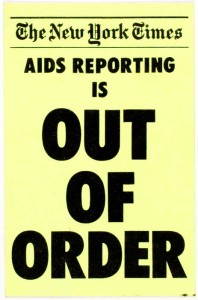 document entering the timeless datascape of the Internet, it will have to find its power in other news-gathering traditions, its activism through other unnoticed trap doors. Online, the document will not be restricted to the United States and Europe, (to date the only locations the AIDS Chronicles have been shown); it will potentially reach a global audience that includes those populations that continue to be most affected by the AIDS pandemic. With a publication url that includes a fragment of the New York Times own digital address, the 2013 Chronicle will shadow the digital pages of the 2013 Times as it travels through Google search pages, like a talkative hitchhiker that is always ‘going wherever you’re going.’ The small box on each page that wraps around the word obituary, or blankly represents it, will become more than an abstract symbol of loss and shame. Online, the deaths the obituary boxes represent will be linked to ‘tags’ that carry the names of actual individuals whose obituaries were once printed inside the newspaper even as the Times kept the front page free of any mention of the virus that killed them. Widgets and SEO options give context and history to the Times‘ engagement with HIV and AIDS as ‘digital stowaways’ that help ‘right’ the pages that ACT-UP once said, when it came to AIDS reporting, were ‘out of order.’