
Posted on a billboard in the Institute’s neighborhood. We couldn’t help but notice the job-seeker’s name.
at the Institute of Cultural Inquiry

Posted on a billboard in the Institute’s neighborhood. We couldn’t help but notice the job-seeker’s name.
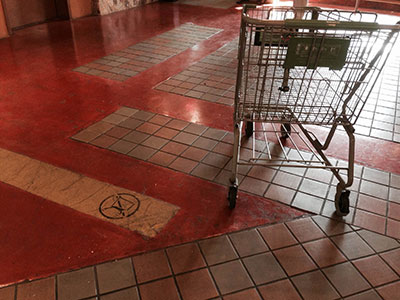
I live at the edge of Chinatown and downtown LA, so the setting for my life revolves around this little border. There isn’t much around except a neighborhood Walmart. I visit about once a week to purchase my groceries and as a result it has become part of my routine.
During my visits, I perform a ritualistic procedure upon entering the store. Each time, I grab a shopping cart and then browse the store freely from left to right, starting from the produce aisle. However, as I try to exit the store, I am stopped by my shopping cart. The wheels lock at a yellow line, which prohibits carts form moving further. My traversing is halted and I am left to ponder the implications of yet another border within my city.


Text circa 1945.

It has been said that man is a rational animal. All my life I have been searching for evidence which could support this.
– Bertrand Russell

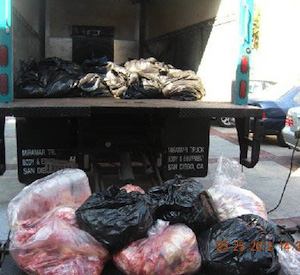
http://www.jewishjournal.com/los_angeles/article/atonement_chickens_swung_and_tossed

The 4th Street Bridge was built in 1931 and since has connected East Los Angeles to Central and West Los Angeles.
It is an important means of transport and yet as the image at right suggests, for many, the iconic bridge represents much more.
This leaves us to ponder:


In a world of ever-evolving technology how do we decide which objects become obsolete and which remain? Is it form vs. function or is there something else that guides us?
Who decides?

Found on Channel Road in Santa Monica.
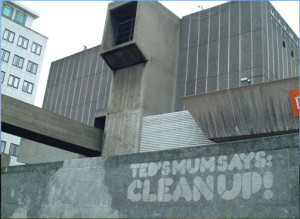
 Taking it’s cues from the ubiquitous ‘wash me’ signs hastily scribbled into the layer of exterior dirt on cars across the world, reverse graffiti (AKA green graffiti or clean tagging) is the act of marking a public space with street art or sponsored campaigns by selectively cleaning through urban grime.
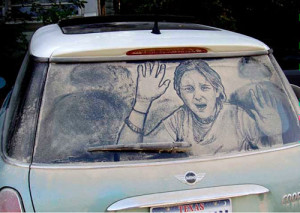 The act is simple and well-worn, but somehow still innovative. While traditional graffiti is largely outlawed for its [arguably] negative effect on private property, few municipalities have laws against cleaning, thus allowing the movement to operate in a grey area, where nothing is added and no harm is done, yet images and text are clearly visible and [further] clean-up is still required for swift removal.
All of which brings to mind a series of questions:
Perhaps only time (and the subsequent impermanence of these works) will tell.
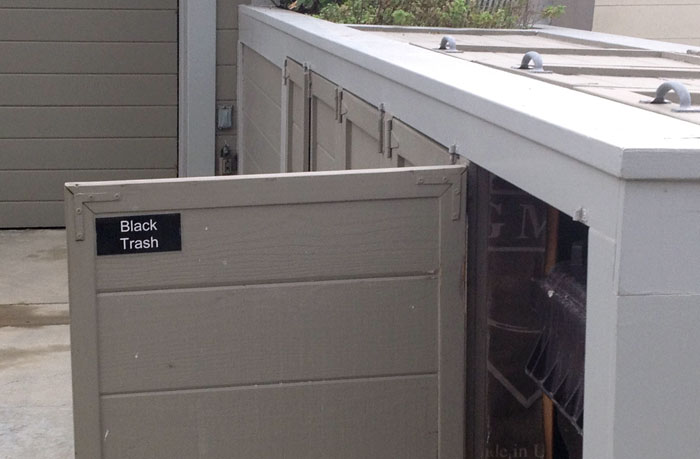
A recent, windy day in Malibu, CA revealed, in more ways than one, a ‘dirty’ underside of the American experience.
The door to an enclosed area for garbage cans had swung open exposing a seemingly ‘private’ directive. This part of town has three trash cans for different types of refuse: green for vegetation, blue for recyclables and black for garbage. Undoubtedly the compartment captured in the above image housed the latter trash can. Yet, once a force of nature dragged the private realm into the public, these two simple words became arresting at least, and to some members of the population even assaultive.
In the public arena these words bring to mind our country’s dark history with African-Americans and hint that this chapter of American history, one fraught with racism and class warfare, may not be as distant as we like to believe. For a phrase that also comes to mind when viewing this ‘innocent’ plaque is its antipode: ‘white trash,’ an often humorously used but always derogatory phrase that assigns the label ‘trash’ to the poor and often uneducated portion of the white population which is perceived as not behaving ‘white’ enough; thus reinforcing the racist idea that these are inherent characteristics of anyone who isn’t white.
Maybe it’s time to retire both ‘black and white’ phrases altogether.
Regardless, one can’t help but wonder how much more money and effort it would have taken to add one more word to this contentious pair on a door that swings open to a popular beach-side street…
…the word ‘can.’

What would Claes Oldenburg think?