Re-appropriation Art?

“Art of Soup” A recent collaboration between Target, Campbell’s and the Andy Warhol Foundation, in celebration of the paintings’ 50th anniversary.  The multicolored cans feature a facsimile autograph by, portrait of, and quote from, Andy Warhol and contain actual tomato soup.

Appropriation Art results from borrowing elements of visual culture (either completely or in part) and re-contextualizing them into new works, that play on the ideas of the original. But what happens when an appropriation artwork becomes iconic enough to be appropriated in its own right?

What are we to make of it when an object of appropriation appropriates its resulting artwork? Can the re-appropriated object be considered art as well or is it merely an ironic byproduct of popular culture? Where do we draw the lines of distinction between art and product?


Vandalism or Activism?

Shocking at first and second glance. The Las Vegas police received numerous panicked calls at 6:30a.m. on Wednesday, August 8th about a billboard located on I-15.

This billboard, reacting to the record high unemployment and suicide rates in Nevada, was slated as vandalism and promptly removed; however, questions surrounding the act remain.

What was someone trying to achieve through this act? Is it an act of vandalism or publicity? Activism or Guerilla art? Would we think of it differently if it was signed by Banksy or any other contemporary street artist?

Where do we draw the line of distinction between these categories?

Pictorial signs

No Weapons Allowed

→√ΔØ! Pictorial Signs (also known as pictographs or ideograms depending on their form) are meant to relay ideas beyond the barrier of language, yet ironically, their simplified messages can sometimes create cultural and linguistic ambiguities.

Some signs can be considered reactionary as in the case of signs that popped up in a Los Angeles movie theater recently. (No guns?) (Were these here before?)(Why are guns representative of all weapons?) (Was this somehow permissible beforehand?)

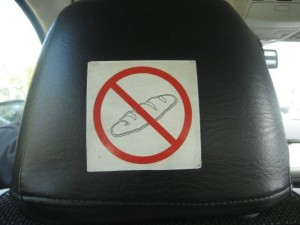
No Baguettes

While others may be reflective of cultural norms, as in the case of a sign in the backseat of a Parisian taxi cab. (No baguettes?) (Is bread symbolic of all food?) (Why bread?) (Is other food OK?) (Does this mean, “no eating”?)

It is here in these ambiguities that we find the possibilities to dive deeper into the cultures that surround them. Signs may be meant to instruct, warn, or inform us but sometimes they only lead to more questions…

The Mystery Spot: Bumper Sticker Semiology

Mystery Spot sticker

Like some of the most profound wisdom, “The Mystery Spot” manifested itself on the rear end of a car.

According to Sandlot Science, Mystery Spots are the product of the great depression, when the entertainment industry was trying to market strange phenomena.  Operating on optical illusions that are “driven by spatial distortion and misdirection,” half the fun of Mystery Spots seems to derive from the buying and selling (if only half-so) of the varied phenomenological explanations for these charmed locations.  Oh, and of course, there’s the bumper sticker.

vintage mystery spot photo

Like bumper stickers that keep you guessing, the allure of the ‘Mystery Spot’ is its low-culture charm, and despite knowing the truth or not, everyone shares the same delusory experience.


Ghostbike in Santa Monica

Ghostbike in Santa Monica

Ghost Bikes are small and somber memorials for bicyclists who are killed on the street. The memorial consists of a bicycle which is painted all white and locked to a street sign near the crash site, accompanied by a small plaque. The bike serves as a reminder of the tragedy that took place on an otherwise anonymous street corner, and as a quiet statement in support of cyclists’ right to safe travel. The first ghost bikes were created in St. Louis, Missouri in 2003. According to the ghostbike website,  there are over 500 ghost bikes that have since appeared in over 180 locations throughout the world.

Ghost bikes are a common sight in New York City. They are hard to miss; their white surface stands out against the grey dust of that urban center. Recently, a ghost bike appeared on the Pacific Coast Highway near the California Incline in Santa Monica. Set against the sparkling sea and leaning against a light pole on one of the clean, wide sidewalks Los Angeles is known for, the quiet monument disappears into the visual field of  a Southern California summer…

…but hopefully not its poignant message.

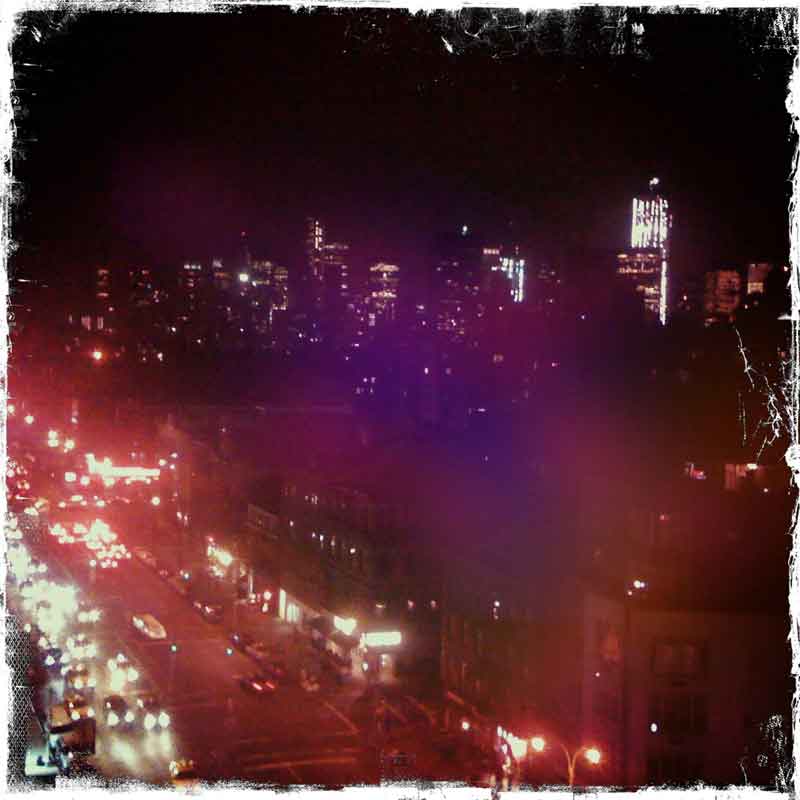
Phantoms Rising – The Freedom Tower in NYC

Even in its digital phantom, the photograph qua photograph belies cultural anxieties.

Ten years later and the site of 9/11’s most horrendous act is still ‘under construction.’ The view from a Bowery Street vantage point, reveals a half-built Freedom Tower (farthest right building). The brightly lit core in the photo’s center cannot compete with the scratches of the image’s edge; their quiet terror amplifies the tower’s righteous excess.

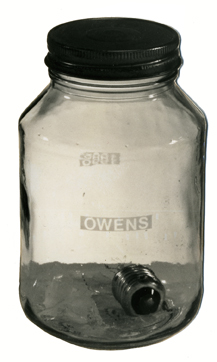
Craig Owens by John Galt

For most artists of a certain age they can remember the first time the public discourse on HIV suddenly became personal through the death of a loved one, a diagnosis of a friend or a long afternoon as an HIV test was being analyzed.  For ICI founder and director Lise Patt, that moment came in 1990 when the art critic Craig Owens died of AIDS. As she recounts it:

Owens wasn’t the first person I knew to die of AIDS and sadly he wasn’t the last one but I remember feeling like someone had punched me in the stomach when I heard of his passing. By 1990, the year of Owens death, AIDS was clearly robbing us of talented painters, photographers and other visual artists but up to that point I didn’t realize that it was also going to steal our voice – the people who talk for us, that contextualize our work, that write us into a history that is fickle at best and often unkind to those of us who create with our hands and not with words.

John Galt, a long-time associate of the ICI, gave Patt this bottle to help assuage her dis-ease. A recycled mayonnaise jar, on the outside surface he etched Owens name and the year of his death. Under the lid was a brief biography and inside the bottle he placed a shattered light bulb, an insider’s message from Galt to Patt, who had often spoke of Owen’s landmark essay “The Allegorical Impulse” as the light bulb that lit her art practice.

In the fall of the same year, Patt asked Galt if she could use his form for a project she was working on. On December 1, 1990 that project was born as the AIDS Bottle Project. Borrowing Galt’s form, 100 bottles representing 100 individuals in the arts who had died from AIDS were displayed at Los Angeles County Museum of Art.