Caught Red Handed
November 1, 2015 – January 31, 2016
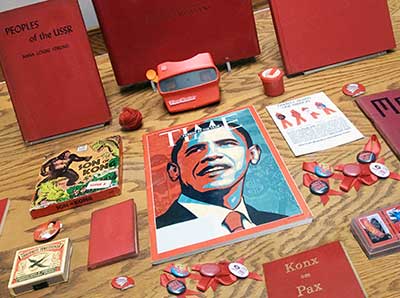
In the red? Out of the blue? Green with envy? Join us for an eclection color coded sampling of books and ephemera from the ICI’s multi-facted library and collections.
at the Institute of Cultural Inquiry

In the red? Out of the blue? Green with envy? Join us for an eclection color coded sampling of books and ephemera from the ICI’s multi-facted library and collections.

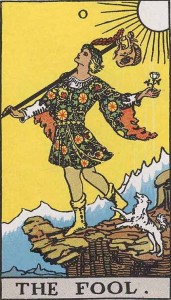
Throughout human history, the persona of the fool and his mythological equivalent, the trickster, has played an essential role in culture: the role of change. In his book Trickster Makes This World (1998),Lewis Hyde describes the trickster as a boundary-crosser, the one with the license to question and challenge boundaries. The trickster will confuse the distinction between right and wrong, scared and profane, clean and dirty, male and female, young and old, living and dead. S(he) is the creative idiot, the wise fool, the gray-haired baby, the cross-dresser, and the speaker of sacred profanities.
TRICKSTER IN EVERY CULTURE
In mythology, the Fool/Trickster might be related to Loki (Norse), Anansi (West African- Akan), Fudugazi (Zulu), Baubo (Greek), and Bes (Egyptian), to name a few. The Fool lives outside of society, he walks between worlds, and that gives him both an advantage in what he can say and do, but also a disadvantage, as he is an outsider. In Yoruba mythology, Eshu is both the guardian of thresholds and crossroads, and the entity we must honor any time we cross a threshold (e.g. our front door) or reach a crossroad in our lives. Not all tricksters are male; the Tibetan Khandroma‘s are female tricksters and shape-shifters. They travel together in the clouds, usually as part of a rainbow. They mess with the weather and they are especially famous for playing tricks on the heroes of folktales to test their heroic qualities. The lessons delivered by mythological tricksters are sometimes cruel, and sometimes gentle and funny, but always necessary to our growth as human beings.
THE FOOL in THE TAROT
In the Tarot, the card of ‘The Fool’ is either left unnumbered or ascribed to zero. It’s names include ‘Il Matto’ in old Italian packs (from Latin ‘mattus – ‘stupefied, senseless‘), ‘Le Mat’ or ‘Le Fol’ in French decks, and in a 17th century list of Latin titles the card is called ‘Stultus’ also meaning ‘Fool’. He is the archetypal medieval jester-fool, a personage who exists outside the laws and codes of normal life. In the most extreme sense he is a madman, a vagrant, and an impoverished wanderer. His place in the tarot is paradoxical for the card can either stand at the beginning or end of the series. Likewise in the old game of Tarot he is called the ‘Excuse’ (in gaming the card is known as the ‘Sckis’ or ‘Skus’) and can be played instead of following suits or ‘trumping’, in defiance of the customary order of values.
TRICKSTER AS LIMINAL FIGURE
The trickster is often found at the liminal zone at the edge of civilization, the place inhabited by hunters, criminals, religious hermits, herdsmen, and others who frequent the margins of human activity. For instance, a popular representation of the trickster is the wild man (also wildman, or “wildman of the woods,” known today as the werewolf). Wild men can be identified by the thick coat of hair covering their bodies. At the same time, they often have the breasts and chins of females, and a mixture of animal and human body parts. In Slavic mythology, a wild man named Leshy appears as a tall man with unruly hair and beard and is sometimes depicted with a tail, hooves, and horns. He shares an attribute with the Fool in the Tarot deck – he carries a stick or wand – to express that he is the master of wood. He has blue blood, which gives his cheeks a blue tinge.
Legend tells us the trickster is often betrayed by her or his feet. In Leshy’s case, he wears his shoes on the wrong feet, or puts them on facing backwards or, in many cases, has one foot that is not human at all; a cloven hoof betrays his ambiguous (animal/man; good/evil) trickster nature.
TRICKSTER AND LANGUAGE
To play with culture and non-culture is by definition to play with semiosis and language; the Trickster is a semiotic tour de force. (S)he speaks the language of animals, dreams, visions, and gods or spirits; (s)he embodies the Other, the inarticulate, (s)he recites the unsayable, and lies with the unknowable. The creator of culture, the Trickster, is not only used to recount etiological myths in order to provide the origins of names of animals and objects, but his or her actions are often the source of cultural habits and rituals.
ARTISTS AS TRICKSTERS
Even in societies that have temporarily mislaid their Trickster-god, the role persists, often assumed by artists, musicians, or poets. The trickster and the artist both challenge the status quo. One of the most salient features of the trickster is that (s)he forces a change in the narrative when the story has gotten stuck in a groove. The artist, like the fool or trickster, is the destroyer of our well-ordered world and the creator of a new one.

On display in the Library and Terri Valli Trotter Study Room
The making of books is a process that straddles the line between fine art and craftsmanship. It can create both what we know and think of as ‘books’ – two covers, hard or soft, with a range of pages sandwiched in between – or it can diverge entirely and take the form of the sculptural, the conceptual, the ‘in-between’ or the ‘none of the above.’
Following our recent involvement in the 2nd annual LA Art Book Fair (hosted by Printed Matter), the Institute of Cultural Inquiry is proud to present a curated display of handmade artist books, books about books from the Institute’s library and unique collections that celebrate the making of unique book art objects.
Featured artists on display include Dorothy Royer, Leslie Corrigan, Janet Klein, Pam Posey, Deborah Cullen, and the Museum of Forgery, among others.

“Trojan Horse” “Gift-Horse” “Horseplay” “If wishes were horses…” “Straight from the horse’s mouth”
Though they no longer function as an element of day-to-day life for most people, the horse lives on as a metaphor for everything from free presents to wishful thinking, to hidden invaders, and beyond. Stemming from the realm of double entendre, ‘the trickster,’ and the playfulness of things ‘hidden in plain sight,’ Geuen Hors pays tribute to the many ‘horses’ that have surfaced at the ICI over the last twenty years.
Ranging from large scale installation to miniature painting, items on display include ‘gifted’ works by Mungo Thomson, Pam Posey, Danny Redfern, Arnaldo Morales, Terri Valli Trotter, the Museum of Forgery, Axel Forrester, Martin Gantman, Deborah Paulsen, John Galt, Yolande Macias Mckay, George Herms, and Sophie Calle (among others), as well as a collection of ‘anonymous gifts’ left behind in books, on shelves, under tress, and in the other shadow spaces of the ICI.
A full map of the items on display can be downloaded here.

The Institute’s Library has generously been gifted a new book, Inventing the American Dream: A History of Curious, Extraordinary, & Just Plain Useful Patents by Stephen van Dulken.
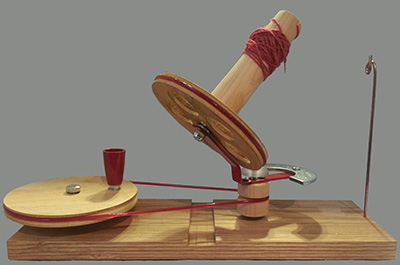
Thank you to Christel Dillbohner for donating a new and exciting tool to the Institute’s collection: a wooden ball winder.
As always, we are excited to see what potential uses and sparks of inspiration are brought about by our interactions with this piece in future projects.