
Found on Channel Road in Santa Monica.
at the Institute of Cultural Inquiry

Found on Channel Road in Santa Monica.
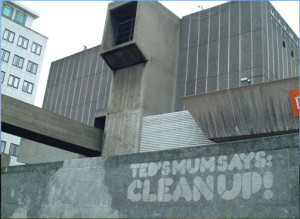
 Taking it’s cues from the ubiquitous ‘wash me’ signs hastily scribbled into the layer of exterior dirt on cars across the world, reverse graffiti (AKA green graffiti or clean tagging) is the act of marking a public space with street art or sponsored campaigns by selectively cleaning through urban grime.
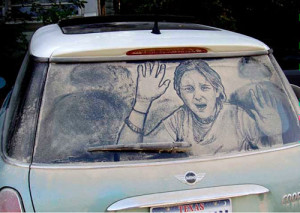 The act is simple and well-worn, but somehow still innovative. While traditional graffiti is largely outlawed for its [arguably] negative effect on private property, few municipalities have laws against cleaning, thus allowing the movement to operate in a grey area, where nothing is added and no harm is done, yet images and text are clearly visible and [further] clean-up is still required for swift removal.
All of which brings to mind a series of questions:
Perhaps only time (and the subsequent impermanence of these works) will tell.

April 13, 2013, 6:00 – 8:00 pm
At the Institute of Cultural Inquiry
Presentation and Discussion will begin at 7pm
The Institute of Cultural Inquiry (ICI) presents Valaco in Babel, a public presentation of our current Visualist-in-Residence, Greg Cohen’s practice-based research at the ICI.
Functioning as a window into visual practice, Valaco in Babel will commence with a self-guided studio visit where the images, objects, and ideas produced during Cohen’s residency at the ICI can be viewed. This will be followed by a session where Cohen, the founder of REASArch (the Group for Research on Experimental Accumulation and Speculative Archives), will discuss aspects of his work within the group’s current project, The Valaco Archive. During this time, guests will also be introduced to the project’s digital component (currently under construction) as a means to familiarize the public with the material and conceptual components of the archive as it continues to evolve.
Using the questionable limitations of ‘the archive’ as a jumping point, The Valaco Archive project endeavors to produce, assess, catalog, and interpret the evidential record and trajectory of an extraordinary, if indeterminate historical persona, Roberto Constantín Valaco, through exploratory visual research. Born Robert Konstanz Wälke, Valaco first surfaced as the putative author of an enigmatic manuscript found in Buenos Aires in 2004 before indications linked him to the identity of an extra in Veit Harlan’s Kolberg, the last and costliest film of the Third Reich. Working speculatively with a complex assortment of elements–visual, textual, material, conceptual—Cohen efforts during his residency at the ICI and beyond aspire to (re-) construct a memory that would unearth the densely sedimented imagery of Valaco’s existence.
The ICI’s “Visualist-in-Residence” (VIR) program offers artists, art theorists, writers, and other visual researchers and culture producers a chance to participate in studio-based visual research in a richly layered and mutable environment. The VIR ‘laboratory’ may function as an artist’s studio, a writing room, a space for gathering data or a quiet space for evaluation and contemplation depending on the needs of each individual project. At the Institute, VIRs are actively encouraged to expand current definitions of visual research and to borrow freely from ICI research practices as they develop aspects of their project in one or more of the following areas: Field work and Data Acquisition; Research and Analysis; Manipulation and Experimentation; Knowledge Transmission and Production; and Public Presentation and Publication. At the end of each residency, the VIRs are invited to present their ‘research’ in a public event/discussion session.
Greg Cohen’s VIR workspace and the materials associated The Valaco Archive project will remain on display (by appointment only via info@culturalinquiry.org) until April 19, 2013. New applications for the Institute of Cultural Inquiry’s VIR program are being accepted through May 31, 2013. To apply, please send a letter of interest to info@culturalinquiry.org.
All ICI public programs are free. Prompt arrival prior to program time is recommended. For questions regarding Valaco in Babel or other ICI events, please contact info@culturalinquiry.org.

ICI Associates help guide and steer the Institute by assisting in the planning, implementation, and archiving of ICI projects and events. In addition to their Institute tasks, Associates spearhead their own projects. As artists, writers, scientists, and other culture workers, their work investigates, defines, and utilizes visual culture. While not Institute projects per se, the range and depth of the Associate projects attests to the vast interests of the ICI.
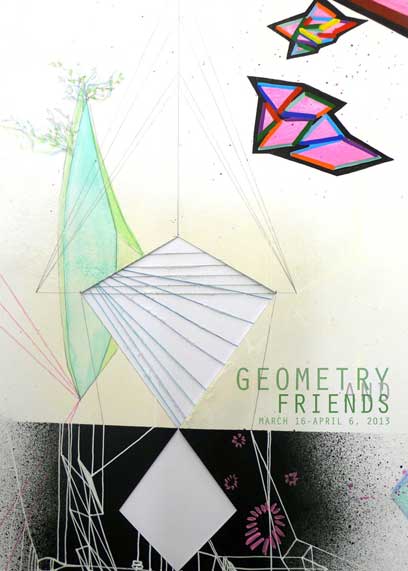 Friends of the ICI, Christine Nguyen and Pam Posey, are being featured in a new exhibition at The Huntington Beach Art Center entitled “Geometry and Friends”
The show “explores the geometric variations in practicing artists. Eclectic ideas of time,space, man vs. nature, and mysticism mingles with fact and fictions of different realities.”
The opening reception is March 16, 2013 – Saturday 7-9pm. “Geometry and Friends in on display thru April 6, 2013.

The ICI is pleased to announce the launch of Phantom Worlds a long-term research theme prompted by a growing cultural interest in worlds that double, mirror and reflect our own. We anticipate a number of significant exhibitions or performances built around this theme, some of which will develop through curatorial projects and at least one that will culminate in our fourth book through ICI press, Barthes’ Myopia.
Phantom Worlds
Phantom worlds can be duplicate worlds but not necessarily alternate universes; they are ones that exist beside our own. We seek out places where these phantom worlds leak and bleed through, where they can be seen or can’t be seen but can be sensed. Our theme grows from our fascination with reflections – with twins, with Dopplegangers, with invisible friends. Is it the phantom one talks to when talking to oneself? And what about worlds written by other beings, by animals, by objects. Sometimes these worlds can only be sensed through a shiver down our spine or a row of goosebumps on our thigh. Phantom Worlds play with our attraction to mirrors, our fascination with reflections, with our feelings of déjà vu, deja connu, deja trouve, something that has already happened, was already known, someone you feel you’ve already met. Phantoms are located where the familiar becomes strange, jamais vu, or within a world of slips – presque vu. We are intrigued by photography’s ability to ‘notice’ these phantom worlds and we wonder if our world is photography’s phantom, not the other way around. We think these phantom worlds might be the places of dreams. We hope to find pathways to their playgrounds, to visit them often, to share their wisdom while keeping the secrets of their most cherished tomes—The Unsayable and The Unsaid. It is said that phantoms follow us, here at the ICI, for a while yet undesignated, we will follow them.
Projects that have emerged within the Phantom Worlds theme include the 100/10 (100 days/10 visions) research-based exhibitions and Speculative Pentimenti: Painting in an Age of Endarkenment.
Former ICI Intern, Caleb Considine’s work is currently being featured at Essex Street in NYC. The show is on display until February 24, 2013.
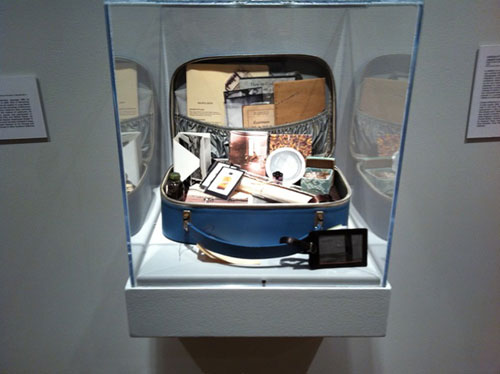
‘Charlotte’, a unique Limited Artist Edition of Searching for Sebald, is currently being featured in a display of new acquisitions at the Long Beach Beach Museum of Art.
New video installation by artist and friend of the ICI, Jeremy Quinn, entitled Mountain II is showing this weekend. “Mountain II is an attempt to build a mountain range using methods inspired by image mapping in 3d modeling software and Google Earth’s terrain view – composited video landscapes are projected onto a faceted construction, stretching the image out as it follows the shapes of the form. The video is in some places abstracted, distorted and pixilated, and in other places a clear representation of landscape.”
Opening reception this Sunday, January 27th, from 2-5 pm at José Drudis-Biada Art Gallery, Mount St. Mary’s College. The show will be on view until March 23, 2013.
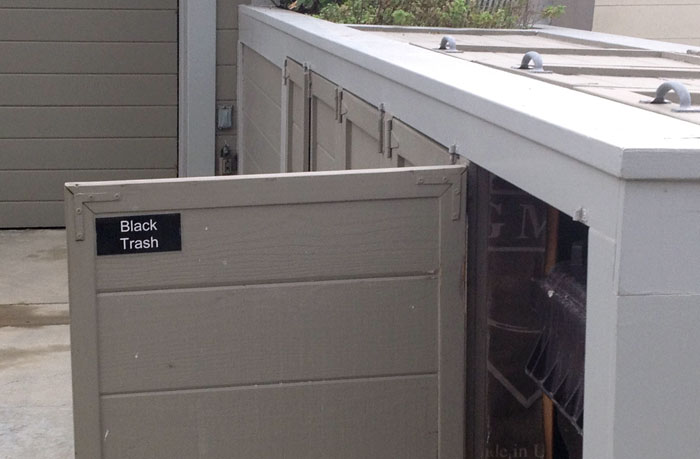
A recent, windy day in Malibu, CA revealed, in more ways than one, a ‘dirty’ underside of the American experience.
The door to an enclosed area for garbage cans had swung open exposing a seemingly ‘private’ directive. This part of town has three trash cans for different types of refuse: green for vegetation, blue for recyclables and black for garbage. Undoubtedly the compartment captured in the above image housed the latter trash can. Yet, once a force of nature dragged the private realm into the public, these two simple words became arresting at least, and to some members of the population even assaultive.
In the public arena these words bring to mind our country’s dark history with African-Americans and hint that this chapter of American history, one fraught with racism and class warfare, may not be as distant as we like to believe. For a phrase that also comes to mind when viewing this ‘innocent’ plaque is its antipode: ‘white trash,’ an often humorously used but always derogatory phrase that assigns the label ‘trash’ to the poor and often uneducated portion of the white population which is perceived as not behaving ‘white’ enough; thus reinforcing the racist idea that these are inherent characteristics of anyone who isn’t white.
Maybe it’s time to retire both ‘black and white’ phrases altogether.
Regardless, one can’t help but wonder how much more money and effort it would have taken to add one more word to this contentious pair on a door that swings open to a popular beach-side street…
…the word ‘can.’