
In May Circum Navigators, a collaborative project between Danae Mattes and ICI Associate, Christel Dillbohner will be shown at the Flora Lamson Hewlett Library, Graduate Theological Union, Berkeley
at the Institute of Cultural Inquiry

In May Circum Navigators, a collaborative project between Danae Mattes and ICI Associate, Christel Dillbohner will be shown at the Flora Lamson Hewlett Library, Graduate Theological Union, Berkeley
FOR IMMEDIATE RELEASE: DECEMBER 23, 2014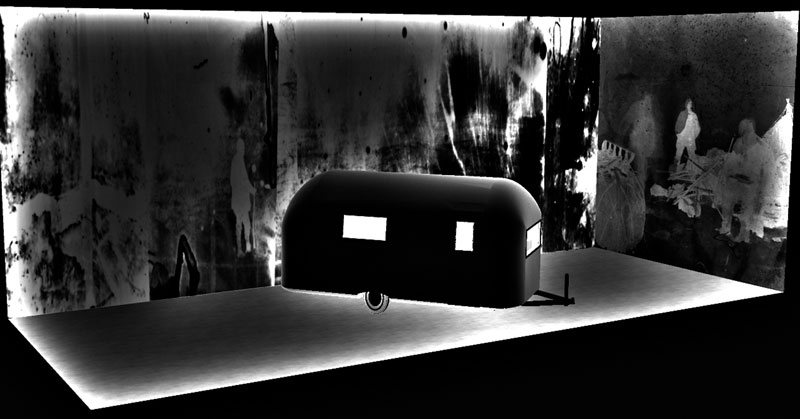 EXHIBITION: In a Mere Full of Rime: a search for photography’s essence
Organized by Lise Patt for Thin End of the Wedge and the Institute of Cultural Inquiry
We generally think of photography as a human-driven activity defined by a momentary capture of the world before us. How could this understanding of photography be challenged by a nineteenth century roll of film that lay in a shallow pool of ice and was subject to a series of slowly-evolving, non-human encounters for 33 years before it was developed? This is the central question behind A Mere Full of Rime: a search for photography’s essence, the Institute of Cultural Inquiry’s month-long collaborative and interactive residency exploring the limits and potentialities of photography at Crossroads School’s Sam Francis Gallery, opening January 15, 2015.
The residency unfolds in an environment whose design derives from the very source material of the residency — 93 photographs originally taken by a member of an ill-fated balloon trip to the North Pole in 1897. We first encounter these photographs as oversized images hanging on the gallery walls where, scaled to the size of the polar world they were once tasked to capture, they are, paradoxically, unable to fulfill a documentary function. Instead, these images present a record of secret signals created on the film by nature’s contaminations and invasions. In their bruises and scars, we find clues about what animates these photographs, what structures them, and the urgency that makes them manifest; we find a suggested story beyond our own desires, one yet to be endowed with meaning. The walls inspire and delimit the visual realm of the residency while offering a backdrop to the researcher’s field station.
Designed from another cultural icon that, like photography, is often called on to embody and carry our phantoms and dreams, the traveling ICI field station is a handmade, paper, Airstream-like structure that houses and records the residency’s research activities. With its shiny surface, the vessel both consolidates and amplifies the visual world that surrounds it; that world—with its photographic fata morganas, its mirrored surfaces, its walk ways filled with large, glacier-like boxes of paper, and its darkened spaces interrupted by eruptions of light—seems to simulate the cold, barren place in which the featured photographs were born. Yet, this is also a world filled with the materials and processes of film-based photography. In truth, the polar trip that produced the images of the residency’s focus was gleaned by the researchers not to create a stage set of some past event but to create a land that is both ‘here and not yet built’ in which the images that inspired the residency are Möbius-like with the world they both inhabit and create.
In a similar way, the researchers’ toolbox relies less on the actual story of how the polar images ‘came into being’ and more on the modes of engagement that brought these images to the ICI’s attention. The photographs in question have always circulated in closed worlds – from the isolated and cut-off polar world of their embryonic beginning, to the frozen island of their undeveloped latency, then the archive drawer where, once developed, they languished due to legal entanglements, and finally to their current residency on a Swedish website, where copyright has limited their circulation. Realizing that these photographs exist both because of and in spite of their limited engagements, the ICI researchers have decided to treat their toolbox as another closed set – in which tools and materials are limited to those brought into the residency on day one and in which all the materials and remnants created will remain on site. Thereafter, any tools or materials needed will be added through MacGyver-esque maneuvers augmented by the researcher’s own ingenuity.
The residency toolbox abides by this restriction as a means of animating the researchers, but the work of the residency will not be subject to a closed set of rules. Inspired by the philosophical work of Deleuze and Guattari – who believed you have to create new concepts for unknown lands, the researchers have eschewed rule-based models, opting instead for an open, self-organizing system that is constantly adjusting and re-organizing itself. The concepts the researchers hope to pursue will not belong to one of photography’s discursive systems but will exist only in and because of the residency world, where they will reveal themselves over the course of the project as a means of proposing “a new threshold, a new direction, a new course for the border.” The residency will be less a testing site of rationally deduced theories about the limits of photography and more a series of meaningful encounters with residency-inspired concepts, and with the individuals who carry these concepts to the researchers in urgently scheduled interchanges. Together, these new ideas will help to frame the constantly shifting direction of the residency’s work.
Even with its overlaying systems of self-reference, In a Mere Full of Rime should not be thought of as a self-contained ‘world as art’ that could travel to any place that is big enough to house it. Ultimately, this is not a work of art to be placed into a world that can then be documented in a photograph but a “ work in art’s world,” as art historian Pamela Lee has termed it, where the photographs under study are both objects and agents of this art world. As much as the residency researchers will consider other trajectories, other histories, and other borders for photography, theirs is ultimately a research ‘at the outside of photography but not outside it.’ As such, the residency’s acts of interpretation will strive to ignite a network of associations, interrelations and affinities between these exceptional images and our current understandings of photography but not without tracking the art world’s stake—including the researcher’s own stake—in maintaining or disrupting these very boundaries.
In a Mere Full of Rime: a search for photography’s essence is a collaborative residency project of the Institute of Cultural Inquiry (ICI) in conjunction with Crossroads School’s Sam Francis Gallery and the Thin End of the Wedge (the E of the We) a peripatetic research entity that helps to bring ICI projects to sites around the world. The residency runs from January 16 to February 13, 2015 at the Sam Francis Gallery in Santa Monica, CA. The Opening is Thursday, January 15th from 6-8 pm. A finissage is planned for February 15 from 4-6 pm.
(Please note that the exhibition was extended to February 20, 2015)
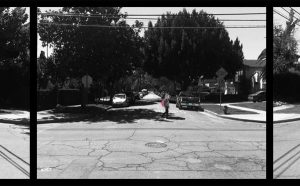
Exhibition: January 8 – February 28, 2015
Reception: Saturday, January 10, 2015, 6 – 9pm
Los Angeles Center for Digital Art
104 East Fourth Street
Los Angeles, California 90013

I first came across the image, L’Ami, by Herve Guibert in 2011 or ’12; it was the frontispiece for Tom Roach’s excellent book Friendship as a Way of Life: Foucault, AIDS and the Politics of Shared Estrangement. Based on Foucault’s essay of the same name the book imagines a way towards a radical conception of friendship, one that is exemplified in his reading of the photograph.
Indeed Guibert’s forceful hand gesture in “L’Ami” can be read as a futile attempt to bridge the infinite distance, the estrangement, between friends. And yet, when a nontranscendent estrangement in the form of finitude becomes the bedrock of friendship, a respect for the absolute alterity and singularity of the self and other is encouraged. A relation founded on a finitude so radically unsharable can be the cornerstone of a community that coheres not in identity but in a more radical being-in-common. In the gaping crevice between friends, a politics of shared estrangement lies in wait.
Roach is in part talking about the relationships built through the radical politics of the AIDS crisis (key word finitude here), in communities of difference, the buddy system and amongst those who were working towards shared aims in the battle against the disease.
Hervé Guibert was a French writer and photographer who died in 1991 from complications from AIDS. He is best known for his short novel To the Friend who did not Save My Life, which is a intimate account of the life and death of Michel Foucault.
Image and text, as well as Guibert’s entire oeuvre spoke to me in a very deep way, so much so that I replicated the image as a photogravure in 2013.
In my personal life I’ve been lucky enough to never had any real close experience with AIDS. While I have had acquaintances who are positive, known and seen the public effects of the disease, I haven’t been touched by it directly. As I grow older though, I have come to understand how deeply it has affected me, and many of my generation, in our experience (particularly) as gay men in the world. Trying to find an understanding of what it meant to come into our sexuality in the beginnings of this epidemic, the media portrayal of the disease and “homosexual lifestyle”, and attempting to figure out who/how to be as a gay man under the assumption that the pursuit of that life included a potential of death and disease, an intimacy of shielded contact, and at least at the time, as a public pariah was I assume, a great challenge for many “gen-X-ers”. My replication of the image was a personal attempt to bridge that “infinite distance” I feel in many of my personal relationships as a result of this life long challenge.
Today it seems there is a very different public face of AIDS. With PrEP, AIDS awareness/know your status campaigns, same-sex marriage “undetectability” etc. there is not the terror connected to the lives of many gay men of the last two generations. With that, it seems there is less urgency and radical politics surrounding what still is an epidemic. AIDS has become just another incurable but manageable disease on a long list that gives big pharm more and more power. Despite the fact that many PWA’s are living long and healthy lives, free of stigma or limitations AIDS is still very much portrayed as a gay man’s health problem.
On this World AIDS Day/Day Without Art I want to remember that this disease has greatly impacted even those who remain directly unaffected by the disease and that the portrayal of healthy, gym toned men living with AIDS is a veil over those people of color, living in the third world, homeless or without access to care or money who are still dying in droves.
We still need to “Act Up, Fight Back, Fight AIDS”
Jaime Knight, 2014
**This post was originally published on December 1, 2014. The images have intentionally been left blank in honor of World AIDS Day / Day With(out) Art.
All measurements are in inches (length x width x height):


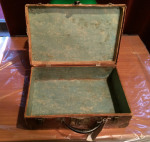


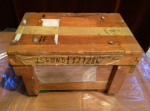


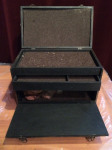
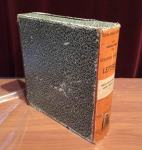
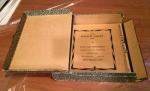
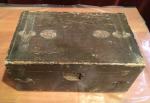
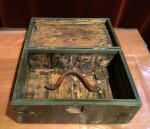


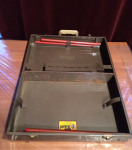


RESERVATION DEADLINE: ASAP until all are reserved.
CACHE CONTENT LIST DEADLINE: December 31, 2014

AmazonSmile features the same products, prices and services as Amazon.com but when you make your purchases through AmazonSmile, Amazon will donate 0.5% of your total eligible purchase price to the ICI or to charitable organization of your choice.
Visit smile.amazon.com or click the embedded link above, to get started.
VIR Anna Ayeroff is currently live-streaming a double vision of her visual research journey across the western US. Follow her journey live through November 12, 2014.
 ICI Director, Lise Patt, will be participating in a career roundtable discussion as part of an upcoming one-day conference that “will explore how the human body and its experiences of illness are imagined and made visible in medical research, practice, and education.” You can RSVP to attend the event here.
MEDICINE AND THE IMAGE: THE VISIBLE HUMAN
Wednesday, November 5, 2014 | 8:30 AM – 7:00 PM
Roundtable on Careers in the Health Humanities & Arts 1:30 – 3:00pm , University of Southern California, Doheny Memorial Library, Room 240
PUBLIC GALLERY EXHIBIT
Monday, November 3 – Friday, November 7, 2014 | Von KleinSmid Center Courtyard