Associate Axel Forrester in London Exhibition

Axel Forrester, one of our founding associates, relocated to England over two years ago. Read about her film, Severance, in a review of a London exhibition curated by Annika Erikson that includes this work.

It follows a string of commuters travelling on the Paris Métro, with eyes closed or staring into space. It is an interesting and visually appealing study of the phenomenon of moving alone in and through public places, being surrounded by people but remaining disconnected.

Read the entire review or check out some of Axel’s videos.

Information Sessions for Curatorial Projects

Manual of Lost IdeasThe ICI has scheduled a series of monthly sessions to help ease the application process for individuals who want to submit curatorial proposals. During each session, we’ll present one of our ongoing projects as a means of demonstrating (not merely presenting) the ICI method.

The first session will be on Wednesday, November 9, 2011 at 7 p.m. and will focus on the Manual of Lost Ideas. Please rsvp by October 31 at info@culturalinquiry.org


Visual Researcher-in-Residence

The Visual Researcher-in-Residence program is designed for artists, writers, scholars or serious tinkerers, whos work or ideas fall outside of the typical bounds of recognized visual genres. We are looking for a visual researcher(s) whose cultural investigations, analyses, examinations, and experimentations are sympathetic with that of the Institute. The visual researcher will be offered a research space and access to the ICI library as well as the ICI’s collection of visual tools.
The ICI’s current research theme is PHANTOM, MIRRORED, AND DOUBLED WORLDS and the resident will be encouraged to interface with this theme.

100/10∆10 The Earth Project Archive

Coordinated by Jojo Black and Elisa Baek with contributions by terra publica
June 28 – August 15, 2011

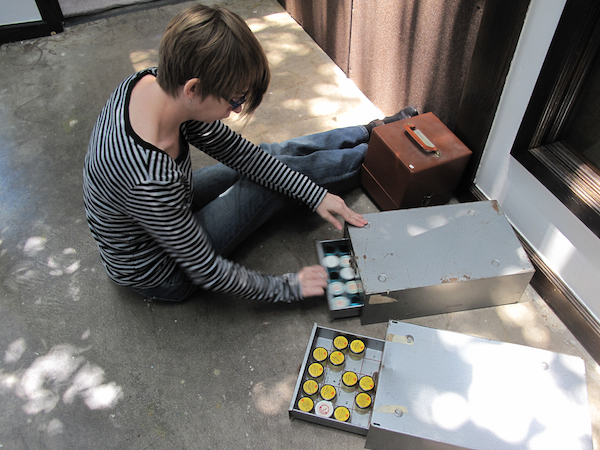
Mappa Mundi: The Earth Project drew inspiration from the ICI’s “Earth Cabinet”, a collection of dirt specimens from all over the world currently housed in a refurbished communion cabinet. These specimens comprise of dirt, dust, grit, shell, sand and other types of earth material from locations including: Ayres Rock, Australia; Suzhou, China; Stonehenge; the Berlin Wall; Zion, Utah; Jerusalem, Israel; Kanagawa, Japan; Paris Catacombs; the Grand Canyon; Gubbio, Italy; and Giza, Egypt. The “Earth Cabinet” collection brings together a myriad of geographic terrains to reveal where the Institute of Cultural Inquiry and its publics have visited in the past, as well as where they might go in the future.

Using the tools and resources of the Internet, The Earth Project provided a platform for people to contribute their own “earth samples” and plot them out on an interactive world map where others can easily view and share them across various networks.

Through their contributions, the terra publica (people of the earth) became the curators of this project. They selected the material, they made the connections, the interpretations, the meanings, they gave the “earth samples” their movement and purpose. 100/10 was an invitation to construct a new world map, one that reflects all the intricacies and experiences we share as individuals on this journey through earth’s terrains.

Here, you find an archived interactive map of The Earth Project – and explore the contributions of terra publica. An archived capture of Mappa Mundi: The Earth Project website, which provided the platform for participation, can also be seen below. You can also visit the documentation page at our laboratory for more information.

 

Hummingbirds in the Garden

Over the last few summers, we have watched the fervent nest-building activity of the hummingbird population that favors our secluded, lush garden. Their bricolaged nests are small enough to fit in a human child’s hand and are often built on the thinnest branches of a tree where they become invisible to the human eye. Each year, we would stand watch over these nests as soon as the mother bird began her quiet occupancy (in itself, a sight to see) but we never saw any chicks; their birth was becoming as legendary as an elephant’s death.

This year, we left for the three day 4th of July weekend with mom still sitting quietly on her nest. When we returned the following Tuesday, the mom was gone and the nest was empty. We later found out that Steven Eighmey, our plant manager, had stopped by the Institute on July 4th. While most humans were lying on beaches or flipping burgers in backyards, the hummingbirds in our garden were getting ready to leave home.

So here, finally, our first documented graduating class of hummingbirds from the ICI garden.