
[It’s wonderful] when you’re out there in the field and you’re first encountering marvelously strange natural adaptation. At first all you’ve got is a few disconnected pieces of raw observation, the sheerest glimpses, but you let your mind go, fantasizing the possible connections, projecting the most fanciful life cycles…later on, sure, you have to batten things down, contrive more rigorous hypotheses and the experiments through which to check them out, everything all clean and careful. But that first take — those first fantasies, those are the best.
– Tom Eisner
As Tom Eisner the late, preeminent biologist hinted in the above quotation, the scientist’s response to a “few disconnected pieces of raw observations” might be hard to distinguish from the preliminary work of the artist. Common wisdom tells us that this shared path quickly diverges when the “possible connections” that continue to flourish and find form in an artist’s work are batten down in science and subjected to the scrutiny of the scientific method. That is, until recently. In the last decade, especially with the advent of research-based studio art practices, the distinction between knowledge production in art and science has quickly eroded. Not only does the contemporary artist often borrow from the methodologies of science, but by integrating heretofore private and hidden research processes into the final artwork, the artist (sometimes unwittingly) exposes the extent to which the current art world, much like its ‘science world’ counterpart, rewards an institutionally sanctioned and legitimized knowledge.

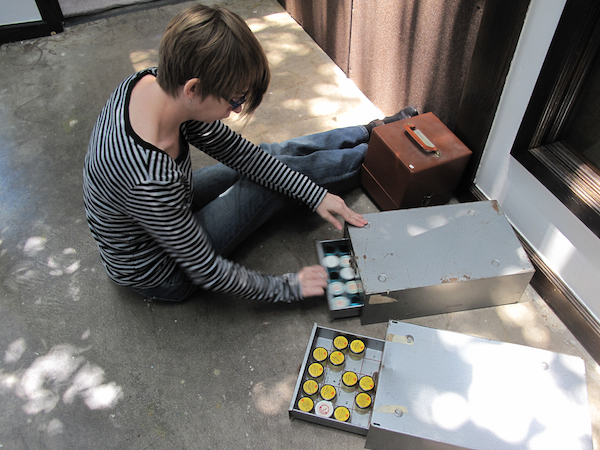
Since its inception in 1991, The Institute of Cultural Inquiry has questioned the accepted distinctions between the research processes of the arts and sciences. In this spirit, the ICI embarked upon the ambitious project: 100/10 (100 days/10 visions), highlighting the cross-disciplinary and oftentimes un-disciplinary nature of knowledge production. Beginning January 31, 2011 and running for 100 consecutive (business) days, the ICI site and its archives were subject to a panoply of interpretations. Ten visual researchers—artists, writers, scientists, and other visual thinkers—played with ideas by blending contemporary visual practices with aspects of the ICI Earth Cabinet, Ephemera Kabinett, a 2,500+ volume library along with the eclectic and historically layered ICI space. To increase the possibilities for inversion and trickster curatorial strategies, the ICI site was reconfigured to include many of the institutional forms the organization has often railed against. Visitors found a “white box gallery,” a dedicated and well-stocked gift shop, and a clearly labeled library. At the same time, visitors encountered the unique and non-traditional features of the ICI laboratory: a time clock (with its adjacent punch cards) that clicks off the time of another (unidentifiable) time zone; a turning carrier for fractured postcards that operates somewhere between clues and evidence; a tattered Ephemera Kabinett with its ambiguously labeled drawers and constantly changing content; and the many nooks and crannies that hide ICI treasures in plain sight. In counterpoint to the new “clean-space” gallery, curators were encouraged to conceptualize their unique trajectories through the ICI body in a “messy-space” laboratory. Modeled after the transparent workspaces of 19th-century natural history museums, this workspace offered visitors a glimpse at research in process.

With little time for curators to conceive of their vision, few display iterations (wherein “display” was conceived within the broadest definition to include catalogs, performances, screenings and tactical events) were landing sites for well-thought out projects. Rather, spurred by the curator’s interaction with the ICI and its archive—perhaps coalescing around a recurring color, a series of linked words or sounds, synchronic events or random visions—these displays evolved along with and through the ideas from which they took their shape, not merely representing but enacting the creative process. 100/10 was a spontaneous, constantly evolving ICI project that reflected the nature of ideas right at the moment they come into play.
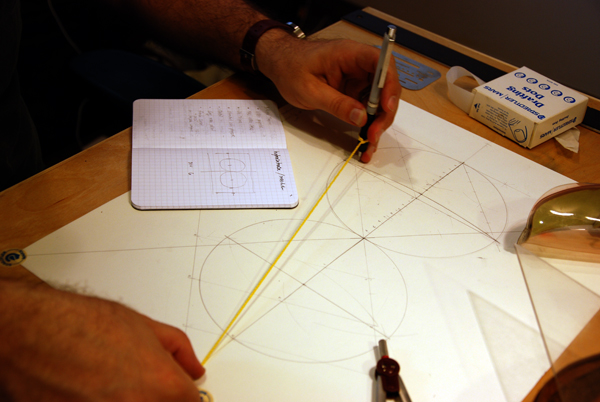
For the premier iteration of this ten-part project, 100/10∆1 curator Alex Harvey and Anna Ayeroff’s multi-media installation Clarion Calls plumbed the Ephemera Kabinett’s filmstrips as well as the utopian mandate haunting the ICI archive. Does the personal story and its nostalgic retreat underpin all studies of history and its documents?
 Harvey illuminated the struggle between form and content that troubles any archive—be it a collection of stories, a chest of documents, or an assortment of shapes we imagine might construct a “perfect world.” If the call of family apocrypha initially drew Ayeroff to Clarion, Utah, her laborious and repetitive re-mappings created a clarion call to the infinite “better world” possibilities that once drove the builders of these ruins.
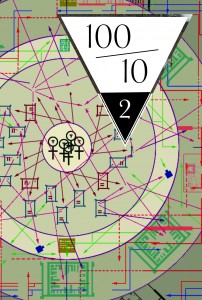 The Ephemera Kabinett became the site for 100/10∆2’s projective excavation, as longtime ICI Associate Antoinette LaFarge and historical writer Ruth Coppens turned to the ICI’s interest in marginalia and annotalia, the metaphorical dirt that would ordinarily fall to the wayside while digging a hole that History may inhabit. Here an article hidden within the pages of a 1910 issue of Ladies Home Journal prompted the recuperation of Louise Brigham (1875-1956), who pioneered a do-it-yourself system for building furniture using simple tools and disassembled packing crates.
For 100/10∆3 spectral geneticist Norway Nori probed the Institute’s roster of collaborators with an on-line questionnaire that amalgamates such popular diagnostic tests as the Minnesota Multiphasic Personality Inventory (MMPI-2), the Rorschach Ink Blot Test, and the Myers Briggs Personality Test. In so doing, he teased out a composite of the myriad publics the ICI has engaged over its twenty years. As it sought emancipation from the market and political pressures that so often relegate art to the realm of leisure, the ICI shied away from more popular metrics that conflate public support with the size of one’s mailing list or a reception’s attendance. Rather, the ICI has consciously cultivated more nuanced ways of defining its public to include not only visual consumers and spectators but also visual thinkers and producers. Abiding by the ICI’s “Rule of 100,” Nori selected 100 people who had in some way collaborated or interacted with the organization in its two decades, extrapolating from this pool’s responses an heretofore unspoken lineage.
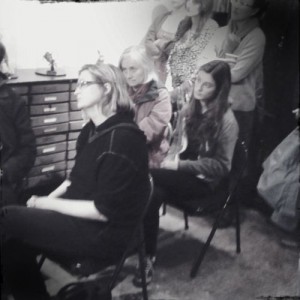 Where 100/10∆3 traces an uncanny warren of shared intellectual closets and their skeletons, curator-artist Karen Frimkess Wolff and artist Paul W. Evans created multiple calls to myriad visions, a dense tangle of potential sight lines for 100/10∆4. Enriched by the ICI’s extensive collection of books and ephemera for the blind and inflected by Frimkess Wolff’s experience teaching art and art history at the Los Angeles Braille Institute, the pair presented a protean, phantasmic landscape of sight, touch, and sound that traversed personal intention and public participations, knowing and acting, thinking and willing.
100/10∆5 celebrated artistic amity while riffing upon the Institute’s progenitors, the Wunderkammer and the 19th-century natural history museum. Curator/artist Pam Posey and artist Christine Nguyen de-mystified the processes by which the study of the natural world—the analyses, taxonomies, methodologies, and institutional edifices that comprise the cultural production of Scientific Knowledge—transforms into a tenuously stable parafiction demanding both skepticism and belief. Taking Paul Harding’s lyrical observations in Tinkers as a point of departure, Posey asked, “What happens if the natural world is declassified? Do we in fact free knowledge from cultural constraints?” Institute artifacts stood alongside and indistinguishable from objects the pair had collected on their treks through the Sierras. Just as a rootball emerged from a leisurely bath in borax encrusted in quartz, or ghostly intimations—shadows, really—took form on the cerulean backdrop of a sun-exposed cyanotype, these tinkers, Posey writes, “work in a realm where the imagined and the actual commingle…where the seepage from the real to the fantastic and vice versa disrupts, unsettles, and challenges the status quo.”

With curator Christel Dillbohner and video artist Inge Kamps’ Vom Licht der Natur in 100/10∆6, the Institute once again offered a prism through which the transmutative power of attention is refracted. This one-day exhibition explicitly drew inspiration from the ICI’s extensive collection of alchemical and metaphysical texts and the sensitively edited time-lapse videos and abstract color photos sublimated the archive’s solidity into the ethereal registration of light through duration.

For 100/10∆7, peripatetic curators Rosie Woodward and Christian Smith enlisted visitors in an urban forensic caper to map newfound cartographies between the Institute and its surroundings. Where history attempts to reveal (or conceal and distort) patterns of causality, the pair deployed the Institute’s vast trove of visual technologies to construct a display that served as a two-way conduit. A manifesto beseeched “Voices will find their way in,” “Questions will find their way out,” as images and messages grew their own legs to walk the streets, be posted on walls, thrown in the trash.
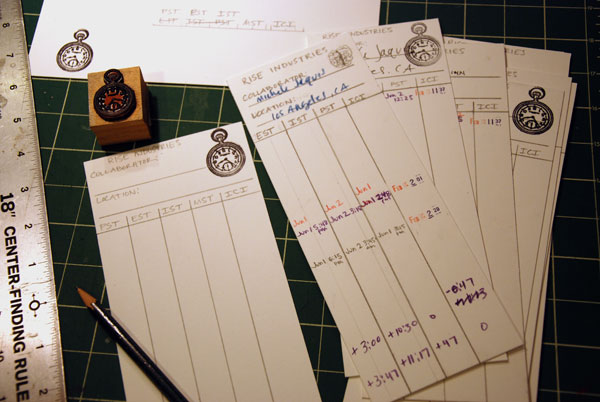
Rise Industries’ co-founders Jeremy J. Quinn and Michele Jaquis took playful measure of the Institute’s phantom worlds for 100/10∆8. The curators explored the slippages in our concepts of distance and time, in relation to the ICI collection, ICI’s location in Southern California, the geographic sprawl of their collaborators in Los Angeles, Boston, India, and all of our absolute/ relative position in the Cosmos. Glass slides precipitated a kaleidoscopic sense of déjà vu’s possibilities for mis-(re)cognition: uncannily, Michele could mistake these images for those taken by her twin sister, Nicole, in India.
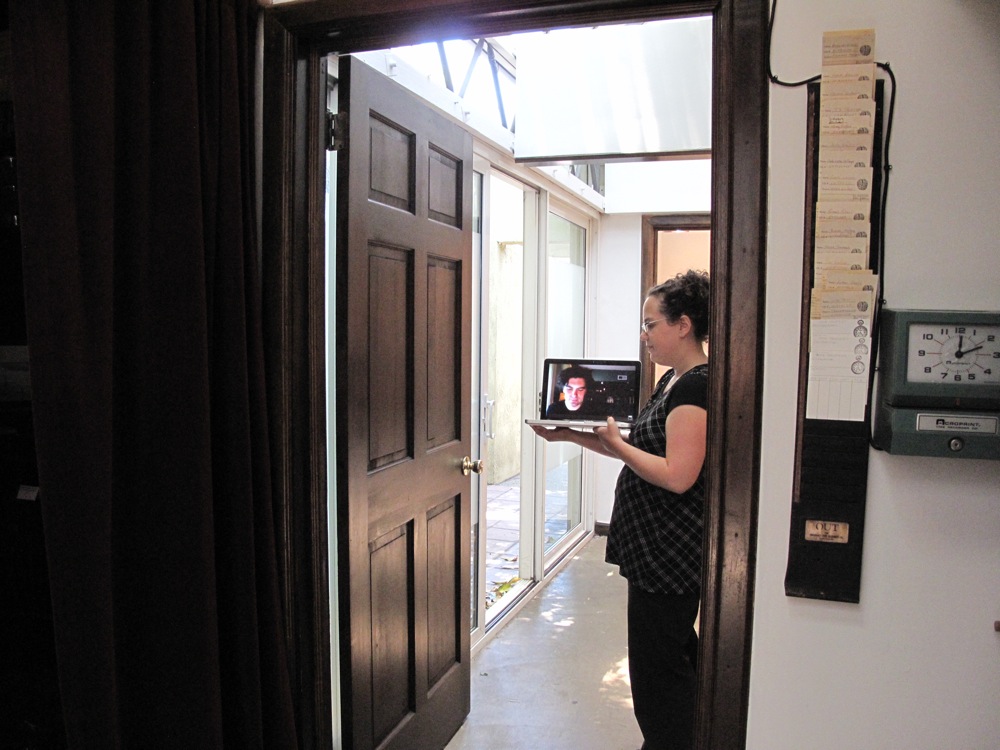
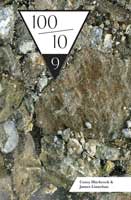
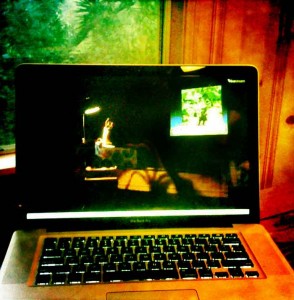 100/10 wound to a close at the end of June but not before artist and curator James Linnehan and artist Corey Hitchcock launched the peephole on the ICI’s dashboard with their remote offering for 100/10∆9. In The Bright Tenderness of Reality, the collaborators created a new “wing” of the Institute, located in the ether of networked consciousness and loosely tethered to the model of Distance Learning. Without recourse to the Institute’s urban and localized physicality and the archives accreted over the Institute’s two decades, artist and curator rummaged through the artist’s videos; fondled text(s) via e-mail and link; unzipped files; employed search engines. For one week in June, 100/10∆9 provided a rare occasion to convene artist and curator, overlay physical and virtual: Institute’s core facility and a satellite several hundred miles away.
The same ICI website became a portal to the social network that curated 100/10∆10, coordinated by ICI Fellows, Jojo Black and Elisa Baek. Building on the ICI’s interest in exploring the intangible and ever-changing phenomenon known as “culture”, Mappa Mundi: The Earth Project extended the focus of the ICI’s “Earth Cabinet” by constructing and supporting an online world map where new spaces for perception, memory, history, and time could be created by reinterpreting the practices of visual thinking within contemporary society. The project, curated by the terra publica, was driven by open-ended directions to help foster the potentialities inherent in participants’ interpretations.
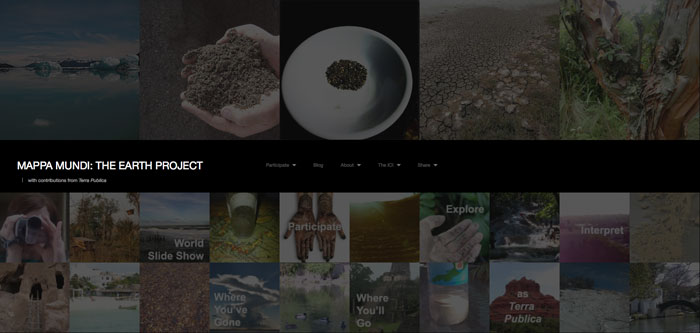
The world map created a universal platform for the public laboratory of 100/10∆10 allowing for the cultivation and development of ideas. It also hinted at the planned second part of this project. In 2013, the 100/10 investigation will meet its conceptual antipode in a network of 100 sites joined by a single day of time.
A unique catalog accompanied each of the ten iterations of this project. Modeled on the New Museum’s catalog for its 2008 landmark show After Nature, the 100/10 catalogs found their form in a dustcover enfolding a slightly used copy of a book that had influenced each show’s curator and artist. The Catalog can be purchased through the ICI Gift Shop.
100/10/10 was the first project to be conceptualized within the ICI 2011-12 study theme of PHANTOM WORLDS: real and imagined worlds that double, mirror and reflect our own.



 The
The 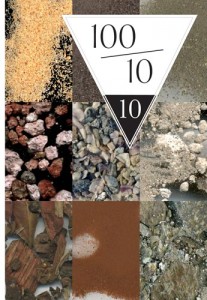 100/10∆10: Mappa Mundi: