SPECULATIVE PENTIMENTI Press Release

Speculative Pentimenti: Painting in an Age of Endarkenment

May 5 – 26, 2012

 Opening Reception:
Saturday, May 5, 7-9 pm

We are living through a dark age. An age of, if you like, endarkenment—and I don’t necessarily mean that negatively. The world is aflood with dark psychic fluid, everything’s stained with it.                                                   – Michael Ventura

Working within the framework of our 2012 research theme of phantom worlds and fueled by our long-held belief that all human activities leave behind a visual trace, the Institute of Cultural Inquiry (ICI) is proud to present Speculative Pentimenti, a visual exploration of contemporary society presented through the work of artist and longtime ICI associate Sande Sisneros.

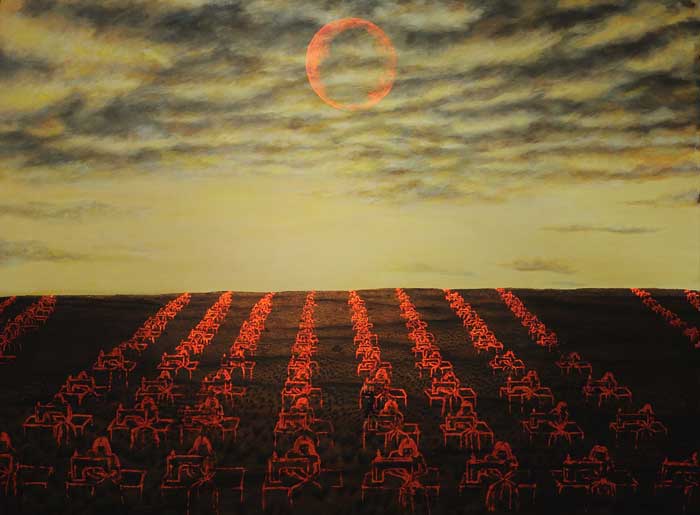
Marrying the detail of Northern Renaissance landscape painting and the immersive and dramatic lighting changes of the theater, Speculative Pentimenti uses visual narratives to express the hidden politics of a world that lies beyond our immediate realm of vision. Using light-sensitive pigments and inverted lighting and optics within the display space, large-scale oil paintings of uninhabited landscapes and disjointedly dramatic skies give way to a tracery of haunting visual narratives that reveal hidden “realities” lurking just below the painted surfaces. Here, a once serene ocean becomes a cesspool of trash while an uninhabited poppy field suddenly turns to menacing scene of war. These ghostly speculations appear in the dark to relay their messages, but then fade back into oblivion when the light comes back on. Both stages or “worlds” are ever present but viewers can never completely see both at the same time thus entangling the two in the visual centers of our brains and the shadow of our memories.

It is through this performative nature that the works express the artist’s true intention, to inspire change through the use of inventive pentimenti. In the world of forms, pentimenti (Italian for remorse or change) evoke x-rays, night vision, and the visual traces of hallucinogens while in art history their study is a recuperative act, a look back to a painting’s origins or an artist’s first intentions. Here, Sisneros uses these ghostly structures to look ahead, to imagine a future where the hidden politics of the world no longer lie beyond our immediate realm of vision but rather become glowingly apparent.

The duality of these images question what we see and (more importantly) what we often times don’t see or choose not to see. Is seeing really believing? Are truth and perception the same? And equally, what are the boundaries of our existence? In exploring these questions, viewers are left to form their own answers and reveal some form of “light” from the “darkness.”

Sande Sisneros is an internationally exhibited, self-taught artist whose works are featured in prominent private collections around the world. Over the course of her career, Sisneros’ works have challenged our connections to sight, memory, nature and the unknown. Speculative Pentimenti brings these elements together to further engage the limits of our reality.

For more information about the show:info@culturalinquiry.org


100/10∆10 Press Release

Institute of Cultural Inquiry 100/10/10 Earth Project100/10∆10: Mappa Mundi:
The Earth Project

Project Launch: Tuesday, June 28, 12:00 pm 
Coordinated by Jojo Black and Elisa Baek with contributions by terra publica

Free and open to the public
Selections from the collaborative final iteration of the 100/10 project can be viewed online here.


For the tenth and final iteration of the Institute of Cultural Inquiry’s ambitious project 100/10 (100 days/10 visions), Mappa Mundi: The Earth Project explores the notion that we are all of the earth, allied through terrestrial bounds, living along an assortment of grounds that reflect both the diversity and uniformity of our world. 100/10∆10 is a participatory project of the Institute of Cultural Inquiry (ICI) that exists with and through the terra publica – the people of the earth – who use the tools and networks of the Internet to collectively re-imagine a world map within the context of human experience.

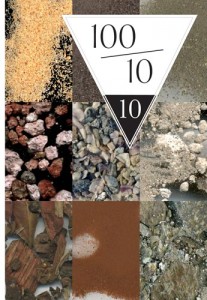
The Earth Project draws inspiration from the Institute of Cultural Inquiry’s “Earth Cabinet”, a collection of dirt specimens from all over the world currently housed in a refurbished communion cabinet. These specimens comprise of dirt, dust, grit, shell, sand and other types of earth material from locations including: Ayres Rock, Australia; Suzhou, China; Stonehenge; the Berlin Wall; Zion, Utah; Jerusalem, Israel; Kanagawa, Japan; Paris Catacombs; the Grand Canyon; Gubbio, Italy; and Giza, Egypt. The “Earth Cabinet” collection brings together a myriad of geographic terrains to reveal where ICI and its publics have visited in the past, as well as where they might go in the future.

Building on the ICI’s interest in exploring the intangible and ever-changing phenomenon known as “culture”, Mappa Mundi: The Earth Project extends the focus of the “Earth Cabinet” by constructing and supporting an online world map where new spaces for perception, memory, history, and time are created by reinterpreting the practices of visual thinking within contemporary society. The project conceptualizes art as an open, cross-disciplinary culture-building activity, where hybrid forms of cooperation and production can emerge freely within the given form. The project’s use of a world map advances ICI’s belief that mapmaking is more about creating and revealing connections through the process of discovery than it is about simply charting areas of the world. With the project’s open-ended directions to help foster the potentialities inherent in participants’ interpretations, the platform of a world map doubles as a public laboratory for cultivating and developing ideas with and through the terra publica.

A unique catalogue will accompany this exhibition, modeled on the New Museum’s catalog for its 2008 landmark show After Nature. Catalogs for the 100/10 shows exist as a dustcover enfolding a slightly used copy of a book that has influenced the show’s curator and artist. 100/10∆10 uses a small, blank sketchbook with field implements, such as small specimen bags and identification tags, nestled between pages. This empty workbook points back to this project’s “potentialities inherent in participants’ interpretations” and calls upon individuals to move out into the “field” of the project, the very earth in which we all inhabit. The catalogs are available online in the ICI gift shop.

Beginning January 31, 2011 and running for 100 consecutive business days, the ICI site and its archives is undergoing a multitude of interpretations. ICI has invited ten researchers-artists, writers, and visual thinkers-to set into play ideas that blend contemporary visual practices with aspects of the ICI Earth Cabinet, Ephemera Kabinett, and a 2,500+ volume library along with the nooks and crannies of the eclectic, historically layered ICI space. With two weeks to conceive of their vision, curators will work in a designated laboratory modeled upon the transparent workspaces of 19th-century natural history museums. Each curator will conceptualize a new trajectory through ICI’s body, transforming the ICI display by the end of their residency. 100/10 project participants to date have included ∆1: Alex Harvey with Anna Ayeroff; ∆2: Antoinette LaFarge with Ruth Coppens; ∆3: Norway Nori; ∆4: Karen Frimkess Wolff and Paul W. Evans; ∆5: Pam Posey with Christine Nguyen; ∆6: Christel Dillbohner with Inge Kamps; ∆7: Christian Smith and Rosie Woodward Smith; ∆8: Jeremy J. Quinn and Michele Jaquis of Rise Industries; as well as ∆9: Corey Hitchcock and James Linnehan.

Since 1991, the Institute of Cultural Inquiry (ICI) has explored the role of visuality in imagining, perpetrating and perpetuating the intangible and ever-changing phenomena known as “culture.” The ICI sponsors displays, symposia, workshops, performances and provides numerous opportunities for both the artist fabricator and the curious spectator of visual culture. The non-profit organization also maintains an active publishing program, releasing the critically acclaimed Searching for Sebald: Photography After W. G. Sebald in 2007. 100/10 is the first project conceptualized within the 2011-12 ICI study theme of Phantom Worlds.

Purchase catalog for 100/10∆10.
Read more about the complete 100/10 project.

100/10∆9 Press Release

100/10∆9: James Linnehan and Corey Hitchcock

June 20 – 26, 2011
Online Launch: Monday, June 20, 12pm at www.culturalinquiry.org

Real Time Lecture, Screening and Live Feed: Saturday, June 25; 7 pm (sharp) – 8:30 pm (blurry); doors open at 6:30 pm

LOCATION: Arts & Consciousness Gallery
John F. Kennedy University Arts Annex, Heinz Building
2956 San Pablo Avenue, 2nd Floor, Berkeley, CA


The Institute of Cultural Inquiry (ICI) is pleased to unveil the virtual peephole on its website for the ninth iteration of its ambitious 100/10 project (100 days/10 curatorial visions). To collaborate on The Bright Tenderness of Reality, artist Corey Hitchcock and curator James Linnehan created a new “wing” of the Institute, located in the ether of networked consciousness and loosely tethered to the model of Distance Learning. Without recourse to the Institute’s urban and localized physicality and the archives accreted over the Institute’s two decades, artist and curator rummaged through the artist’s videos; fondled text(s) via e-mail and link; unzipped files; employed search engines. Thus far, artist and curator have met in physical space only occasionally and for reassurance. A mere 90 minutes on Saturday evening, June 25th, provides a rare occasion to convene artist and curator, overlay physical and virtual: Institute’s core facility and a satellite several hundred miles away. A lecture and screening will exist in real time at the Arts & Consciousness Gallery at JFK University in Berkeley but it can also be viewed through a peephole via the ICI’s website.

Modes of becoming proliferate in Corey Hitchcock’s video world: edits are imprecise, equations are inelegant, line is not unerring, gravity is inconstant, objects are unintelligent, nature experiments before the camera, narrative is disrupted, illusion falters. Corey Hitchcock is what is referred to in fiction as an “unreliable narrator.” The 21st-century omniscient camera becomes just another object without proper or usual behaviors, as unseeing as the elegantly gloved hand which pokes through the scenery and draws. In these video dioramas the wildlife misbehaves, the scenery crumbles: the artist, revealed through occasional rips in the backdrop, is no more than a blind stagehand.

The Bright Tenderness of Reality brought to the curator’s mind a phrase from James Joyce: “the ineluctable modality of the visible.” The ineluctable is the visible—the real—the artwork—not the artist, not the curator. And bright?—because reality has intelligence and essential qualities; bright in that it has its own light, neither borrowed nor given … and shadows in Corey Hitchcock’s videos are shadows on the moon—pure, clear shadows—not the earthly shadows of cynicism or nostalgia or yearning—these are bright shadows. From June 20 – 26, 201l, they can be viewed via the ICI website by following a link on the directory (landing) page. The virtual launch time is 12 p.m. on Monday, June 20, 2011.

A unique catalogue accompanies this exhibition and extends the Institute’s thinking on W.G. Sebald. Modeled on the New Museum’s catalog for its 2008 landmark show After Nature, 100/10 catalogues exist as a dustcover enfolding a slightly used copy of a book that has influenced the show’s curator and artist. The 100/10∆9 catalog, wrapped around Ivar Ekeland’s Mathematics and the Unexpected, may be purchased in the mobile ICI gift shop at the A&C Gallery or through the ICI website.

James Linnehan defers to Jules Henri Poincaré’s “The Sciences and the Humanities” (1911) for his biography:

Amongst the men who have, always usefully but with differing degrees of brilliance, given service to science, some have received in their youth a solid classical education, refined in some cases, whereas the literary schooling of others has been rushed, incomplete and summary. It is tempting to conclude that literary study is useless to the scientist, since so many of them manage without. But that would be hasty. Is it really true that we can’t make out differences between the work of the one sort and the other and discern their hallmarks, so to speak? Well, that’s a comparison I don’t wish to carry out here. It would require me to name names, and I wouldn’t wish to offend anyone, even the dead. In such matters it is hard to judge, but if, in any case, we were to show that the one type were equally good scientists as the other, what exactly would be proven? The fact of the matter is self-evident. For a long time, it has been difficult to make your name and, in general to rise above your station, without schooling. Those who have succeeded nonetheless have done so thanks to an exceptional energy which has made up for the lack of a range of other advantages, and which has put them on a par with more cultivated individuals of a less sturdy character.

Corey Hitchcock (www.coreyhitchcock.com) was raised until she reached the age of thirteen, in an isolated, suburban compound, without contact from the outside world. All of her visual work began as attempts to understand the larger world she encountered, once she had dug her way out. She received her MFA from JFKU’s Arts and Consciousness program in 2005, and was given a Cadogan-Murphy award for her graduate work. She is a graduate of the Foundation for Shamanic Studies three-year program, has a transpersonal medicine practice, and engages geomantically with the Earth on a regular basis. She explores the shadow zones between worlds to retrieve hidden information about our compromised natural selves to help us remember what makes us most delightfully human.

Beginning January 31, 2011 and running for 100 consecutive business days, the ICI site and its archives is undergoing a multitude of interpretations. ICI has invited ten researchers-artists, writers, and visual thinkers-to set into play ideas that blend contemporary visual practices with aspects of the ICI Earth Cabinet, Ephemera Kabinett, and a 2,500+ volume library along with the nooks and crannies of the eclectic, historically layered ICI space. With two weeks to conceive of their vision, curators will work in a designated laboratory modeled upon the transparent workspaces of 19th-century natural history museums. Each curator will conceptualize a new trajectory through ICI’s body, transforming the ICI display by the end of their residency. 100/10 project participants to date have included ∆1: Alex Harvey with Anna Ayeroff; ∆2: Antoinette LaFarge with Ruth Coppens; ∆3: Norway Nori; ∆4: Karen Frimkess Wolff and Paul W. Evans; ∆5: Pam Posey with Christine Nguyen; ∆6: Christel Dillbohner with Inge Kamps; ∆7: Christian Smith and Rosie Woodward Smith; as well as ∆8: Rise Industries.

Since 1991, the Institute of Cultural Inquiry (ICI) has explored the role of visuality in imagining, perpetrating and perpetuating the intangible and ever-changing phenomena known as “culture.” The ICI sponsors displays, symposia, workshops, performances and provides numerous opportunities for both the artist fabricator and the curious spectator of visual culture. The non-profit organization also maintains an active publishing program, releasing the critically acclaimed Searching for Sebald: Photography After W. G. Sebald in 2007. 100/10 is the first project conceptualized within the 2011-12 ICI study theme of Phantom Worlds.

Purchase catalog for 100/10∆9.
Read more about the complete 100/10 project.

100/10∆8 Press Release

100/10∆8: Rise Industries at the Institute of Cultural Inquiry (ICI)

June 1 – 25, 2011

Thurs. – Fri.  12- 5 pm; by reservation via website
Saturdays 1-5; no reservations required
Reception: June 11th, 7-9 pm
Free to the public; suggested $5 donation

LOCATION:
1512 S. Robertson Blvd. , Los Angeles, CA 90035
(two blocks south of Pico); street parking available


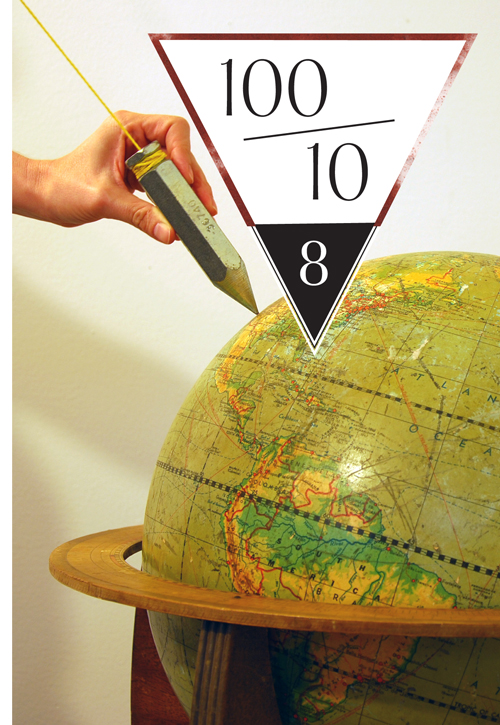
For this eighth iteration of the Institute of Cultural Inquiry’s ambitious project 100/10, showcasing ten curatorial visions over 100 business days, Rise Industries co-founders Jeremy J. Quinn and Michele Jaquis begin at the heart of the Institute’s idiosyncratic, evocative holdings. There, two objects lie. One, an industrial Acroprint clock, matter-of-factly clicks off comings and goings according to some indeterminate time zone. The other, a globe, renders Earth as a miniaturized perfect sphere, its pasted political boundaries frozen in time and encased in a grid of latitude and longitude. Both imply—and miss—so much.

Quinn and Jaquis take playful measure of the Institute’s phantom worlds, their gravitational pulls, the ebbs and flows of personal narratives lapping at the ICI collections’ contours. Anachronistic time-keeping devices. A faded 1961 Triple-A Trip-Tik presages Jaquis’ from her 2000 cross-country relocation to Los Angeles. Glass slides of images precipitate a kaleidoscopic sense of déjà vu’s possibilities for mis-(re)cognition: uncannily, Michele can mistake these for those taken by her twin sister, Nicole, in India. Expanding upon these moments of “knowing better,” the curators explore the slippages in our concepts of distance and time, in relation to the ICI collection, ICI’s location in Southern California, the geographic sprawl of their collaborators in Los Angeles, Boston, India, and our absolute/ relative position in the Cosmos.

A unique catalogue accompanies this exhibition and extends the Institute’s thinking on W.G. Sebald. Modeled on the New Museum’s catalog for its 2008 landmark show After Nature, 100/10 catalogues exist as a dustcover enfolding a slightly used copy of a book that has influenced the show’s curators. The 100/10∆8 catalog, wrapped around Umberto Eco’s The Island of the Day Before, may be purchased in the ICI gift shop or through the ICI website.

Multidisciplinary artist Jeremy J. Quinn works in installation, video, sound, sculpture, printmaking, photography, and environmental graphics. Trained as an architect, Jeremy looks at spaces in terms of hidden structure or geometries, as well as how they are inhabited and manipulated by people. He is fascinated by the many complex systems of daily life, and tries to find order and clarity beneath the chaos we inhabit. He has focused most recently on interrogating the meaning and representation of landscape, using video and installation to build alternate landscapes in “Mountain” and “Anza-Borrego Expanded Landscape”, and through sound in “Transference”. Jeremy received a Master of Architecture degree from the Southern California Institute of Architecture, and a Bachelor of Science from the University of Hartford, where he studied architecture and sculpture. He is currently a project manager at Pablo Maida Architect in Santa Monica, CA.

Interdisciplinary artist and educator Michele Jaquis examines the complexities within personal relationships, identity, language and communication through video, installation, performance and digital imagery. She earned her MFA in sculpture from Rhode Island School of Design in 2000 and her BFA in sculpture and experimental studio with a minor in psychology from Hartford Art School/University of Hartford in 1997. Her work has been presented in galleries, museums, film festivals, conferences, and alternative spaces through the US and in Australia, Canada, Ireland and New Zealand. Recent awards include a 2011 Otis College Faculty Development Grant, 2011 Creative Capacity Fund’s Next Gen Arts Leader Professional Development Grant, 2009 Vermont Studio Center Artists Residency Grant, and 2008 Director’s Chair Film Festival Best Documentary Award. She is currently Assistant Professor and Director of Interdisciplinary Studies at Otis College of Art and Design in Los Angeles.

Rise Industries Collaborators:

Sarah Rushford is a multimedia artist, designer, and arts administrator living in Boston, MA. She earned her BFA from Hartford Art School in 1998 and MA in Media Studies from The New School in 2001. As a multimedia artist she is currently working in writing, video and alternative print processes, and has recently completed a residency at TAKT Kunstprojektraum in Berlin. Her work has been exhibited in Boston, New York, Los Angeles and Berlin and has upcoming exhibitions at Massachusetts College of Art and Design and the Worcester Art Museum. With previous experience as a Media Arts Teacher and Media Literacy Coordinator, Sarah recently founded Circadia, a web design and production company for artists, small businesses and non-profits. She is also an Assistant in Institutional Research at MassArt and has been a member of Axiom Center For New and Experimental Media in Boston.

Tim Devin is an artist based in Somerville, MA, whose work deals with humanizing public space, and combating the negative effects of urban anonymity. Tim’s projects have involved community, public space, books, zines, maps, walking tours, and giving things away for free. He has shown his projects around Boston and the U.S. as well as in a number of different countries. Since early 2011, Tim has also been a board member of the Somerville Arts Council.

Mike Feldman is an LA-based pianist, composer, and sound mixer. His work spans many genres including jazz, funk, electronic, classical, and experimental. He explores the process of improvisation and its correlation to the subconscious mind, as well as the relationship between sound and image. He is also very interested in the varying frequencies and amplitudes to which the air molecules around his head are vibrating at any given moment. Mike holds a Bachelor of Music from the Hartt School, in Hartford, CT where he studied Music Production Technology and Jazz Piano. He is currently a staff audio editor at Sony Pictures, and is co-owner of audio post-production company Boxing Nuns. He is keyboardist for LA funk band Cousin Junebug.

Nicole Jaquis is a new media artist and teacher, committed to empowering others to utilize various multimedia technologies to explore and share personal stories, ideas, differences and commonalities, in the pursuit of transcending both geographical and cultural boundaries. Since 2001 Nicole has split her time between New York and Northern India, while documenting the Naga Sadhus and Sadhvis of Juna Akhara, (the largest and oldest organization of Shiva worshiping Hindu ascetics). As a founding member of Projectile Arts based in Brooklyn, she was an Associate Producer for their documentary, Take Me to the River. She is now the Founder and Director of Aesthetics With Cameras, which provides multimedia services, tools and training to Juna Akhara. Nicole has a BA in Photography and Philosophy from Lake Forest College; has completed graduate level coursework in Educational Multimedia Development at Harvard University and in Photography at International Center for Photography. Her photographs and videos have been exhibited through out New York, New England, and India.

John Kim is a Los Angeles-based conceptual artist, who works with a variety of media to question everyday assumptions and rethink the manners in which we interact with our world. His process is exploratory and often highly whimsical. If asked to summarize his work, he’d likely say he’s “still trying to figure out this art thing,” and “I am not a very serious person but I do take art very seriously… I think”. John Kim received his BFA from Otis College of Art and Design and his MFA from California Institute of the Arts.

Boris Margolin is a computer programmer, writer, and musician.  His focus is on structures, physical or abstract, that embody information in unexpected ways.  Boris earned a Bachelor’s degree in Mathematics from Simon’s Rock College and a Master’s degree in Computer Science from the University of Massachusetts Amherst, where he focused on security protocol analysis and design. He lives in Jamaica Plain, Massachusetts and is the chief technologist of a small financial services company.

Beginning January 31, 2011 and running for 100 consecutive business days, the ICI site and its archives is undergoing a multitude of interpretations. ICI has invited ten researchers-artists, writers, and visual thinkers-to set into play ideas that blend contemporary visual practices with aspects of the ICI Earth Cabinet, Ephemera Kabinett, and a 2,500+ volume library along with the nooks and crannies of the eclectic, historically layered ICI space. With two weeks to conceive of their vision, curators will work in a designated laboratory modeled upon the transparent workspaces of 19th-century natural history museums. Each curator will conceptualize a new trajectory through ICI’s body, transforming the ICI display by the end of their residency. 100/10 project participants to date have included ∆1: Alex Harvey with Anna Ayeroff; ∆2: Antoinette LaFarge with Ruth Coppens; ∆3: Norway Nori; ∆4: Karen Frimkess Wolff and Paul W. Evans; ∆5: Pam Posey with Christine Nguyen; ∆6: Christel Dillbohner with Inge Kamps; as well as ∆7: Christian Smith and Rosie Woodward Smith.

Since 1991, the Institute of Cultural Inquiry (ICI) has explored the role of visuality in imagining, perpetrating and perpetuating the intangible and ever-changing phenomena known as “culture.” The ICI sponsors displays, symposia, workshops, performances and provides numerous opportunities for both the artist fabricator and the curious spectator of visual culture. The non-profit organization also maintains an active publishing program, releasing the critically acclaimed Searching for Sebald: Photography After W. G. Sebald in 2007. 100/10 is the first project conceptualized within the 2011-12 ICI study theme of Phantom Worlds.

Purchase catalog for 100/10∆8.
Read more about the complete 100/10 project.

100/10∆7 Press Release

100/10∆7: Christian Smith and Rosie Woodward Smith

One Day Event – Saturday May 28, 2011
Free to the public
From 1-7pm, visitors are invited to
collaborate and intervene in tactical activities
Reception from 7-9pm

LOCATION
1512 S. Robertson Blvd., Los Angeles, CA 90035
(two blocks south of Pico); street parking available


For the seventh iteration of the Institute of Cultural Inquiry’s ambitious project 100/10 (100 days/10 visions), peripatetic curators Rosie Woodward Smith and Christian Smith enlist visitors in an urban forensic caper to map newfound cartographies between the Institute and its surroundings.  Where history attempts to reveal (or conceal and distort) patterns of causality, the pair deploys the Institute’s vast trove of visual technologies to construct a display that serves as a two-way conduit. “Voices will find their way in,” they say. “Questions will find their way out.  Images and messages will grow their own legs to walk the streets, be posted on walls, thrown in the trash.”

On May 28th, visitors are invited to trawl a square-block area around the ICI, plumbing a microcosm of the city grid for evidence—moments and phenomena, serendipitous coincidences of people, places, and things. A specially designated guest plinth will display selections from these foraging expeditions over the course of the day. The curators have also reconfigured the ICI laboratory space into a workshop for creating posters from the text and images generated in the first weeks of their residency. They will be printing on recycled t-shirts that visitors may bid upon with payment in the form of a reciprocal exchange: services, monies, and/or objects. At twilight the curators will discuss their process. An open microphone will allow guest poets and thinkers to hold forth on the curators’ working theme of ‘life as a mirror.’

A unique catalogue accompanies this exhibition.  Modeled on the New Museum’s catalog for its 2008 landmark show After Nature, catalogues for the 100/10 shows exist as a dustcover enfolding a slightly used copy of a book that has influenced the show’s curator and artist. The 100/10∆7 catalog, wrapped around Italo Calvino’s Invisible Cities, may be purchased in the ICI gift shop or through the ICI website.

Artist and architectural psychologist Rosie Woodward Smith was born to Trotskyist parents in England’s industrial midlands.  She has dissertated upon graffiti as a counter-cultural response to advertising, worked with acclaimed interactive theatre group Punchdrunk, produced workshops with Hackney Quest to enable young people to create pieces of spoken word performance, designed theatrical storefront installations, and advocated for prisoners’ freedom of expression.

Christian Smith mines the pedestrian potential of Los Angeles, California, after extended peregrinations through London, Berlin, Istanbul, and San Francisco. Smith’s formative years were spent in Germany, England, Toronto, and a yellow-tinged dreamscape. Committed to the intersections of sound, theatre, and writing, Smith has acted in experimental films, published photo-editorial pieces in Istanbul, and exhibited in London, most recently in a group show entitled Luxury Goods: The Price of Art.

Smith and Woodward Smith, with the assistance of award-winning street photographer Ima Kuroda, are in the midst of an ongoing photography and mapping project, Walking LA, that encourages communities to assemble collections of detail and motif to say something about their own specific locale.  In recasting the street as a museum, a place to contemplate the inner beauty of the objects found there, the artists hope to provoke a deeper awareness in ordinary people concerning their immediate environment.

—–

Beginning January 31, 2011 and running for 100 consecutive business days, the ICI site and its archives is undergoing a multitude of interpretations. ICI has invited ten researchers-artists, writers, and visual thinkers-to set into play ideas that blend contemporary visual practices with aspects of the ICI Earth Cabinet, Ephemera Kabinett, and a 2,500+ volume library along with the nooks and crannies of the eclectic, historically layered ICI space. With two weeks to conceive of their vision, curators will work in a designated laboratory modeled upon the transparent workspaces of 19th-century natural history museums. Each curator will conceptualize a new trajectory through ICI’s body, transforming the ICI display by the end of their residency. 100/10 project participants have included ∆1: Alex Harvey with Anna Ayeroff; ∆2: Antoinette LaFarge with Ruth Coppens; ∆3: Norway Nori; ∆4: Karen Frimkess Wolff and Paul W. Evans; ∆5: Pam Posey with Christine Nguyen; as well as ∆6: Christel Dillbohner with Inge Kamps.

—–

Since 1991, the Institute of Cultural Inquiry (ICI) has explored the role of visuality in imagining, perpetrating and perpetuating the intangible and ever-changing phenomena known as “culture.” The ICI sponsors displays, symposia, workshops, performances and provides numerous opportunities for both the artist fabricator and the curious spectator of visual culture. The non-profit organization also maintains an active publishing program, releasing the critically acclaimed Searching for Sebald: Photography After W. G. Sebald in 2007. 100/10 is the first project conceptualized within the 2011-12 ICI study theme of Phantom Worlds.

Purchase catalog for 100/10∆7.
Read more about the complete 100/10 project.
100/10∆5 Press Release

100/10∆5: Pam Posey and Christine Nguyen at the Institute of Cultural Inquiry (ICI)

April 19 – May 15, 2011
Free to the public

Reception: Saturday, May 7th, 7-9pm
Curator’s Talk: Sunday, May 15th, 4-5pm

LOCATION
1512 S. Robertson Blvd., Los Angeles, CA 90035
(two blocks south of Pico); street parking available


The Institute of Cultural Inquiry is pleased to announce the fifth iteration of its ambitious project 100/10 (100 days/10 visions), a collaboration between Los Angeles-based curator/artist Pam Posey and artist Christine Nguyen. Fascinated by the Institute’s fantastical Earth Cabinet, a monolithic oak chest that houses hundreds of soil samples from far-flung (and sometimes unverifiable) locales, Posey and Nguyen de-mystify the processes by which the study of the natural world–the analyses, taxonomies, methodologies, and institutional edifices that comprise the cultural production of Scientific Knowledge–transforms into a tenuously stable parafiction demanding both skepticism and belief. Their installation alludes to this study of an elusive empirical world by collapsing the scientist’s universe of purported facts and the confabulist’s arena of the fictive.

Posey has taken up a totemic line from Paul Harding’s Tinkers: “Shadows leaked out from beneath the edge of the forest.”  In the “overgrown forest” of the Institute’s extensive holdings accumulated over its two decades, Posey asks, how do phantom worlds leak out from the real world, casting shadows of doubt upon its seeming veracity? In this shadow-play, both tinkerers will place their own art–individual and collaborative–alongside natural objects and ICI artifacts; the installation will change daily over the course of the residency.  A unique catalog will accompany this exhibition.  Modeled upon the New Museum’s catalog for its 2008 landmark show After Nature, catalogs for the 100/10 shows exist as a dustcover wrapped around a slightly used copy of a book that has influenced the show’s curator and artist. The 100/10∆5 catalog, housing Harding’s Tinkers, may be purchased in the ICI gift shop or through the ICI website.

Pam Posey is a Los Angeles-based artist who received her BA from Bennington College and her MFA from the University of Massachusetts. She has had solo exhibitions at Craig Krull Gallery, and her work has been included in group exhibitions at Andrewshire Gllery, Carl Berg Gallery, Domestic Setting, and the Torrance Art Museum.

Christine Nguyen currently resides in Los Angeles, California. She received her B.F.A from California State University, Long Beach and M.F.A from University of California, Irvine. Her solo exhibitions have been featured at the Hammer Museum (Project), Michael Kohn Gallery, Andrewshire Gallery, and Sam Lee Gallery in Los Angeles. Her work has also been included in group exhibitions at the Kunsthalle zu Kiel, Kiel, Germany; Laguna Beach Art Museum, Laguna Beach; 4-F Gallery, Los Angeles, PH Gallery, New York; San Art, Ho Chi Minh City, Vietnam; Sprueth Magers Projekte, Munich, Germany; and 10 Chancery Lane Gallery, Hong Kong.

Posey and Nguyen have been known to hike together in the Sierra Mountains. They make extremely slow progress because of their tendency to tinker with nature along the way. Nguyen’s work with salt causes her to spend time at oceans and salt flats while Posey investigates rogue urban gardens. Nguyen also composes and sings her own songs while Posey collects found sounds, both natural and urban, on her iPhone.

—–

Beginning January 31, 2011 and running for 100 consecutive business days, the ICI site and its archives will undergo a multitude of interpretations. ICI has invited ten researchers—artists, writers, and visual thinkers—to set into play ideas that blend contemporary visual practices with aspects of the ICI Earth Cabinet, Ephemera Kabinett, and a 2,500+ volume library along with the nooks and crannies of the eclectic, historically layered ICI space. With just two weeks to conceive of their vision, curators will work in a designated laboratory modeled upon the transparent workspaces of 19th-century natural history museums. Each curator will conceptualize a new trajectory through ICI’s body, transforming the ICI display by the end of their residency.100/10project participants have included ∆1: Alex Harvey with Anna Ayeroff, ∆2: Antoinette LaFarge with Ruth Coppens, ∆3: Norway Nori as well as ∆4: Karen Frimkess Wolff and Paul Evans.

—–

Since 1991, the Institute of Cultural Inquiry (ICI) has explored the role of visuality in imagining, perpetrating and perpetuating the intangible and ever-changing phenomena known as “culture.” The ICI sponsors displays, symposia, workshops, performances and provides numerous opportunities for both the artist fabricator and the curious spectator of visual culture. The non-profit organization also maintains an active publishing program, releasing the critically acclaimed Searching for Sebald: Photography After W. G. Sebald in 2007. 100/10 is the first project conceptualized within the 2011-12 ICI study theme of Phantom Worlds.

Purchase catalog for 100/10∆5.
Read more about the complete 100/10 project.
100/10∆6 Press Release

100/10∆6: Christel Dillbohner and Inge Kamps at the Institute of Cultural Inquiry (ICI)
One Day Event – Wednesday April 27, 2011
1-5 p.m.; no reservations required.
Free to the public

LOCATION
1512 S. Robertson Blvd., Los Angeles, CA 90035
(two blocks south of Pico); street parking available


For the sixth iteration of the Institute of Cultural Inquiry’s ambitious project 100/10 (100 days/10 visions), curator-artist Christel Dillbohner has opened doorways to parts of the ICI that are rarely seen or addressed. At the center of her vision is Köln-based artist Inge Kamps’ Vom Licht der Natur, a research based exploration into the natural world utilizing processes that mirror Dillbohner’s own experiences as an organic gardener and collector of medicinal and edible plants. Kamps uses a transformative process to transmute her focused observations into a special “sight,” thereby enabling her to collect and represent the colorful essences of light within a garden’s verdant realm. For this one-day exhibition, we are introduced to Kamps’ unique process through a series of abstract color photos and time-lapse videos. Dillbohner, a long-time associate of the Institute, has chosen to nestle Kamps work within the shadowy corners of the ICI to animate the artist’s alchemical leanings with the organization’s substantial holdings of alchemical texts; treatises by masters like Hermes Trismegistus, Albertus Magnus and Paracelsus, the latter being a philosopher Kamps is particularly drawn to.

A unique catalog will accompany this exhibition. Modeled on the New Museum’s catalog for its 2008 landmark show, After Nature, the document exists as a dustcover wrapped around a slightly used book that has influenced the show’s curator and artist. For 100/10∆6, the book is Mediziner Heiler Philosoph by Paracelsus. It can be purchased in the ICI gift shop or through the ICI website.


Christel Dillbohner is an art practitioner whose engagement with cultural and natural studies has informed her art of process painting, assemblage, and site-specific installations for over 30 years. Originally from Cologne, Germany, she now lives and works in Berkeley, California. She has traveled widely and publishes her ‘sojournal’ observations in small editions.  Recent projects include An den Ufern der Zeit (2007), Ice Floe (2009) and the collaborative installation Interspacing (2010). Her website is www.dillbohner.de.

Inge Kamps, a native of Cologne, Germany, is a painter, photographer and video artist who investigates social phenomena and the natural world and believes the role of the artist includes participating in the cultural discourse. She founded the artists’ collective “Künstler auf dem Hagengelände e.V.” (1988) and is a curator with a handful of  projects including PaarWeise (1987), Lob des Schattens (1998), and Drittes Ufer ( 2003). Among her large-scale video installations are Babel (1994), Made in Kalk (1998), and Zeit-Wände VII (2003). Her website is www.kamps-lab.de

—–

Beginning January 31, 2011 and running for 100 consecutive business days, the ICI site and its archives will undergo a multitude of interpretations. ICI has invited ten researchers—artists, writers, and visual thinkers—to set into play ideas that blend contemporary visual practices with aspects of the ICI Earth Cabinet, Ephemera Kabinett, and a 2,500+ volume library along with the nooks and crannies of the eclectic, historically layered ICI space. With just two weeks to conceive of their vision, curators will work in a designated laboratory modeled upon the transparent workspaces of 19th-century natural history museums. Each curator will conceptualize a new trajectory through ICI’s body, transforming the ICI display by the end of their residency.100/10 project participants have included ∆1: Alex Harvey with Anna Ayeroff, ∆2: Antoinette LaFarge with Ruth Coppens, ∆3: Norway Nori as well as ∆4: Karen Frimkess Wolff and Paul Evans. ∆5: Pam Posey will begin on April 11, 2011 and will run for 5 consecutive weeks.

—–

Since 1991, the Institute of Cultural Inquiry (ICI) has explored the role of visuality in imagining, perpetrating and perpetuating the intangible and ever-changing phenomena known as “culture.” The ICI sponsors displays, symposia, workshops, performances and provides numerous opportunities for both the artist fabricator and the curious spectator of visual culture. The non-profit organization also maintains an active publishing program, releasing the critically acclaimed Searching for Sebald: Photography After W. G. Sebald in 2007. 100/10 is the first project conceptualized within the 2011-12 ICI study theme of Phantom Worlds.

Purchase catalog for 100/10∆6.
Read more about the complete 100/10 project.

100/10∆3 Press Release

100/10∆3: Norway Nori

Launching April 11, 2011

Robert Smithson has become an important figure in my working life, not because I depend on him in any way, but because his work allows me a conceptual space where I can often reside. Artists don’t talk about this very much, because it’s extremely difficult to describe. It’s like an incredible excitement and attraction across time; a personal repartee with another’s thinking and energy communicated through their work.

—Tacita Dean

 
Robert Smithson has dirtied my sheets, his shards of glass are always ending up in my arse whenever I sit up in my conceptual bed.  I’ve spent most of my time in the studio trying to coax him out of my head by concocting the most elaborate traps that never seem to work.

—Norway Nori

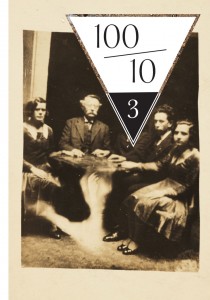
Artist and spectral geneticist Norway Nori has focused on the ICI collaborator’s list for his contribution to 100/10. On April 1, 2011, Nori will send a brief e-questionnaire to a select group of individuals. Abiding by the ICI’s ‘rule of 100,’ Nori has selected 100 people who have in some way collaborated or interacted with the organization over its 20-year history.

Although we often willingly acknowledge the artists and thinkers whom we emulate, we often hide from view or discussion the creative forces crowding our conceptual bed, an artist to whom our work is continually likened, a theorist we continually try to hide in a footnote who is brought to center stage by members of a peer review or an insistent interlocutor at a public lecture. We all carry an artist, a scholar, a public figure as a thorn in our side. If, as Tacita Dean states, the artists we admire create the conceptual space in which we ply our craft, Nori believes the artists and scholars we dislike, disavow, or try to discredit, are the ones who more often direct our actions, create our paths, unmake our comfortable artistic bed.

Nori also believes groups of people coalesce around shared “intruders,” that a more silent, hidden genealogy binds groups of people together (“the façade of shared interests is a ruse”). Even though a collection of ICI practices may not reveal an essential core activity or sensibility, uncanny overlaps and resonances trace out an intellectual warren of shared closets. Nori builds on Ludwig Wittgenstein’s concept of “family resemblances,” wherein things that appear to be connected by a common feature may in fact be connected by a series of overlapping similarities, where no one feature is common to all. Dubbing his process spectral genetics, Nori intends to build the ICI’s phantom “family tree” from the answers on the collaborator’s questionnaires.

The questionnaire is an amalgamation of popular diagnostic tests including the Minnesota Multiphasic Personality Inventory (MMPI-2), the Rorschach Ink Blot Test, the Myers Briggs Personality Test, and a simple genetic screening questionnaire you might fill out in a doctor’s office. It includes such questions as: “Do you like animals?”, “Do you lock your apartment or house at night?” and “what is the brand name of your comfort food?” Together, the questions create a raucous narrative that hints at an endless stream of interpretations. All invitees to the survey will receive a one-year “Mesmer” membership to the Institute of Cultural Inquiry.

Nori’s final report will be published as an insert to his 100/10∆3 catalog. This unique publication features a dustcover “catalog” that wraps around a slightly used book of the artist’s choice. Nori has chosen Ludwig Wittgenstein: The Blue and Brown Books thereby revealing one of his own family “roots.” The 100/10∆3 catalog will be available through our gift shop beginning June 1, 2011.

—–

Since 1991, the Institute of Cultural Inquiry (ICI) has explored the role of visuality in imagining, perpetrating and perpetuating the intangible and ever-changing phenomena known as “culture.” The ICI sponsors displays, symposia, workshops, performances and provides numerous opportunities for both the artist fabricator and the curious spectator of visual culture. The non-profit organization also maintains an active publishing program, releasing the critically acclaimed Searching for Sebald: Photography After W. G. Sebald in 2007. 100/10 is the first project conceptualized within the 2011-12 ICI study theme of Phantom Worlds.

Purchase catalog for 100/10∆3.
Read more about the complete 100/10 project.

100/10∆4 Press Release

100/10∆4: Karen Frimkess Wolff and Paul W. Evans at the ICI

April 11-24, 2011
Hours: Thurs. – Sat  12- 5 pm; by reservation via website

Reception: April 16th; 4-6 pm; Artist Talk 5pm.
Free to the public; suggested $5 donation

LOCATION:
1512 S. Robertson Blvd. , Los Angeles, CA 90035
(two blocks south of Pico); street parking available


For this fourth iteration of the Institute of Cultural Inquiry’s ambitious project 100/10 (100 days/10 visions), curator-artist Karen Frimkess Wolff and artist Paul W. Evans invite us to “Consider A Path (passing fragments, as much as human understanding may grasp).”  Enriched by the ICI’s extensive collection of books and ephemera for the blind and inflected by Frimkess Wolff’s experience teaching art and art history at the Los Angeles Braille Institute, the pair presents a protean, phantasmic landscape of sight, touch, and sound that traverses personal intention and public participations, knowing and acting, thinking and willing.  How do we apprehend and convey ourselves through worlds, real and imagined?

From a single sheet of iron-on eyes once destined for foster-child dolls, Evans has multiplied the eye images, lifting them onto structures that evoke seeing and seers, scenarios of watchers and watching. Multiple calls to myriad visions—a dense tangle of potential sight lines—confound the classic white gallery space’s imperative of legible display. A laboratory space probes visitors’ sense of touch against the resonant backdrop of Frimkess Wolff’s interactive bell lines.

A unique catalog will accompany this exhibition.  Modeled upon the New Museum’s catalog for its 2008 landmark show After Nature, catalogs for the 100/10 shows exist as a dustcover wrapped around a slightly used copy of a book that has influenced the show’s curator and artist. The 100/10∆4 catalog, housing E.E. Cummings’ Enormous Room, may be purchased in the ICI gift shop or through the ICI website. A reception and curator’s talk will be held on Sat., April 16, 2011, 4-6 p.m.

Beginning January 31, 2011 and running for 100 consecutive business days, the ICI site and its archives will undergo a multitude of interpretations. ICI has invited ten researchers—artists, writers, and visual thinkers—to set into play ideas that blend contemporary visual practices with aspects of the ICI Earth Cabinet, Ephemera Kabinett, and a 2,500+ volume library along with the nooks and crannies of the eclectic, historically layered ICI space. With just two weeks to conceive of their vision, curators will work in a designated laboratory modeled upon the transparent workspaces of 19th-century natural history museums. Each curator will conceptualize a new trajectory through ICI’s body, transforming the ICI display by the end of their residency. 100/10 project participants to date have included ∆1: Alex Harvey with Anna Ayeroff, ∆2: Antoinette LaFarge with Ruth Coppens as well as ∆3: Norway Nori.

Karen Frimkess Wolff is a Los Angeles-born artist whose drawings, constructions, and sound installations have been exhibited extensively in California, throughout the United States and in Germany.  A recipient of the Los Angeles Cultural Affairs Grant in 1991, she was also one of thirty Americans nominated for the 1976 Paris Bienniele.

Paul W. Evans [www.pweny.com] has exhibited widely throughout the United States and in England at such venues as Artists Space, New York, the Brooklyn Museum of Art, and Gasworks, London.  Re-placing found images in specific painted environments, his work explores the tension between originality and reproduction, the infinitely reproducible photocopy and the singular act of painting.

—–

Since 1991, the Institute of Cultural Inquiry (ICI) has explored the role of visuality in imagining, perpetrating and perpetuating the intangible and ever-changing phenomena known as “culture.” The ICI sponsors displays, symposia, workshops, performances and provides numerous opportunities for both the artist fabricator and the curious spectator of visual culture. The non-profit organization also maintains an active publishing program, releasing the critically acclaimed Searching for Sebald: Photography After W. G. Sebald in 2007. 100/10 is the first project conceptualized within the 2011-12 ICI study theme of Phantom Worlds.

Purchase catalog for 100/10∆4.
Read more about the complete 100/10 project.

100/10∆2 Press Release

100/10∆2: Antoinette LaFarge with Ruth Coppens: “Evidence of Evidence”

March 7-25, 2011
Hours: Thurs. – Sat.  12- 5 pm; by reservation via website

Reception: March 20th, 2-5 pm; Reading 3 pm. 
LaFarge reads selections from her research.
Free to the public; suggested $5 donation

LOCATION:
1512 S. Robertson Blvd. , Los Angeles, CA 90035
(two blocks south of Pico); street parking available


For “Evidence of Evidence,” curators Antoinette LaFarge and Ruth Coppens probe the relationships between evidence, information and the archive as they unearth lost connections within the Institute of Cultural Inquiry’s large body of eclectic holdings. Although researchers typically proceed with some idea of what they want to find out—a hypothesis to ask, a theory to test—LaFarge and Coppens have left it to the ICI archive to offer them a prompt. The nature of archival materials is to be presumptively evidential: but of what? “How do we walk the long road between origins and conclusions,” LaFarge asks, “to what extent do we derail ourselves and our successors by what we ourselves create and leave behind?” Documenting the process of excavation and its results, LaFarge and Coppens seize upon this residue to stir the archive’s memories, forge missing links and remember forgotten relationships.  The 100/10∆2 catalog, housing Lewis Hyde’s Trickster Makes this World, may be purchased in the ICI gift shop or through the ICI website. 

Antoinette LaFarge is an artist-writer engaged with mapping the terrain where deception, actuality, and enactment come into conflict with notions of authenticity and authority. Her areas of activity include mixed-reality performance, interactive installation, avatar improvisation, and fictive art. Recent projects include WISP (World-Integrated Social Proxy) (2010), Hangmen Also Die (2010), World of World (2009), and Playing the Rapture (2008-09). In the 1990s she founded one of the first net-based performance troupes, the Plaintext Players. She has co-curated two groundbreaking exhibitions on computer games and art: “SHIFT-CTRL” in 2000 and “ALT+CTRL” in 2003, both at UC Irvine, where she is Professor of Digital Media in the Studio Art department. Her projects website is www.forger.com, and her blog is www.artisallwehave.com.

Ruth Coppens is a writer of historically inflected fiction and poetry. Of Flemish descent, she grew up in Brussels and London before moving to the United States, where she now lives. She earned a bachelor’s degree in history from the University of Liège in 2008 and then worked as a research asssistant for Veilinghuis Bernaerts (Antwerp) and Le Claire Kunsthandel (Hamburg). She has published her work in Versal, Thema, Palooka, and elsewhere and is presently working on a book of short writings, Meander.

—–

“Evidence of Evidence” is the second iteration of its ambitious project 100/10 (100 days/10 visions). Beginning January 31, 2011 and running for 100 consecutive days, the ICI site and its archives will undergo a multitude of interpretations. ICI has invited 10 visual researchers to set into play ideas that blend contemporary visual practices with aspects of the ICI Earth Cabinet, Ephemera Kabinett, and a 2,500+ volume library inside the eclectic and historically layered ICI space. With just two weeks to conceive of their vision, each curator will conceptualize a new trajectory through the ICI’s corpus, transforming the ICI display by the end of their residency.

—–

Since 1991, the Institute of Cultural Inquiry (ICI) has explored the role of visuality in imagining, perpetrating and perpetuating the intangible and ever-changing phenomena known as “culture.” The ICI sponsors displays, symposia, workshops, performances and provides numerous opportunities for both the artist fabricator and the curious spectator of visual culture. The non-profit organization also maintains an active publishing program, releasing the critically acclaimed Searching for Sebald: Photography After W. G. Sebald in 2007. 100/10 is the first project conceptualized within the 2011-12 ICI study theme of Phantom Worlds.

Purchase catalog for 100/10∆2.
Read more about the complete 100/10 project.