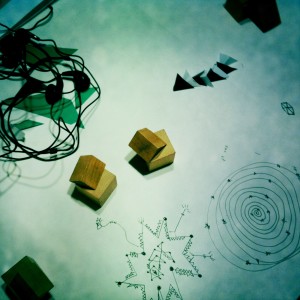
Available Cache Boxes

All measurements are in inches (length x width  x height):

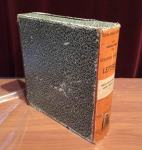
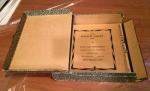
  1.  old cardboard film case (14.5 x 14.5 x 2)
  2.  old cardboard film case (14.5 x 14.5 x 2)
    cache1and2-inside cache1and2-outside
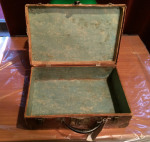
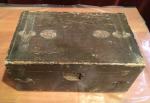
  3.  cardboard suitcase (15.5 x 10 x 4.5)
    cache3-outside cache3-inside
  4. cardboard suitcase (11 x 8.5 x 4)
    cache4-outside cache4-inside
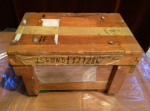
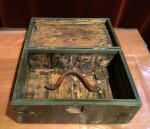
  5.  wooden box from Lockheed – used to transport ‘sensitive object’ (12 x 7 x 7)
  6.  wooden box from Lockheed – used to transport ‘sensitive object’ (12 x 7 x 7)
  7.  wooden box from Lockheed – used to transport ‘sensitive object’ (12 x 7 x 7)cache5_6_7-outside cache5_6_7-inside
  8.  wooden box (8.5 x 7.5 x 7)
    cache8-inside
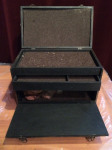
  9.  large box with drawer and top tray (15 x 8.5 x 10.5)
    cache9-outsidecache9-inside
  10.  letter organizer with binder ring (11.5 x 10 x 2.5)
    cache10-outside cache10-inside
  11.  wooden box (13.5 x 8.5 x 6)
    cache11-outside cache11-inside
  12.  large oversized box (20 x 10 x 12)
  13.  traditional doctor’s bag (12 x 4.5 x 5)
    cache13
  14.  wooden box with four slots (7.5 x 9.5 x 5.5)
    cache14-outside cache14-inside
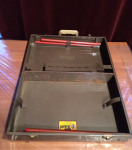
  15.  metal suitcase with legs inside that fold out to make a table (18 x 11 x 6)
    cache15-outsidecache15-insidecache15-legscache15-table
  16.  something you have of equal size and appearance (please check with us in advance)
  17.  something you have of equal size and appearance (please check with us in advance)
  18.  something you have of equal size and appearance (please check with us in advance)
  19.  something you have of equal size and appearance (please check with us in advance)
  20.  something you have of equal size and appearance (please check with us in advance)

RESERVATION DEADLINE: ASAP until all are reserved.
CACHE CONTENT LIST DEADLINE: December 31, 2014


LIBRARY DISPLAY: A Fool’s Journey

ICI-BLOGfool_card2-wICI-BLOGfool_card-w

A Fool’s Journey

Selections from the ICI Library and Ephemera Kabinett

September 1 – October 12, 2014.

Throughout human history, the persona of the fool and his mythological equivalent, the trickster, has played an essential role in culture: the role of change.  In his book Trickster Makes This World (1998),Lewis Hyde describes the trickster as a boundary-crosser, the one with the license to question and challenge boundaries. The trickster will confuse the distinction between right and wrong, scared and profane, clean and dirty, male and female, young and old, living and dead. S(he) is the creative idiot, the wise fool, the gray-haired baby, the cross-dresser, and the speaker of sacred profanities.

TRICKSTER IN EVERY CULTURE

In mythology, the Fool/Trickster might be related to Loki (Norse), Anansi (West African- Akan), Fudugazi (Zulu), Baubo (Greek), and Bes (Egyptian), to name a few. The Fool lives outside of society, he walks between worlds, and that gives him both an advantage in what he can say and do, but also a disadvantage, as he is an outsider. In Yoruba mythology, Eshu is both the guardian of thresholds and crossroads, and the entity we must honor any time we cross a threshold (e.g. our front door) or reach a crossroad in our lives. Not all tricksters are male; the Tibetan Khandroma‘s are female tricksters and shape-shifters. They travel together in the clouds, usually as part of a rainbow. They mess with the weather and they are especially famous for playing tricks on the heroes of folktales to test their heroic qualities. The lessons delivered by mythological tricksters are sometimes cruel, and sometimes gentle and funny, but always necessary to our growth as human beings.

THE FOOL in THE TAROT

In the Tarot, the card of ‘The Fool’ is either left unnumbered or ascribed to zero. It’s names include ‘Il Matto’ in old Italian packs (from Latin ‘mattus – ‘stupefied, senseless‘), ‘Le Mat’ or ‘Le Fol’ in French decks, and in a 17th century list of Latin titles the card is called ‘Stultus’ also meaning ‘Fool’. He is the archetypal medieval jester-fool, a personage who exists outside the laws and codes of normal life. In the most extreme sense he is a madman, a vagrant, and an impoverished wanderer. His place in the tarot is paradoxical for the card can either stand at the beginning or end of the series. Likewise in the old game of Tarot he is called the ‘Excuse’ (in gaming the card is known as the ‘Sckis’ or ‘Skus’) and can be played instead of following suits or ‘trumping’, in defiance of the customary order of values.

TRICKSTER AS LIMINAL FIGURE

The trickster is often found at the liminal zone at the edge of civilization, the place inhabited by hunters, criminals, religious hermits, herdsmen, and others who frequent the margins of human activity. For instance, a popular representation of the trickster is the wild man (also wildman, or “wildman of the woods,” known today as the werewolf). Wild men can be identified by the thick coat of hair covering their bodies. At the same time, they often have the breasts and chins of females, and a mixture of animal and human body parts. In Slavic mythology, a wild man named Leshy appears as a tall man with unruly hair and beard and is sometimes depicted with a tail, hooves, and horns. He shares an attribute with the Fool in the Tarot deck – he carries a stick or wand – to express that he is the master of wood. He has blue blood, which gives his cheeks a blue tinge.

Legend tells us the trickster is often betrayed by her or his feet. In Leshy’s case, he wears his shoes on the wrong feet, or puts them on facing backwards or, in many cases, has one foot that is not human at all; a cloven hoof betrays his ambiguous (animal/man; good/evil) trickster nature.

TRICKSTER AND LANGUAGE

To play with culture and non-culture is by definition to play with semiosis and language; the Trickster is a semiotic tour de force. (S)he speaks the language of animals, dreams, visions, and gods or spirits; (s)he embodies the Other, the inarticulate, (s)he recites the unsayable, and lies with the unknowable. The creator of culture, the Trickster, is not only used to recount etiological myths in order to provide the origins of names of animals and objects, but his or her actions are often the source of cultural habits and rituals.

ARTISTS AS TRICKSTERS

Even in societies that have temporarily mislaid their Trickster-god, the role persists, often assumed by artists, musicians, or poets. The trickster and the artist both challenge the status quo. One of the most salient features of the trickster is that (s)he forces a change in the narrative when the story has gotten stuck in a groove. The artist, like the fool or trickster, is the destroyer of our well-ordered world and the creator of a new one.

LIBRARY DISPLAY: A Book by Any Other Name

library

   A Book by Any Other Name

On display in the Library and Terri Valli Trotter Study Room

February 10 – April 30, 2014

The making of books is a process that straddles the line between fine art and craftsmanship. It can create both what we know and think of as ‘books’ – two covers, hard or soft, with a range of pages sandwiched in between – or it can diverge entirely and take the form of the sculptural, the conceptual, the ‘in-between’ or the ‘none of the above.’

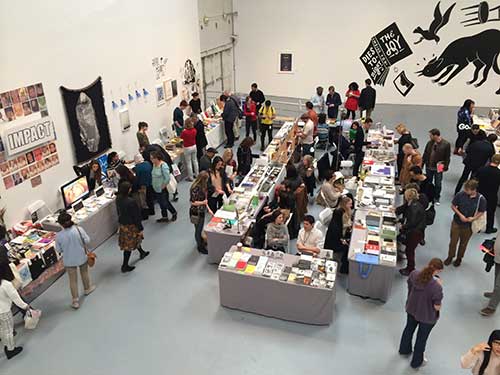
Following our recent involvement in the 2nd annual LA Art Book Fair (hosted by Printed Matter), the Institute of Cultural Inquiry is proud to present a curated display of handmade artist books, books about books from the Institute’s library and unique collections that celebrate the making of unique book art objects.

Featured artists on display include Dorothy Royer, Leslie Corrigan, Janet Klein, Pam Posey, Deborah Cullen, and the Museum of Forgery, among others.


GUEST EDITORS SOUGHT FOR ICI PRESS

ICIP-admin_icon-w

CALL FOR GUEST EDITORS/CURATORS

The ICI Press is seeking guest editors and/or curators for two upcoming books in its long-standing ‘eye’ series. These compilations will join Bataille’s Eye (1997) and Benjamin’s Blind Spot (2001) as projects that examine theoretical texts that have remained on university syllabi in a variety of vision-based disciplines even though they are often characterized as problematic and outdated. Why do these works continue to occupy privileged positions? Does our allegiance to their teachings create blind spots in our thinking or do they exist outside of time or pop agendas as unique catalysts to ever-evolving thought ?

ICIP-BTplay_cards-wROLAND BARTHES’ CAMERA LUCIDA

With a mix of scholarly texts and artist projects, the first publication will examine Camera Lucida, Roland Barthes’ book on photography. Our goal is to consider the content of Barthes’ book, characterized as ‘flawed, impossible, infuriating, and moving’ even in its day but also its symmetrical and ‘photographic’ (postive/negative) book design that has been subject to as many ‘translations’ as the text. We imagine some proposals where Barthes is omnipresent while in others he might be nothing but a ghostly presence. Camera Lucida evokes strong emotions in its readers; we hope to create a book of equal passion. We are seeking a guest editor and a guest curator for this project but will also consider candidates that feel they are qualified and able to commit to both positions.

3 liubolin2ROGER CAILLOIS’ “MIMICRY AND LEGENDARY PSYCHASTHENIA”
The second book project will unpack Roger Caillois’ seminal essay “Mimicry and Legendary Psychasthenia.” Caillois has cycled in and out of contemporary thinking with cultural escorts that were unimaginable when the essay was first published. Written in the height of surrealism, Caillois could not imagine the degree to which his ideas would be tested with the ‘Ghost Army’ of WW II. And recently, Caillois’ theories have come back into play as theorists and practitioners explore challenges to vision brought on by the Internet. Given Caillois’ multi-disciplinary interests, we imagine a project that reaches across disciplines not only in the range of its scholarly texts but also in its visual contributions and in the design of the final book form. We are seeking a guest editor/curator with an adventurous spirit although we will not rule out editor/curator teams or collaborative groups.

A $1000 honorarium is available for each publication (to be split, if there are separate editors/curators) along with multiple copies of the finished book and/or deluxe artist edition planned for each publication. Guest Editor duties are outlined here.

Please send a letter outlining your interest in either project along with a current cv, a writing sample, and examples of, or links to, relevant past work to info@culturalinquiry.org. We will begin the interview process on March 1, 2014 and will continue until we find the right candidate.


LIBRARY DISPLAY: Guen Hors

Geuen Hors

ICI-BLOGgeuen_horse-w

 On display in the Library and Terri Valli Trotter Study Room September 30 2013 – January 31 2014


“Trojan Horse” “Gift-Horse” “Horseplay” “If wishes were horses…” “Straight from the horse’s mouth”

Though they no longer function as an element of day-to-day life for most people, the horse lives on as  a metaphor for everything from free presents to wishful thinking, to hidden invaders, and beyond. Stemming from the realm of double entendre, ‘the trickster,’ and the playfulness of things ‘hidden in plain sight,’ Geuen Hors pays tribute to the many ‘horses’ that have surfaced at the ICI over the last twenty years.

Ranging from large scale installation to miniature painting, items on display include ‘gifted’ works by Mungo Thomson, Pam Posey, Danny Redfern, Arnaldo Morales, Terri Valli Trotter, the Museum of Forgery, Axel Forrester, Martin Gantman, Deborah Paulsen, John Galt, Yolande Macias Mckay, George Herms, and Sophie Calle (among others), as well as a collection of ‘anonymous gifts’ left behind in books, on shelves, under tress, and in the other shadow spaces of the ICI.

A full map of the items on display can be downloaded here.

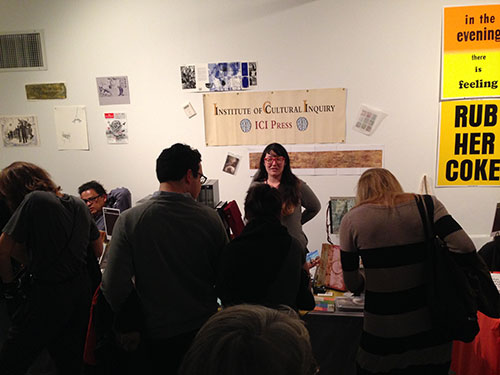
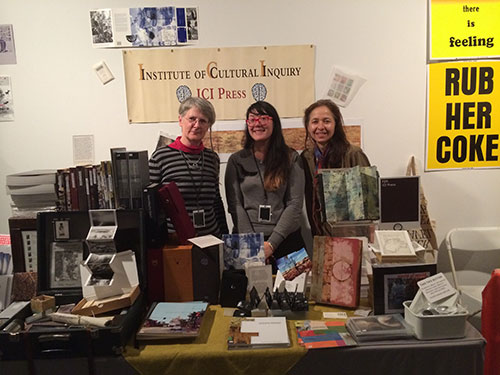
ICI Press at L.A. Art Book Fair in February 2014

ICIP-GIFTla_art_bookfair-w


Join ICI Press at the
2nd Annual LA Art Book Fair
at the Geffen Contemporary at MOCA

January 30 – February 2, 2014
Friday, 11— pm
Saturday, 12—6 pm
Sunday, 11—6 pm
Preview, Thursday, January 30, 6—9 pm ($10 entrance fee)

Visit us at Booth # F29

This event is free and open to the public.

The LA Art Book Fair is a unique event for artists’ books, catalogs, monographs, periodicals and zines presented by more than 250 presses, artists, and independent publishers from 19 countries.

For more information about our participation in the event contact us at info@culturalinquiry.org. For information abut the fair and tickets to the Thursday night preview, please visit the fair website: www.laartbookfair.net

Visualist-in-Residence Project

ICI-PROJ100_10_5_lab-w

Due to space limitations, VIR applications for 2016 are currently not being accepted. This project may resume in 2017.

The VIR residency offers local artists, art theorists, writers, and other culture producers an environment that is oriented towards knowledge production through its well-equipped study and production facilities. Resources include a 3,000-volume library; an Ephemera Kabinett that contains cultural residue from the last 100 years; a collection of arcane visual tools or their handbooks (sometimes both); and a unique physical site with its own collection of phantom histories and secrets. 

Froebel Star Folding

We are looking for adventurous ‘visualists’ to help us ‘theorize the materials’ or ‘materialize the theories’ of the various processes of knowledge production that are ‘visually orchestrated.’ These are activities that interrogate and extend current conceptions of ‘studio-based research’ as they are being extolled in the academy.

Some of the features of the Residency include:

The VIR laboratory is available for residencies lasting between 1-4 weeks. We can only offer a work space at this time (no live-in) but access is 24/7 to accommodate residents who have a ‘day job’ or other demands on their time during ICI’s normal business hours.

At the very least, each resident will arrive with a single question to jump-start her or his visual research but, more often, the resident arrives with a project already underway that will benefit from an investigatory period at the ICI.

The Institute will provide limited manpower and, at time,  financial assistance. We will also facilitate partnerships with a roster of highly skilled ICI Associates and supporters to enrich the VIR residency experience.

The VIR quarters will be open to the public as part of regularly scheduled ICI tours at least one Saturday per month (depending on the concurrent ICI project) and/or by appointment.

The Resident will interact with the ICI staff and/or Associates on a regular basis to discuss the Resident’s work, either through meetings or online interactions,

At the end of the residency, the VIR will be encouraged to summarize their research processes and findings during some type of recorded discussion with ICI staff and/or associates. This exchange might include an interview, a non-verbal demonstration, an exchange on social media, or some other recorded form based on the scope and range of the residency.

In addition to ‘documenting’ their residency on the ICI’s website, the Resident will also be asked to create a material trace of their tenure to be placed in a special box that will become a part of the ICI repository.

VIR Residents have included:
Julene Paul, Spring 2012
Jared Neilsen, Summer 2012
Greg Cohen, Winter 2012-13
Christel Dillbohner, Spring 2013
Martin Gantman, Winter 2013
Maya Gurantz, Summer 2014
Anna Ayeroff, Summer-Fall 2014
Jaime Knight, Fall 2014
Amy Kaczur, Spring 2015
Christopher Handran, Summer 2015

Find more information about the VIR Project at http://www.culturalinquiry.org/blog/activities/2014-visualist-in-residence-project
or email us at info@culturalinquiry.org