

Category: Activities
Protected: Associate Point System
Protected: Legal Documents
Press Release
Mit dem anderen Blick
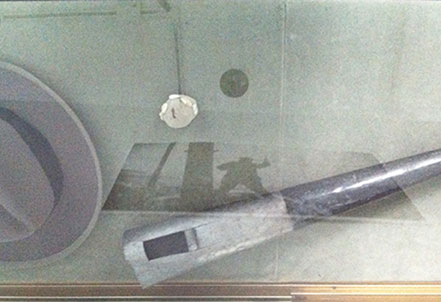
May 18, 2013, 6:00 – 8:00 pm
At the Institute of Cultural Inquiry
Presentation and Discussion will begin at 6:30pm
The Institute of Cultural Inquiry (ICI) presents Mit dem anderen Blick, a public presentation of our current Visualist-in-Residence, Christel Dillbohner’s practice-based research at the ICI.
The ICI’s “Visualist-in-Residence” (VIR) program offers artists, art theorists, writers, and other visual researchers and culture producers a chance to participate in studio-based visual research in a richly layered and mutable environment. The VIR ‘laboratory’ may function as an artist’s studio, a writing room, a space for gathering data or a quiet space for evaluation and contemplation depending on the needs of each individual project. At the Institute, VIRs are actively encouraged to expand current definitions of visual research and to borrow freely from ICI research practices as they develop aspects of their project in one or more of the following areas: Field work and Data Acquisition; Research and Analysis; Manipulation and Experimentation; Knowledge Transmission and Production; and Public Presentation and Publication. At the end of each residency, the VIRs are invited to present their ‘research’ in a public event/discussion session.
Christel Dillbohner’s VIR workspace and the materials associated with her findings will remain on display (by appointment only via info@culturalinquiry.org) until May 25, 2013. New applications for the Institute of Cultural Inquiry’s VIR program are being accepted through May 31, 2013. To apply, please send a detailed letter of interest to info@culturalinquiry.org.
All ICI public programs are free. Prompt arrival prior to program time is recommended. For questions regarding Mit dem anderen Blick or other ICI events, please contact info@culturalinquiry.org.
Press Release
Valaco in Babel
An evening with Visualist-in-Residence, Greg Cohen

April 13, 2013, 6:00 – 8:00 pm
At the Institute of Cultural Inquiry
Presentation and Discussion will begin at 7pm
The Institute of Cultural Inquiry (ICI) presents Valaco in Babel, a public presentation of our current Visualist-in-Residence, Greg Cohen’s practice-based research at the ICI.
Functioning as a window into visual practice, Valaco in Babel will commence with a self-guided studio visit where the images, objects, and ideas produced during Cohen’s residency at the ICI can be viewed. This will be followed by a session where Cohen, the founder of REASArch (the Group for Research on Experimental Accumulation and Speculative Archives), will discuss aspects of his work within the group’s current project, The Valaco Archive. During this time, guests will also be introduced to the project’s digital component (currently under construction) as a means to familiarize the public with the material and conceptual components of the archive as it continues to evolve.
Using the questionable limitations of ‘the archive’ as a jumping point, The Valaco Archive project endeavors to produce, assess, catalog, and interpret the evidential record and trajectory of an extraordinary, if indeterminate historical persona, Roberto Constantín Valaco, through exploratory visual research. Born Robert Konstanz Wälke, Valaco first surfaced as the putative author of an enigmatic manuscript found in Buenos Aires in 2004 before indications linked him to the identity of an extra in Veit Harlan’s Kolberg, the last and costliest film of the Third Reich. Working speculatively with a complex assortment of elements–visual, textual, material, conceptual—Cohen efforts during his residency at the ICI and beyond aspire to (re-) construct a memory that would unearth the densely sedimented imagery of Valaco’s existence.
The ICI’s “Visualist-in-Residence” (VIR) program offers artists, art theorists, writers, and other visual researchers and culture producers a chance to participate in studio-based visual research in a richly layered and mutable environment. The VIR ‘laboratory’ may function as an artist’s studio, a writing room, a space for gathering data or a quiet space for evaluation and contemplation depending on the needs of each individual project. At the Institute, VIRs are actively encouraged to expand current definitions of visual research and to borrow freely from ICI research practices as they develop aspects of their project in one or more of the following areas: Field work and Data Acquisition; Research and Analysis; Manipulation and Experimentation; Knowledge Transmission and Production; and Public Presentation and Publication. At the end of each residency, the VIRs are invited to present their ‘research’ in a public event/discussion session.
Greg Cohen’s VIR workspace and the materials associated The Valaco Archive project will remain on display (by appointment only via info@culturalinquiry.org) until April 19, 2013. New applications for the Institute of Cultural Inquiry’s VIR program are being accepted through May 31, 2013. To apply, please send a letter of interest to info@culturalinquiry.org.
All ICI public programs are free. Prompt arrival prior to program time is recommended. For questions regarding Valaco in Babel or other ICI events, please contact info@culturalinquiry.org.
Associates

ICI Associates help guide and steer the Institute by assisting in the planning, implementation, and archiving of ICI projects and events. In addition to their Institute tasks, Associates spearhead their own projects. As artists, writers, scientists, and other culture workers, their work investigates, defines, and utilizes visual culture. While not Institute projects per se, the range and depth of the Associate projects attests to the vast interests of the ICI.
Phantom Worlds – ICI Research and Publication Theme for 2011-2014

The ICI is pleased to announce the launch of Phantom Worlds a long-term research theme prompted by a growing cultural interest in worlds that double, mirror and reflect our own. We anticipate a number of significant exhibitions or performances built around this theme, some of which will develop through curatorial projects and at least one that will culminate in our fourth book through ICI press, Barthes’ Myopia.
Phantom Worlds
Phantom worlds can be duplicate worlds but not necessarily alternate universes; they are ones that exist beside our own. We seek out places where these phantom worlds leak and bleed through, where they can be seen or can’t be seen but can be sensed. Our theme grows from our fascination with reflections – with twins, with Dopplegangers, with invisible friends. Is it the phantom one talks to when talking to oneself? And what about worlds written by other beings, by animals, by objects. Sometimes these worlds can only be sensed through a shiver down our spine or a row of goosebumps on our thigh. Phantom Worlds play with our attraction to mirrors, our fascination with reflections, with our feelings of déjà vu, deja connu, deja trouve, something that has already happened, was already known, someone you feel you’ve already met. Phantoms are located where the familiar becomes strange, jamais vu, or within a world of slips – presque vu. We are intrigued by photography’s ability to ‘notice’ these phantom worlds and we wonder if our world is photography’s phantom, not the other way around. We think these phantom worlds might be the places of dreams. We hope to find pathways to their playgrounds, to visit them often, to share their wisdom while keeping the secrets of their most cherished tomes—The Unsayable and The Unsaid. It is said that phantoms follow us, here at the ICI, for a while yet undesignated, we will follow them.
Projects that have emerged within the Phantom Worlds theme include the 100/10 (100 days/10 visions) research-based exhibitions and Speculative Pentimenti: Painting in an Age of Endarkenment.
Past Display – A Museum of Infinite Possibilities
A Museum of Infinite Possibilities
February 25 – April 15, 2012
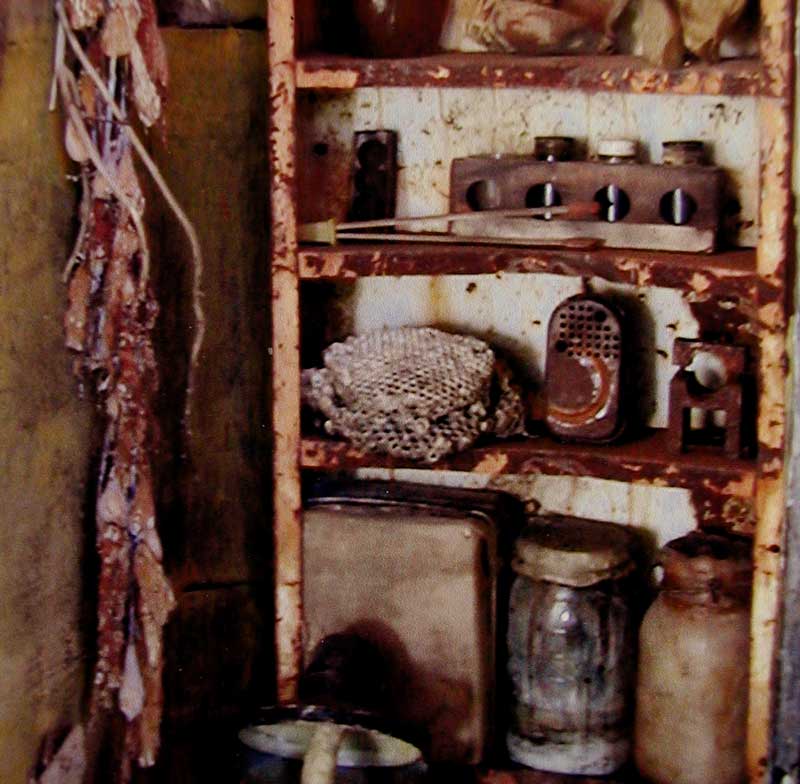
“I am familiar with the surface of things…Fraying, tattered, cracked, flattened, swollen, dried, scrawny, bristling, moldy, clenched, tangled, punctured, battered, bashed-in, scooped-out, withered, engorged, trampled, toppled, crushed, bald, listing, leaning, twisting hanging, buried, wedged, jammed, impaled, straggling, stretched, disjointed, disembowled, skinned, docked, gnawed, entrenched.” (Rosamond Purcell, Owl’s Head: On the Nature of Lost Things, Quantuck Lane Press, NY, NY, 2003, p. 29)
Inspired by Rosamond Purcell’s imagined museums, the ICI opened the drawers to its Ephemera Kabinett and invited the public to unleash its many secrets.
Museum of Obsolete Tools
Museum of Wires
Museum of the Croquet and Musket Ball
Museum of Natural Disasters
Museum of Ruined Landscapes
Museum of Failed Attempts
Museum of Filthy Mail
Museum of Bisected Objects
Museum of Corrosion
Visitors had the opportunity to suggest new categories for the ICI’s Ephemera Kabinett database (“fraying, moldy, trampled, skinned, withered”) as they re-arranged objects from the archive into ever-changing, new ‘museum collections.’
SPECULATIVE PENTIMENTI Press Release
Speculative Pentimenti: Painting in an Age of Endarkenment
May 5 – 26, 2012
Opening Reception:
Saturday, May 5, 7-9 pm
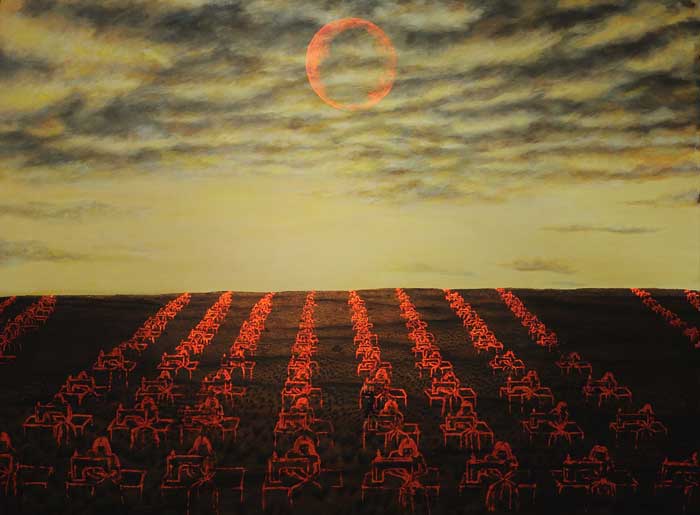
We are living through a dark age. An age of, if you like, endarkenment—and I don’t necessarily mean that negatively. The world is aflood with dark psychic fluid, everything’s stained with it. – Michael Ventura
Working within the framework of our 2012 research theme of phantom worlds and fueled by our long-held belief that all human activities leave behind a visual trace, the Institute of Cultural Inquiry (ICI) is proud to present Speculative Pentimenti, a visual exploration of contemporary society presented through the work of artist and longtime ICI associate Sande Sisneros.
Marrying the detail of Northern Renaissance landscape painting and the immersive and dramatic lighting changes of the theater, Speculative Pentimenti uses visual narratives to express the hidden politics of a world that lies beyond our immediate realm of vision. Using light-sensitive pigments and inverted lighting and optics within the display space, large-scale oil paintings of uninhabited landscapes and disjointedly dramatic skies give way to a tracery of haunting visual narratives that reveal hidden “realities” lurking just below the painted surfaces. Here, a once serene ocean becomes a cesspool of trash while an uninhabited poppy field suddenly turns to menacing scene of war. These ghostly speculations appear in the dark to relay their messages, but then fade back into oblivion when the light comes back on. Both stages or “worlds” are ever present but viewers can never completely see both at the same time thus entangling the two in the visual centers of our brains and the shadow of our memories.
It is through this performative nature that the works express the artist’s true intention, to inspire change through the use of inventive pentimenti. In the world of forms, pentimenti (Italian for remorse or change) evoke x-rays, night vision, and the visual traces of hallucinogens while in art history their study is a recuperative act, a look back to a painting’s origins or an artist’s first intentions. Here, Sisneros uses these ghostly structures to look ahead, to imagine a future where the hidden politics of the world no longer lie beyond our immediate realm of vision but rather become glowingly apparent.
The duality of these images question what we see and (more importantly) what we often times don’t see or choose not to see. Is seeing really believing? Are truth and perception the same? And equally, what are the boundaries of our existence? In exploring these questions, viewers are left to form their own answers and reveal some form of “light” from the “darkness.”
Sande Sisneros is an internationally exhibited, self-taught artist whose works are featured in prominent private collections around the world. Over the course of her career, Sisneros’ works have challenged our connections to sight, memory, nature and the unknown. Speculative Pentimenti brings these elements together to further engage the limits of our reality.
For more information about the show:info@culturalinquiry.org
Mind the Gap Exhibition at Kent Gallery

A clandestine photograph of TRANSIT co-founder Evelyn Farny as she performs the world premiere of “Panorama” by composer Angélica Negrón on Thursday, February 2, 2012 at Kent Gallery in New York City. She also performed pieces by Alexandra Gardner, Caroline Shaw, and György Ligeti.
The works by Hans Haacke and Charles Gaines on the walls behind her are part of “Mind the Gap,” a Kent Gallery exhibition inspired by the ICI’s book Searching for Sebald with works that ‘operate between and within signs in order to discover, tease out, and make manifest meaning that is neither obvious nor orthodox.’ The Gaines piece (right) draws its inspiration from Georges Bataille, the subject of the ICI’s first full-length publication. These ‘Sebaldian’ moments no longer surprise us. But we were inspired by the full-length exhibition catalog produced solely for the internet. We applaud this impulse to remove commodity from acts of thought.
The exhibition, which includes work by Joseph Beuys, Walid Raad, Mark Lombardi, Alfredo Jaar, Heide Fasnacht and others, runs until February 25, 2012