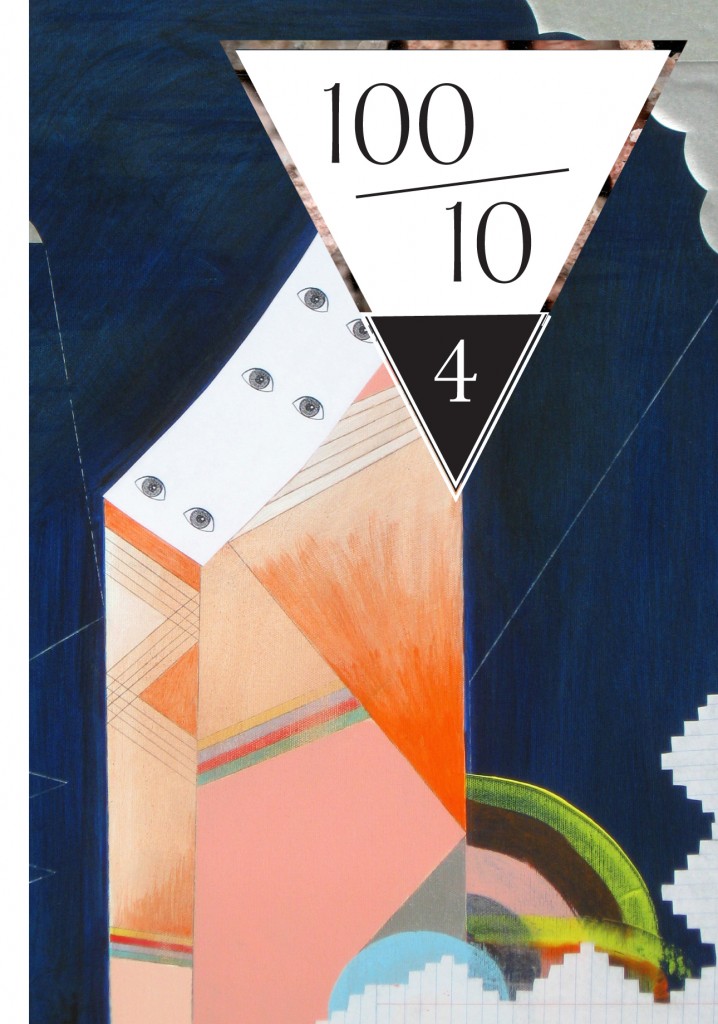
100/10∆4 Catalog

The Catalog for the 100/10/04 project is adapted from E.E. Cummings’ Enormous Room  by Karen Frimkess-W0lff, curator of this iteration of the 100/10 project.

The catalogs for the 100/10 (100 days/10 visions) project are an homage to many of the ICI’s favorite people and things: W. G. Sebald, his poem After Nature, The New Museum in New York. Modeled on that museum’s catalog for their 2008 exhibition After Nature, this book also owes allegiance to Aby Warburg (1866-1929). Under the dustcover you’ll find a “good neighbor,” a book that impacted the curator of this project iteration (and so, a different title for each participant) even though that book’s influence may not be immediately apparent in the exhibition photos that are sprinkled within its pages. Warburg, lamenting the possible loss of open stacks in public libraries, argued that when looking for a desired book on a library shelf it is often its neighbor that first draws your attention, its good neighbor that holds the answer you are seeking.

This catalog can be purchased in the ICI gift shop for $25.

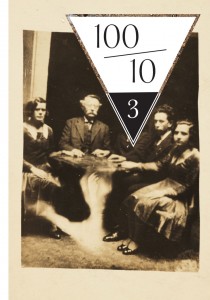
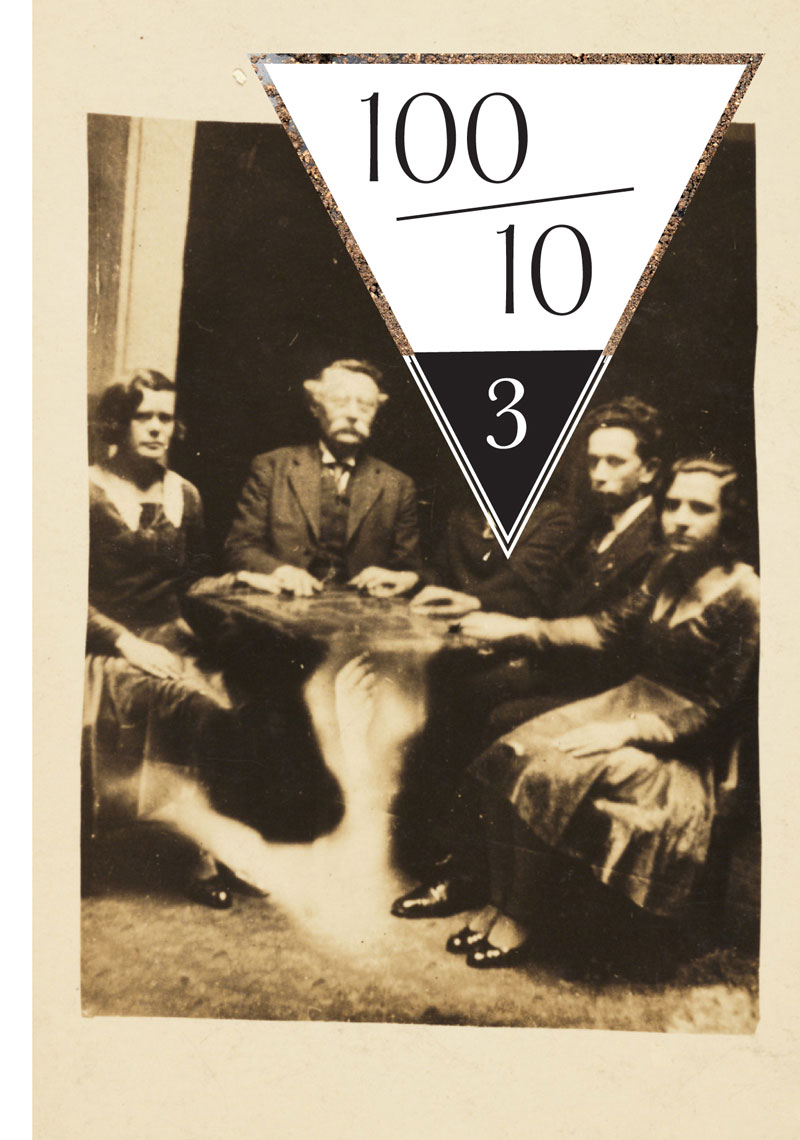
100/10∆3 Catalog

The catalogs for the 100/10 (100 days/10 visions) project are an homage to many of the ICI’s favorite people and things: W. G. Sebald, his poem After Nature, The New Museum in New York. Modeled on that museum’s catalog for their 2008 exhibition After Nature, this book also owes allegiance to Aby Warburg (1866-1929). Under the dustcover you’ll find a “good neighbor,” a book that impacted the curator of this project iteration (and so, a different title for each participant) even though that book’s influence may not be immediately apparent in the exhibition photos that are sprinkled within its pages. Warburg, lamenting the possible loss of open stacks in public libraries, argued that when looking for a desired book on a library shelf it is often its neighbor that first draws your attention, its good neighbor that holds the answer you are seeking.

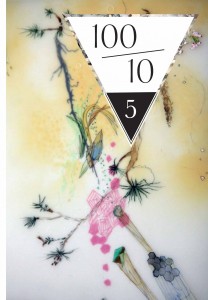
100/10∆5 Press Release

100/10∆5: Pam Posey and Christine Nguyen at the Institute of Cultural Inquiry (ICI)

April 19 – May 15, 2011
Free to the public

Reception: Saturday, May 7th, 7-9pm
Curator’s Talk: Sunday, May 15th, 4-5pm

LOCATION
1512 S. Robertson Blvd., Los Angeles, CA 90035
(two blocks south of Pico); street parking available


The Institute of Cultural Inquiry is pleased to announce the fifth iteration of its ambitious project 100/10 (100 days/10 visions), a collaboration between Los Angeles-based curator/artist Pam Posey and artist Christine Nguyen. Fascinated by the Institute’s fantastical Earth Cabinet, a monolithic oak chest that houses hundreds of soil samples from far-flung (and sometimes unverifiable) locales, Posey and Nguyen de-mystify the processes by which the study of the natural world–the analyses, taxonomies, methodologies, and institutional edifices that comprise the cultural production of Scientific Knowledge–transforms into a tenuously stable parafiction demanding both skepticism and belief. Their installation alludes to this study of an elusive empirical world by collapsing the scientist’s universe of purported facts and the confabulist’s arena of the fictive.

Posey has taken up a totemic line from Paul Harding’s Tinkers: “Shadows leaked out from beneath the edge of the forest.”  In the “overgrown forest” of the Institute’s extensive holdings accumulated over its two decades, Posey asks, how do phantom worlds leak out from the real world, casting shadows of doubt upon its seeming veracity? In this shadow-play, both tinkerers will place their own art–individual and collaborative–alongside natural objects and ICI artifacts; the installation will change daily over the course of the residency.  A unique catalog will accompany this exhibition.  Modeled upon the New Museum’s catalog for its 2008 landmark show After Nature, catalogs for the 100/10 shows exist as a dustcover wrapped around a slightly used copy of a book that has influenced the show’s curator and artist. The 100/10∆5 catalog, housing Harding’s Tinkers, may be purchased in the ICI gift shop or through the ICI website.

Pam Posey is a Los Angeles-based artist who received her BA from Bennington College and her MFA from the University of Massachusetts. She has had solo exhibitions at Craig Krull Gallery, and her work has been included in group exhibitions at Andrewshire Gllery, Carl Berg Gallery, Domestic Setting, and the Torrance Art Museum.

Christine Nguyen currently resides in Los Angeles, California. She received her B.F.A from California State University, Long Beach and M.F.A from University of California, Irvine. Her solo exhibitions have been featured at the Hammer Museum (Project), Michael Kohn Gallery, Andrewshire Gallery, and Sam Lee Gallery in Los Angeles. Her work has also been included in group exhibitions at the Kunsthalle zu Kiel, Kiel, Germany; Laguna Beach Art Museum, Laguna Beach; 4-F Gallery, Los Angeles, PH Gallery, New York; San Art, Ho Chi Minh City, Vietnam; Sprueth Magers Projekte, Munich, Germany; and 10 Chancery Lane Gallery, Hong Kong.

Posey and Nguyen have been known to hike together in the Sierra Mountains. They make extremely slow progress because of their tendency to tinker with nature along the way. Nguyen’s work with salt causes her to spend time at oceans and salt flats while Posey investigates rogue urban gardens. Nguyen also composes and sings her own songs while Posey collects found sounds, both natural and urban, on her iPhone.

—–

Beginning January 31, 2011 and running for 100 consecutive business days, the ICI site and its archives will undergo a multitude of interpretations. ICI has invited ten researchers—artists, writers, and visual thinkers—to set into play ideas that blend contemporary visual practices with aspects of the ICI Earth Cabinet, Ephemera Kabinett, and a 2,500+ volume library along with the nooks and crannies of the eclectic, historically layered ICI space. With just two weeks to conceive of their vision, curators will work in a designated laboratory modeled upon the transparent workspaces of 19th-century natural history museums. Each curator will conceptualize a new trajectory through ICI’s body, transforming the ICI display by the end of their residency.100/10project participants have included ∆1: Alex Harvey with Anna Ayeroff, ∆2: Antoinette LaFarge with Ruth Coppens, ∆3: Norway Nori as well as ∆4: Karen Frimkess Wolff and Paul Evans.

—–

Since 1991, the Institute of Cultural Inquiry (ICI) has explored the role of visuality in imagining, perpetrating and perpetuating the intangible and ever-changing phenomena known as “culture.” The ICI sponsors displays, symposia, workshops, performances and provides numerous opportunities for both the artist fabricator and the curious spectator of visual culture. The non-profit organization also maintains an active publishing program, releasing the critically acclaimed Searching for Sebald: Photography After W. G. Sebald in 2007. 100/10 is the first project conceptualized within the 2011-12 ICI study theme of Phantom Worlds.

Purchase catalog for 100/10∆5.
Read more about the complete 100/10 project.

100/10∆6 Press Release

100/10∆6: Christel Dillbohner and Inge Kamps at the Institute of Cultural Inquiry (ICI)

One Day Event – Wednesday April 27, 2011
1-5 p.m.; no reservations required.
Free to the public

LOCATION
1512 S. Robertson Blvd., Los Angeles, CA 90035
(two blocks south of Pico); street parking available


For the sixth iteration of the Institute of Cultural Inquiry’s ambitious project 100/10 (100 days/10 visions), curator-artist Christel Dillbohner has opened doorways to parts of the ICI that are rarely seen or addressed. At the center of her vision is Köln-based artist Inge Kamps’ Vom Licht der Natur, a research based exploration into the natural world utilizing processes that mirror Dillbohner’s own experiences as an organic gardener and collector of medicinal and edible plants. Kamps uses a transformative process to transmute her focused observations into a special “sight,” thereby enabling her to collect and represent the colorful essences of light within a garden’s verdant realm. For this one-day exhibition, we are introduced to Kamps’ unique process through a series of abstract color photos and time-lapse videos. Dillbohner, a long-time associate of the Institute, has chosen to nestle Kamps work within the shadowy corners of the ICI to animate the artist’s alchemical leanings with the organization’s substantial holdings of alchemical texts; treatises by masters like Hermes Trismegistus, Albertus Magnus and Paracelsus, the latter being a philosopher Kamps is particularly drawn to.

A unique catalog will accompany this exhibition. Modeled on the New Museum’s catalog for its 2008 landmark show, After Nature, the document exists as a dustcover wrapped around a slightly used book that has influenced the show’s curator and artist. For 100/10∆6, the book is Mediziner Heiler Philosoph by Paracelsus. It can be purchased in the ICI gift shop or through the ICI website.


Christel Dillbohner is an art practitioner whose engagement with cultural and natural studies has informed her art of process painting, assemblage, and site-specific installations for over 30 years. Originally from Cologne, Germany, she now lives and works in Berkeley, California. She has traveled widely and publishes her ‘sojournal’ observations in small editions.  Recent projects include An den Ufern der Zeit (2007), Ice Floe (2009) and the collaborative installation Interspacing (2010). Her website is www.dillbohner.de.

Inge Kamps, a native of Cologne, Germany, is a painter, photographer and video artist who investigates social phenomena and the natural world and believes the role of the artist includes participating in the cultural discourse. She founded the artists’ collective “Künstler auf dem Hagengelände e.V.” (1988) and is a curator with a handful of  projects including PaarWeise (1987), Lob des Schattens (1998), and Drittes Ufer ( 2003). Among her large-scale video installations are Babel (1994), Made in Kalk (1998), and Zeit-Wände VII (2003). Her website is www.kamps-lab.de

—–

Beginning January 31, 2011 and running for 100 consecutive business days, the ICI site and its archives will undergo a multitude of interpretations. ICI has invited ten researchers—artists, writers, and visual thinkers—to set into play ideas that blend contemporary visual practices with aspects of the ICI Earth Cabinet, Ephemera Kabinett, and a 2,500+ volume library along with the nooks and crannies of the eclectic, historically layered ICI space. With just two weeks to conceive of their vision, curators will work in a designated laboratory modeled upon the transparent workspaces of 19th-century natural history museums. Each curator will conceptualize a new trajectory through ICI’s body, transforming the ICI display by the end of their residency.100/10 project participants have included ∆1: Alex Harvey with Anna Ayeroff, ∆2: Antoinette LaFarge with Ruth Coppens, ∆3: Norway Nori as well as ∆4: Karen Frimkess Wolff and Paul Evans. ∆5: Pam Posey will begin on April 11, 2011 and will run for 5 consecutive weeks.

—–

Since 1991, the Institute of Cultural Inquiry (ICI) has explored the role of visuality in imagining, perpetrating and perpetuating the intangible and ever-changing phenomena known as “culture.” The ICI sponsors displays, symposia, workshops, performances and provides numerous opportunities for both the artist fabricator and the curious spectator of visual culture. The non-profit organization also maintains an active publishing program, releasing the critically acclaimed Searching for Sebald: Photography After W. G. Sebald in 2007. 100/10 is the first project conceptualized within the 2011-12 ICI study theme of Phantom Worlds.

Purchase catalog for 100/10∆6.
Read more about the complete 100/10 project.
100/10∆3 Press Release

100/10∆3: Norway Nori

Launching April 11, 2011

Robert Smithson has become an important figure in my working life, not because I depend on him in any way, but because his work allows me a conceptual space where I can often reside. Artists don’t talk about this very much, because it’s extremely difficult to describe. It’s like an incredible excitement and attraction across time; a personal repartee with another’s thinking and energy communicated through their work.

—Tacita Dean

 
Robert Smithson has dirtied my sheets, his shards of glass are always ending up in my arse whenever I sit up in my conceptual bed.  I’ve spent most of my time in the studio trying to coax him out of my head by concocting the most elaborate traps that never seem to work.

—Norway Nori

Artist and spectral geneticist Norway Nori has focused on the ICI collaborator’s list for his contribution to 100/10. On April 1, 2011, Nori will send a brief e-questionnaire to a select group of individuals. Abiding by the ICI’s ‘rule of 100,’ Nori has selected 100 people who have in some way collaborated or interacted with the organization over its 20-year history.

Although we often willingly acknowledge the artists and thinkers whom we emulate, we often hide from view or discussion the creative forces crowding our conceptual bed, an artist to whom our work is continually likened, a theorist we continually try to hide in a footnote who is brought to center stage by members of a peer review or an insistent interlocutor at a public lecture. We all carry an artist, a scholar, a public figure as a thorn in our side. If, as Tacita Dean states, the artists we admire create the conceptual space in which we ply our craft, Nori believes the artists and scholars we dislike, disavow, or try to discredit, are the ones who more often direct our actions, create our paths, unmake our comfortable artistic bed.

Nori also believes groups of people coalesce around shared “intruders,” that a more silent, hidden genealogy binds groups of people together (“the façade of shared interests is a ruse”). Even though a collection of ICI practices may not reveal an essential core activity or sensibility, uncanny overlaps and resonances trace out an intellectual warren of shared closets. Nori builds on Ludwig Wittgenstein’s concept of “family resemblances,” wherein things that appear to be connected by a common feature may in fact be connected by a series of overlapping similarities, where no one feature is common to all. Dubbing his process spectral genetics, Nori intends to build the ICI’s phantom “family tree” from the answers on the collaborator’s questionnaires.

The questionnaire is an amalgamation of popular diagnostic tests including the Minnesota Multiphasic Personality Inventory (MMPI-2), the Rorschach Ink Blot Test, the Myers Briggs Personality Test, and a simple genetic screening questionnaire you might fill out in a doctor’s office. It includes such questions as: “Do you like animals?”, “Do you lock your apartment or house at night?” and “what is the brand name of your comfort food?” Together, the questions create a raucous narrative that hints at an endless stream of interpretations. All invitees to the survey will receive a one-year “Mesmer” membership to the Institute of Cultural Inquiry.

Nori’s final report will be published as an insert to his 100/10∆3 catalog. This unique publication features a dustcover “catalog” that wraps around a slightly used book of the artist’s choice. Nori has chosen Ludwig Wittgenstein: The Blue and Brown Books thereby revealing one of his own family “roots.” The 100/10∆3 catalog will be available through our gift shop beginning June 1, 2011.

—–

Since 1991, the Institute of Cultural Inquiry (ICI) has explored the role of visuality in imagining, perpetrating and perpetuating the intangible and ever-changing phenomena known as “culture.” The ICI sponsors displays, symposia, workshops, performances and provides numerous opportunities for both the artist fabricator and the curious spectator of visual culture. The non-profit organization also maintains an active publishing program, releasing the critically acclaimed Searching for Sebald: Photography After W. G. Sebald in 2007. 100/10 is the first project conceptualized within the 2011-12 ICI study theme of Phantom Worlds.

Purchase catalog for 100/10∆3.
Read more about the complete 100/10 project.

100/10∆4 Press Release

100/10∆4: Karen Frimkess Wolff and Paul W. Evans at the ICI
April 11-24, 2011
Hours: Thurs. – Sat  12- 5 pm; by reservation via website

Reception: April 16th; 4-6 pm; Artist Talk 5pm.
Free to the public; suggested $5 donation

LOCATION:
1512 S. Robertson Blvd. , Los Angeles, CA 90035
(two blocks south of Pico); street parking available


For this fourth iteration of the Institute of Cultural Inquiry’s ambitious project 100/10 (100 days/10 visions), curator-artist Karen Frimkess Wolff and artist Paul W. Evans invite us to “Consider A Path (passing fragments, as much as human understanding may grasp).”  Enriched by the ICI’s extensive collection of books and ephemera for the blind and inflected by Frimkess Wolff’s experience teaching art and art history at the Los Angeles Braille Institute, the pair presents a protean, phantasmic landscape of sight, touch, and sound that traverses personal intention and public participations, knowing and acting, thinking and willing.  How do we apprehend and convey ourselves through worlds, real and imagined?

From a single sheet of iron-on eyes once destined for foster-child dolls, Evans has multiplied the eye images, lifting them onto structures that evoke seeing and seers, scenarios of watchers and watching. Multiple calls to myriad visions—a dense tangle of potential sight lines—confound the classic white gallery space’s imperative of legible display. A laboratory space probes visitors’ sense of touch against the resonant backdrop of Frimkess Wolff’s interactive bell lines.

A unique catalog will accompany this exhibition.  Modeled upon the New Museum’s catalog for its 2008 landmark show After Nature, catalogs for the 100/10 shows exist as a dustcover wrapped around a slightly used copy of a book that has influenced the show’s curator and artist. The 100/10∆4 catalog, housing E.E. Cummings’ Enormous Room, may be purchased in the ICI gift shop or through the ICI website. A reception and curator’s talk will be held on Sat., April 16, 2011, 4-6 p.m.

Beginning January 31, 2011 and running for 100 consecutive business days, the ICI site and its archives will undergo a multitude of interpretations. ICI has invited ten researchers—artists, writers, and visual thinkers—to set into play ideas that blend contemporary visual practices with aspects of the ICI Earth Cabinet, Ephemera Kabinett, and a 2,500+ volume library along with the nooks and crannies of the eclectic, historically layered ICI space. With just two weeks to conceive of their vision, curators will work in a designated laboratory modeled upon the transparent workspaces of 19th-century natural history museums. Each curator will conceptualize a new trajectory through ICI’s body, transforming the ICI display by the end of their residency. 100/10 project participants to date have included ∆1: Alex Harvey with Anna Ayeroff, ∆2: Antoinette LaFarge with Ruth Coppens as well as ∆3: Norway Nori.

Karen Frimkess Wolff is a Los Angeles-born artist whose drawings, constructions, and sound installations have been exhibited extensively in California, throughout the United States and in Germany.  A recipient of the Los Angeles Cultural Affairs Grant in 1991, she was also one of thirty Americans nominated for the 1976 Paris Bienniele.

Paul W. Evans [www.pweny.com] has exhibited widely throughout the United States and in England at such venues as Artists Space, New York, the Brooklyn Museum of Art, and Gasworks, London.  Re-placing found images in specific painted environments, his work explores the tension between originality and reproduction, the infinitely reproducible photocopy and the singular act of painting.

—–

Since 1991, the Institute of Cultural Inquiry (ICI) has explored the role of visuality in imagining, perpetrating and perpetuating the intangible and ever-changing phenomena known as “culture.” The ICI sponsors displays, symposia, workshops, performances and provides numerous opportunities for both the artist fabricator and the curious spectator of visual culture. The non-profit organization also maintains an active publishing program, releasing the critically acclaimed Searching for Sebald: Photography After W. G. Sebald in 2007. 100/10 is the first project conceptualized within the 2011-12 ICI study theme of Phantom Worlds.

Purchase catalog for 100/10∆4.
Read more about the complete 100/10 project.