
 The catalogs for the 100/10 (100 days/10 visions) project are an homage to many of the ICI’s favorite people and things: W. G. Sebald, his poem After Nature, The New Museum in New York. Modeled on that museum’s catalog for their 2008 exhibition After Nature, this book also owes allegiance to Aby Warburg (1866-1929). Under the dustcover you’ll find a “good neighbor,” a book that impacted the curator of this project iteration (and so, a different title for each participant) even though that book’s influence may not be immediately apparent in the exhibition photos that are sprinkled within its pages. Warburg, lamenting the possible loss of open stacks in public libraries, argued that when looking for a desired book on a library shelf it is often its neighbor that first draws your attention, its good neighbor that holds the answer you are seeking.
Category: News
100/10∆8 Artweek.LA Preview

100/10∆8 Rise Industries
Follow Rise Industries on RiseIndustries.org

100/10∆9 Press Release
 100/10∆9: James Linnehan and Corey Hitchcock
June 20 – 26, 2011
Online Launch: Monday, June 20, 12pm at www.culturalinquiry.org
Real Time Lecture, Screening and Live Feed: Saturday, June 25; 7 pm (sharp) – 8:30 pm (blurry); doors open at 6:30 pm
LOCATION: Arts & Consciousness Gallery
John F. Kennedy University Arts Annex, Heinz Building
2956 San Pablo Avenue, 2nd Floor, Berkeley, CA
The Institute of Cultural Inquiry (ICI) is pleased to unveil the virtual peephole on its website for the ninth iteration of its ambitious 100/10 project (100 days/10 curatorial visions). To collaborate on The Bright Tenderness of Reality, artist Corey Hitchcock and curator James Linnehan created a new “wing” of the Institute, located in the ether of networked consciousness and loosely tethered to the model of Distance Learning. Without recourse to the Institute’s urban and localized physicality and the archives accreted over the Institute’s two decades, artist and curator rummaged through the artist’s videos; fondled text(s) via e-mail and link; unzipped files; employed search engines. Thus far, artist and curator have met in physical space only occasionally and for reassurance. A mere 90 minutes on Saturday evening, June 25th, provides a rare occasion to convene artist and curator, overlay physical and virtual: Institute’s core facility and a satellite several hundred miles away. A lecture and screening will exist in real time at the Arts & Consciousness Gallery at JFK University in Berkeley but it can also be viewed through a peephole via the ICI’s website.
Modes of becoming proliferate in Corey Hitchcock’s video world: edits are imprecise, equations are inelegant, line is not unerring, gravity is inconstant, objects are unintelligent, nature experiments before the camera, narrative is disrupted, illusion falters. Corey Hitchcock is what is referred to in fiction as an “unreliable narrator.” The 21st-century omniscient camera becomes just another object without proper or usual behaviors, as unseeing as the elegantly gloved hand which pokes through the scenery and draws. In these video dioramas the wildlife misbehaves, the scenery crumbles: the artist, revealed through occasional rips in the backdrop, is no more than a blind stagehand.
The Bright Tenderness of Reality brought to the curator’s mind a phrase from James Joyce: “the ineluctable modality of the visible.” The ineluctable is the visible—the real—the artwork—not the artist, not the curator. And bright?—because reality has intelligence and essential qualities; bright in that it has its own light, neither borrowed nor given … and shadows in Corey Hitchcock’s videos are shadows on the moon—pure, clear shadows—not the earthly shadows of cynicism or nostalgia or yearning—these are bright shadows. From June 20 – 26, 201l, they can be viewed via the ICI website by following a link on the directory (landing) page. The virtual launch time is 12 p.m. on Monday, June 20, 2011.
A unique catalogue accompanies this exhibition and extends the Institute’s thinking on W.G. Sebald. Modeled on the New Museum’s catalog for its 2008 landmark show After Nature, 100/10 catalogues exist as a dustcover enfolding a slightly used copy of a book that has influenced the show’s curator and artist. The 100/10∆9 catalog, wrapped around Ivar Ekeland’s Mathematics and the Unexpected, may be purchased in the mobile ICI gift shop at the A&C Gallery or through the ICI website.
James Linnehan defers to Jules Henri Poincaré’s “The Sciences and the Humanities” (1911) for his biography:
Amongst the men who have, always usefully but with differing degrees of brilliance, given service to science, some have received in their youth a solid classical education, refined in some cases, whereas the literary schooling of others has been rushed, incomplete and summary. It is tempting to conclude that literary study is useless to the scientist, since so many of them manage without. But that would be hasty. Is it really true that we can’t make out differences between the work of the one sort and the other and discern their hallmarks, so to speak? Well, that’s a comparison I don’t wish to carry out here. It would require me to name names, and I wouldn’t wish to offend anyone, even the dead. In such matters it is hard to judge, but if, in any case, we were to show that the one type were equally good scientists as the other, what exactly would be proven? The fact of the matter is self-evident. For a long time, it has been difficult to make your name and, in general to rise above your station, without schooling. Those who have succeeded nonetheless have done so thanks to an exceptional energy which has made up for the lack of a range of other advantages, and which has put them on a par with more cultivated individuals of a less sturdy character.
Corey Hitchcock (www.coreyhitchcock.com) was raised until she reached the age of thirteen, in an isolated, suburban compound, without contact from the outside world. All of her visual work began as attempts to understand the larger world she encountered, once she had dug her way out. She received her MFA from JFKU’s Arts and Consciousness program in 2005, and was given a Cadogan-Murphy award for her graduate work. She is a graduate of the Foundation for Shamanic Studies three-year program, has a transpersonal medicine practice, and engages geomantically with the Earth on a regular basis. She explores the shadow zones between worlds to retrieve hidden information about our compromised natural selves to help us remember what makes us most delightfully human.
Beginning January 31, 2011 and running for 100 consecutive business days, the ICI site and its archives is undergoing a multitude of interpretations. ICI has invited ten researchers-artists, writers, and visual thinkers-to set into play ideas that blend contemporary visual practices with aspects of the ICI Earth Cabinet, Ephemera Kabinett, and a 2,500+ volume library along with the nooks and crannies of the eclectic, historically layered ICI space. With two weeks to conceive of their vision, curators will work in a designated laboratory modeled upon the transparent workspaces of 19th-century natural history museums. Each curator will conceptualize a new trajectory through ICI’s body, transforming the ICI display by the end of their residency. 100/10 project participants to date have included ∆1: Alex Harvey with Anna Ayeroff; ∆2: Antoinette LaFarge with Ruth Coppens; ∆3: Norway Nori; ∆4: Karen Frimkess Wolff and Paul W. Evans; ∆5: Pam Posey with Christine Nguyen; ∆6: Christel Dillbohner with Inge Kamps; ∆7: Christian Smith and Rosie Woodward Smith; as well as ∆8: Rise Industries.
—
Since 1991, the Institute of Cultural Inquiry (ICI) has explored the role of visuality in imagining, perpetrating and perpetuating the intangible and ever-changing phenomena known as “culture.” The ICI sponsors displays, symposia, workshops, performances and provides numerous opportunities for both the artist fabricator and the curious spectator of visual culture. The non-profit organization also maintains an active publishing program, releasing the critically acclaimed Searching for Sebald: Photography After W. G. Sebald in 2007. 100/10 is the first project conceptualized within the 2011-12 ICI study theme of Phantom Worlds.
Purchase catalog for 100/10∆9.
Read more about the complete 100/10 project.
100/10∆9 Postcard

ICI ‘Get Cultured’ Pick for 944 Magazine

100/10∆7 WalkingLA
Follow 100/10∆7 Curators Cristian Smith and Rosie Woodward on Walking LA
100/10∆8 Press Release
 100/10∆8: Rise Industries at the Institute of Cultural Inquiry (ICI)
June 1 – 25, 2011
Thurs. – Fri. 12- 5 pm; by reservation via website
Saturdays 1-5; no reservations required
Reception: June 11th, 7-9 pm
Free to the public; suggested $5 donation
LOCATION:
1512 S. Robertson Blvd. , Los Angeles, CA 90035
(two blocks south of Pico); street parking available
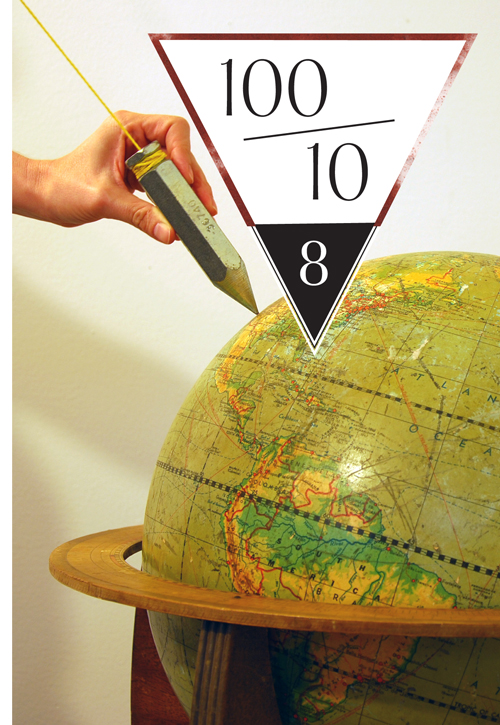
For this eighth iteration of the Institute of Cultural Inquiry’s ambitious project 100/10, showcasing ten curatorial visions over 100 business days, Rise Industries co-founders Jeremy J. Quinn and Michele Jaquis begin at the heart of the Institute’s idiosyncratic, evocative holdings. There, two objects lie. One, an industrial Acroprint clock, matter-of-factly clicks off comings and goings according to some indeterminate time zone. The other, a globe, renders Earth as a miniaturized perfect sphere, its pasted political boundaries frozen in time and encased in a grid of latitude and longitude. Both imply—and miss—so much.
Quinn and Jaquis take playful measure of the Institute’s phantom worlds, their gravitational pulls, the ebbs and flows of personal narratives lapping at the ICI collections’ contours. Anachronistic time-keeping devices. A faded 1961 Triple-A Trip-Tik presages Jaquis’ from her 2000 cross-country relocation to Los Angeles. Glass slides of images precipitate a kaleidoscopic sense of déjà vu’s possibilities for mis-(re)cognition: uncannily, Michele can mistake these for those taken by her twin sister, Nicole, in India. Expanding upon these moments of “knowing better,” the curators explore the slippages in our concepts of distance and time, in relation to the ICI collection, ICI’s location in Southern California, the geographic sprawl of their collaborators in Los Angeles, Boston, India, and our absolute/ relative position in the Cosmos.
A unique catalogue accompanies this exhibition and extends the Institute’s thinking on W.G. Sebald. Modeled on the New Museum’s catalog for its 2008 landmark show After Nature, 100/10 catalogues exist as a dustcover enfolding a slightly used copy of a book that has influenced the show’s curators. The 100/10∆8 catalog, wrapped around Umberto Eco’s The Island of the Day Before, may be purchased in the ICI gift shop or through the ICI website.
Multidisciplinary artist Jeremy J. Quinn works in installation, video, sound, sculpture, printmaking, photography, and environmental graphics. Trained as an architect, Jeremy looks at spaces in terms of hidden structure or geometries, as well as how they are inhabited and manipulated by people. He is fascinated by the many complex systems of daily life, and tries to find order and clarity beneath the chaos we inhabit. He has focused most recently on interrogating the meaning and representation of landscape, using video and installation to build alternate landscapes in “Mountain” and “Anza-Borrego Expanded Landscape”, and through sound in “Transference”. Jeremy received a Master of Architecture degree from the Southern California Institute of Architecture, and a Bachelor of Science from the University of Hartford, where he studied architecture and sculpture. He is currently a project manager at Pablo Maida Architect in Santa Monica, CA.
Interdisciplinary artist and educator Michele Jaquis examines the complexities within personal relationships, identity, language and communication through video, installation, performance and digital imagery. She earned her MFA in sculpture from Rhode Island School of Design in 2000 and her BFA in sculpture and experimental studio with a minor in psychology from Hartford Art School/University of Hartford in 1997. Her work has been presented in galleries, museums, film festivals, conferences, and alternative spaces through the US and in Australia, Canada, Ireland and New Zealand. Recent awards include a 2011 Otis College Faculty Development Grant, 2011 Creative Capacity Fund’s Next Gen Arts Leader Professional Development Grant, 2009 Vermont Studio Center Artists Residency Grant, and 2008 Director’s Chair Film Festival Best Documentary Award. She is currently Assistant Professor and Director of Interdisciplinary Studies at Otis College of Art and Design in Los Angeles.
Rise Industries Collaborators:
Sarah Rushford is a multimedia artist, designer, and arts administrator living in Boston, MA. She earned her BFA from Hartford Art School in 1998 and MA in Media Studies from The New School in 2001. As a multimedia artist she is currently working in writing, video and alternative print processes, and has recently completed a residency at TAKT Kunstprojektraum in Berlin. Her work has been exhibited in Boston, New York, Los Angeles and Berlin and has upcoming exhibitions at Massachusetts College of Art and Design and the Worcester Art Museum. With previous experience as a Media Arts Teacher and Media Literacy Coordinator, Sarah recently founded Circadia, a web design and production company for artists, small businesses and non-profits. She is also an Assistant in Institutional Research at MassArt and has been a member of Axiom Center For New and Experimental Media in Boston.
Tim Devin is an artist based in Somerville, MA, whose work deals with humanizing public space, and combating the negative effects of urban anonymity. Tim’s projects have involved community, public space, books, zines, maps, walking tours, and giving things away for free. He has shown his projects around Boston and the U.S. as well as in a number of different countries. Since early 2011, Tim has also been a board member of the Somerville Arts Council.
Mike Feldman is an LA-based pianist, composer, and sound mixer. His work spans many genres including jazz, funk, electronic, classical, and experimental. He explores the process of improvisation and its correlation to the subconscious mind, as well as the relationship between sound and image. He is also very interested in the varying frequencies and amplitudes to which the air molecules around his head are vibrating at any given moment. Mike holds a Bachelor of Music from the Hartt School, in Hartford, CT where he studied Music Production Technology and Jazz Piano. He is currently a staff audio editor at Sony Pictures, and is co-owner of audio post-production company Boxing Nuns. He is keyboardist for LA funk band Cousin Junebug.
Nicole Jaquis is a new media artist and teacher, committed to empowering others to utilize various multimedia technologies to explore and share personal stories, ideas, differences and commonalities, in the pursuit of transcending both geographical and cultural boundaries. Since 2001 Nicole has split her time between New York and Northern India, while documenting the Naga Sadhus and Sadhvis of Juna Akhara, (the largest and oldest organization of Shiva worshiping Hindu ascetics). As a founding member of Projectile Arts based in Brooklyn, she was an Associate Producer for their documentary, Take Me to the River. She is now the Founder and Director of Aesthetics With Cameras, which provides multimedia services, tools and training to Juna Akhara. Nicole has a BA in Photography and Philosophy from Lake Forest College; has completed graduate level coursework in Educational Multimedia Development at Harvard University and in Photography at International Center for Photography. Her photographs and videos have been exhibited through out New York, New England, and India.
John Kim is a Los Angeles-based conceptual artist, who works with a variety of media to question everyday assumptions and rethink the manners in which we interact with our world. His process is exploratory and often highly whimsical. If asked to summarize his work, he’d likely say he’s “still trying to figure out this art thing,” and “I am not a very serious person but I do take art very seriously… I think”. John Kim received his BFA from Otis College of Art and Design and his MFA from California Institute of the Arts.
Boris Margolin is a computer programmer, writer, and musician. His focus is on structures, physical or abstract, that embody information in unexpected ways. Boris earned a Bachelor’s degree in Mathematics from Simon’s Rock College and a Master’s degree in Computer Science from the University of Massachusetts Amherst, where he focused on security protocol analysis and design. He lives in Jamaica Plain, Massachusetts and is the chief technologist of a small financial services company.
—
Beginning January 31, 2011 and running for 100 consecutive business days, the ICI site and its archives is undergoing a multitude of interpretations. ICI has invited ten researchers-artists, writers, and visual thinkers-to set into play ideas that blend contemporary visual practices with aspects of the ICI Earth Cabinet, Ephemera Kabinett, and a 2,500+ volume library along with the nooks and crannies of the eclectic, historically layered ICI space. With two weeks to conceive of their vision, curators will work in a designated laboratory modeled upon the transparent workspaces of 19th-century natural history museums. Each curator will conceptualize a new trajectory through ICI’s body, transforming the ICI display by the end of their residency. 100/10 project participants to date have included ∆1: Alex Harvey with Anna Ayeroff; ∆2: Antoinette LaFarge with Ruth Coppens; ∆3: Norway Nori; ∆4: Karen Frimkess Wolff and Paul W. Evans; ∆5: Pam Posey with Christine Nguyen; ∆6: Christel Dillbohner with Inge Kamps; as well as ∆7: Christian Smith and Rosie Woodward Smith.
Since 1991, the Institute of Cultural Inquiry (ICI) has explored the role of visuality in imagining, perpetrating and perpetuating the intangible and ever-changing phenomena known as “culture.” The ICI sponsors displays, symposia, workshops, performances and provides numerous opportunities for both the artist fabricator and the curious spectator of visual culture. The non-profit organization also maintains an active publishing program, releasing the critically acclaimed Searching for Sebald: Photography After W. G. Sebald in 2007. 100/10 is the first project conceptualized within the 2011-12 ICI study theme of Phantom Worlds.
Purchase catalog for 100/10∆8.
Read more about the complete 100/10 project.
100/10∆8 Postcard

100/10∆7 Catalog
 The catalogs for the 100/10 (100 days/10 visions) project are an homage to many of the ICI’s favorite people and things: W. G. Sebald, his poem After Nature, The New Museum in New York. Modeled on that museum’s catalog for their 2008 exhibition After Nature, this book also owes allegiance to Aby Warburg (1866-1929). Under the dustcover you’ll find a “good neighbor,” a book that impacted the curator of this project iteration (and so, a different title for each participant) even though that book’s influence may not be immediately apparent in the exhibition photos that are sprinkled within its pages. Warburg, lamenting the possible loss of open stacks in public libraries, argued that when looking for a desired book on a library shelf it is often its neighbor that first draws your attention, its good neighbor that holds the answer you are seeking.