



Category: Associates
100/10∆2 Press Release
 100/10∆2: Antoinette LaFarge with Ruth Coppens: “Evidence of Evidence”
March 7-25, 2011
Hours: Thurs. – Sat. 12- 5 pm; by reservation via website
Reception: March 20th, 2-5 pm; Reading 3 pm.
LaFarge reads selections from her research.
Free to the public; suggested $5 donation
LOCATION:
1512 S. Robertson Blvd. , Los Angeles, CA 90035
(two blocks south of Pico); street parking available
For “Evidence of Evidence,” curators Antoinette LaFarge and Ruth Coppens probe the relationships between evidence, information and the archive as they unearth lost connections within the Institute of Cultural Inquiry’s large body of eclectic holdings. Although researchers typically proceed with some idea of what they want to find out—a hypothesis to ask, a theory to test—LaFarge and Coppens have left it to the ICI archive to offer them a prompt. The nature of archival materials is to be presumptively evidential: but of what? “How do we walk the long road between origins and conclusions,” LaFarge asks, “to what extent do we derail ourselves and our successors by what we ourselves create and leave behind?” Documenting the process of excavation and its results, LaFarge and Coppens seize upon this residue to stir the archive’s memories, forge missing links and remember forgotten relationships. The 100/10∆2 catalog, housing Lewis Hyde’s Trickster Makes this World, may be purchased in the ICI gift shop or through the ICI website.
Antoinette LaFarge is an artist-writer engaged with mapping the terrain where deception, actuality, and enactment come into conflict with notions of authenticity and authority. Her areas of activity include mixed-reality performance, interactive installation, avatar improvisation, and fictive art. Recent projects include WISP (World-Integrated Social Proxy) (2010), Hangmen Also Die (2010), World of World (2009), and Playing the Rapture (2008-09). In the 1990s she founded one of the first net-based performance troupes, the Plaintext Players. She has co-curated two groundbreaking exhibitions on computer games and art: “SHIFT-CTRL” in 2000 and “ALT+CTRL” in 2003, both at UC Irvine, where she is Professor of Digital Media in the Studio Art department. Her projects website is www.forger.com, and her blog is www.artisallwehave.com.
Ruth Coppens is a writer of historically inflected fiction and poetry. Of Flemish descent, she grew up in Brussels and London before moving to the United States, where she now lives. She earned a bachelor’s degree in history from the University of Liège in 2008 and then worked as a research asssistant for Veilinghuis Bernaerts (Antwerp) and Le Claire Kunsthandel (Hamburg). She has published her work in Versal, Thema, Palooka, and elsewhere and is presently working on a book of short writings, Meander.
—–
“Evidence of Evidence” is the second iteration of its ambitious project 100/10 (100 days/10 visions). Beginning January 31, 2011 and running for 100 consecutive days, the ICI site and its archives will undergo a multitude of interpretations. ICI has invited 10 visual researchers to set into play ideas that blend contemporary visual practices with aspects of the ICI Earth Cabinet, Ephemera Kabinett, and a 2,500+ volume library inside the eclectic and historically layered ICI space. With just two weeks to conceive of their vision, each curator will conceptualize a new trajectory through the ICI’s corpus, transforming the ICI display by the end of their residency.
—–
Since 1991, the Institute of Cultural Inquiry (ICI) has explored the role of visuality in imagining, perpetrating and perpetuating the intangible and ever-changing phenomena known as “culture.” The ICI sponsors displays, symposia, workshops, performances and provides numerous opportunities for both the artist fabricator and the curious spectator of visual culture. The non-profit organization also maintains an active publishing program, releasing the critically acclaimed Searching for Sebald: Photography After W. G. Sebald in 2007. 100/10 is the first project conceptualized within the 2011-12 ICI study theme of Phantom Worlds.
Purchase catalog for 100/10∆2.
Read more about the complete 100/10 project.
100/10∆1 Froebel Star Folding Workshop and “Listening”

please join us for a
FROEBEL STAR FOLDING WORKSHOP
&
LISTENING
with Alex Harvey and Anna Ayeroff
Saturday, February 26, 2011; 2-5pm
in the library
the Institute of Cultural Inquiry
reservations required
The Froebel star was designed by Friedrich Wilhelm August Fröbel (1782-1852), the German educator who developed the concept of ‘kindergarten’ and the Froebel gifts and occupations which inspired Frank Lloyd Wright. As a child, the future architect played with Froebel blocks, “with the cube, the sphere and the triangle,” all of which remained “in his fingers” as he began to design his famous buildings. Fröbel’s building forms and movement games were also forerunners of abstract art, as well as a source of inspiration to the Bauhaus movement.
The star, made from folded strips of papers, is one of Froebel’s “occupations, “ used to help children recognize and appreciate the common patterns and forms found in nature. At the ICI, the act of folding a Froebel star becomes a cipher for creating a unique chronicle of our times. Please join us and help us write (and fold) a history of our world that is “hidden in plain sight.”
While folding, workshop participants will hear an unfolding of the history of failed utopian colony, Clarion, Utah. LISTENING with Alex Harvey and Anna Ayeroff is a collaboration based on Ayeroff’s installation “Clarion Calls,” on view as part of the first iteration of the ICI’s 100/10 project (100/10∆1: Alex Harvey and Anna Ayeroff).
Materials will be provided but we encourage you to bring unusual papers to the workshop. This workshop qualifies for researcher membership.
100/10∆1 Press Release
 100/10∆1: Alex Harvey and Anna Ayeroff at the Institute of Cultural Inquiry (ICI)
January 31 – March 3, 2011
Hours: Thurs. – Sat. 12- 5 pm; by reservation via website
Reception: February 5th, 7-9 pm
Free to the public; suggested $5 donation
LOCATION:
1512 S. Robertson Blvd. , Los Angeles, CA 90035
(two blocks south of Pico); street parking available
[It’s wonderful] when you’re out there in the field and you’re first encountering marvelously strange natural adaptation. At first all you’ve got is a few disconnected pieces of raw observation, the sheerest glimpses, but you let your mind go, fantasizing the possible connections, projecting the most fanciful life cycles…later on, sure, you have to batten things down, contrive more rigorous hypotheses and the experiments through which to check them out, everything all clean and careful. But that first take — those first fantasies, those are the best.
– Tom Eisner –
As Tom Eisner the preeminent biologist and professor emeritus at Cornell hints in the above quotation, the scientist’s response to a “few disconnected pieces of raw observations” might be hard to distinguish from the preliminary work of the artist. At the same time, common wisdom tells us that this shared path quickly diverges when the “possible connections” that continue to flourish and find form in an artist’s artwork are batten down in science and subjected to the scrutiny of the scientific method. That is, until recently. In the last decade, especially with the advent of research-based studio art practices, the distinction between knowledge production in art and science has quickly eroded. Not only does the contemporary artist often borrow from the methodologies of science, but by integrating heretofore private and hidden research processes into the final artwork, the artist (sometimes unwittingly) exposes the extent to which the current art world, much like its ‘science world’ counterpart, rewards an institutionally sanctioned and legitimized knowledge.
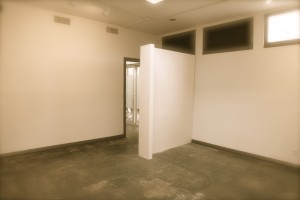 Since its inception in 1991, The Institute of Cultural Inquiry has brought focus to the similarities and has questioned the accepted distinctions between the research processes of the arts and sciences. In this spirit, the ICI is pleased to announce the launch of an ambitious project: 100/10 (100 days/10 visions), which highlights the cross-disciplinary (or un-disciplinary) nature of knowledge production. Beginning January 31, 2011 and running for 100 consecutive (business) days, the ICI site and its archives will undergo a multitude of interpretations. Ten visual researchers—artists, writers, scientists, and other visual thinkers—will “play” with ideas that blend contemporary visual practices with aspects of the ICI Earth Cabinet, Ephemera Kabinett, and a 2,500+ volume library along with the ‘small display spaces’ of the eclectic and historically layered ICI space. To facilitate this project and to increase the possibilities for inversion and trickster curatorial strategies, the ICI site has been reconfigured to include many of the “institutional” forms the organization has often railed against. Visitors will find a “white box gallery,” a dedicated and well-stocked gift shop, and a clearly labeled library. At the same time, visitors will still find the unique, non-traditional features of the ICI laboratory– a time clock (with its adjacent punch cards) that clicks off the time of another (unidentifiable) time zone, a turning carrier for fractured postcards and other ephemera that operate somewhere between clues and evidence, a tattered Ephemera Kabinett with its ambiguously labeled drawers and constantly changing content and the many nooks and crannies that hide ICI treasures in plain sight/site. As a counterpart to our new “clean-space” gallery, we have also created a studio that will become the “messy-space” laboratory for our curators to configure their unique trajectories within the ICI body. Modeled on the transparent workspaces of 19th century natural history museums, visitors to the ICI will be able to glimpse research “in process.”
With little time for curators to conceive of their vision (approx. two weeks), few of the display iterations (wherein “display” is conceived within the broadest definition to include catalogs, performances, screenings and tactical events) will be landing sites for well-thought out projects. We anticipate displays that bring together what Joseph Beuy’s called “nips at the heel” – ideas that, like a dog that wants to go outside to play, nag you until you can no longer ignore their urgency. Whether it is a recurring color, a series of linked words or sounds, synchronic events or random visions—these “nips” that might be spurred on or disrupted by the curator’s interaction with the ICI and its archive, will come together—as a new form, as an excavation, or maybe nothing more than an interpretation—and change the ongoing display. Each of the ten iterations will evolve along with and through the ideas from which they take their shape. As such, the displays will not merely represent but will enact the creative process. 100/10 is a spontaneous, malleable and constantly evolving ICI project that reflects the nature of ideas right at the moment they come into play.
 For the premier iteration of this ten-part project, 100/10∆1, the ICI has invited and collaborated with curator Alex Harvey to bring a number of rich and complex ideas to the “table.” At the center of his vision is Anna Ayeroff’s installation, Clarion Calls, a research-based exploration that draws parallels between utopias and history- both of which are rooted in the paradox of being a ‘better’ and ‘non-existent’ place. The display includes prints, sculpture, film and an 80-slide slideshow from which we are given a fragmentary story about a failed Jewish colony with a resident who shares the artist’s last name. Does the personal story and its nostalgic retreat underpin all studies of history and its documents? Harvey throws light on the single question that continually haunts the ICI archive. Ayeroff’s answer comes in the form of a large Mylar sculpture that invades the ICI space through an open window. The artist employs the form of a cosmic dust particle to build her own utopian place, integrating her abstract drawings and sculpture into the visual history of Clarion. By utilizing the fractal patterns of this celestial form, the artist revitalizes her photographs of a ruined past. If the call of family apocrypha initially brought Ayeroff to Clarion, Utah (study documents from that Interpretive Field Project are included in the ICI display) her laborious and repetitive re-mappings create a clarion call to the infinite “better world” possibilities that once drove the builders of these ruins.
 Harvey’s display illuminates the struggle between form and content that “troubles” any archive – be it a collection of stories, a chest of documents or an assortment of shapes we imagine might build a “perfect world.” A series of displays throughout the library and in other ICI “small spaces,” will engage visitors with Harvey’s complex and multi-layered ideas. Also on display is a print portfolio that includes lithographs by Ayeroff including prints made from filmstrips found in the ICI Ephemera Kabinett.
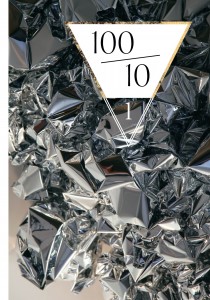
A unique catalog will accompany this show. Modeled on the New Museum’s catalog for its 2008 landmark exhibition After Nature, the document exists as a dustcover wrapped around a slightly used book of the curator’s choosing with images from the display scattered through its pages. For 100/10∆1, the book is Songlines by Bruce Chatwin. The catalog can be purchased through the ICI gift shop or online through the ICI website.
Visits to the ICI space are by reservation. A $5 fee is suggested but not required. Additional participants to the 100/10 project will be announced as they are selected.
100/10∆1 is the first project to be conceptualized within the ICI 2011-12 study theme of PHANTOM WORLDS—real and imagined worlds that double, mirror and reflect our own.
—
Since 1991, the Institute of Cultural Inquiry (ICI) has explored the role of visuality in imagining, perpetrating and perpetuating the intangible and ever-changing phenomena known as “culture.” The projects and activities of the ICI are concentrated in four main areas: Field work and Data Acquisition; Research and Analysis; Creative Manipulation and Production; Public Presentation and Publication. Favoring the messy toolbox over the latest tool, creative tinkering over the execution of a pre-made plan, the stories and lessons gleaned from the remains of material culture over strict adherence to du jour theory, the ICI offers artists and other culture producers an environment for collaborative, long-term projects with methods that rely not just on innovation but on excavation and renovation as well. Adopting the maxim: projects not programs, The ICI follows the timetable of ideas; it speaks only when it has something to say.
The ICI sponsors displays, symposia, workshops, performances and provides numerous opportunities for both the artist fabricator and the curious spectator of visual culture. A newly instituted Residency Program offers a local artist or writer the opportunity to collaborate with the ICI to develop their work within the thematic focus of the organization. The ICI also maintains an active publishing program through ICI Press. The critically acclaimed Searching for Sebald: Photography After W. G. Sebald was released in 2007 and Barthes’ Tear, a meditation on the enduring influence of Roland’s Barthes’ Camera Lucida on contemporary theory is currently in production.
Purchase catalog for 100/10∆1.
Read more about the complete 100/10 project.
Urÿonstelaii

We have just added Urÿonstelaii by Pablo Helguera to the ICI Library. Helguera contributed to our Searching for Sebald publication and the limited artist project associated with that book. His latest book recounts a tale about a mysterious sect of Dutch mystics who arrived to an island in the New World in 1660 with the objective to create a new society. Their governing principle revolved around the uninterrupted performance of a single dramatic work in seven tableaux vivants. Invoking alchemical imagery and hermetic thought, their goal was to arrive to a higher state of being by collectively embodying the symbolic representation of all of human and divine knowledge. Their experiment, which would last a century, would test the human boundaries of time, physical endurance, and the collective commitment toward an idea.
Uryonstelaii is a project consisting of two complementary components: a book published by Jorge Pinto Books,New York, and a one-time only series of performed prologue tours delivered by historical re-enactors as part of Helguera’s performance for The Sixth Borough, an exhibition at Governors Island in the summer of 2010 curated by Manon Slome and Julian Navarro for No Longer Empty.
Lise Patt, the director of the Institute of Cultural Inquiry, had the honor of reading the draft of the book and wrote this brief commentary (reprinted on the back cover): “Like a ‘lamb in wolf’s clothing,’ Pablo Helguera uses the exoteric mechanisms of historical erudition to lure us to his magical island of the Ourobourians. But right about the time we lose our footing on the land’s slippery shores—when we begin to wonder if the artist has gleaned an esoteric tradition for more than just source material for his island’s symbols and nomenclature, when we start to navigate his land with the non-verbal hunches of the alchemists’ score, and call into question the artifices we employ to gather the world around us—we realize Helguera has really taken us on a journey to another land altogether, the most forbidden of places–the self.”
Read more about this project at Pablo Helguera’s website.
Searching for Sebald: Photography After W. G. Sebald (2007)
 Searching for Sebald: Photography After W. G. Sebald is a collection of original essays and visual projects inspired by the work of W. G. Sebald. The interest in Sebald has crossed disciplines, igniting passionate dialogue among and between scholars and practitioners. This unique project, with its intricate weave of image and text, captures this spirited conversation in both theory and praxis. Searching for Sebald is edited by Lise Patt with Christel Dillbohner.
ISBN: 978-1-889917-11-5 (Trade Edition)
600 pages; 300 illustrations, 100 color.
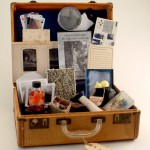
The book is also available in three special editions including a sleeved Reader’s Edition, a boxed Collector’s Edition, and a unique, limited Artist Edition of 100 ‘traveling suitcases.’ This special offering includes 20 original artworks by a roster of internationally recognized artists packaged with a hardcover copy of Searching for Sebald and a copy of Sebald’s four ‘prose fictions.’ Purchase the Reader’s Edition, Collector’s Edition and the Artist Edition from the ICI Gift shop.


Bataille’s Eye & ICI Field Notes 4 (1997)
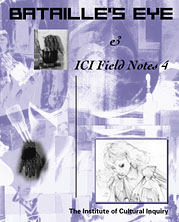 In 1928, Georges Bataille published his “pornographic” novella Story of the Eye under the pseudonym Lord Auch. Infamous in its own day, this erotic tale has become a pivotal text for art history, comparative literature, and cultural criticism. Bataille’s Eye, edited by Deborah Cullen, presents essays, artworks and research related to Story of the Eye and is the first book to reproduce the original illustrations created by André Masson and Hans Bellmer for the first two editions of the novella. Bataille’s Eye also includes a detailed publishing history that outlines the various appearances of the tale since 1928 along with a lengthy “excavation” project comparing key passages from four known versions of Bataille’s tale, including a now-rare 1953 translation. A unique set of prints commissioned from 13 international artists and printed at Robert Blackburn’s legendary Printmaking Workshop in New York City has been reproduced in this volume under the title Oeillet.
Editor: Deborah Cullen
Publisher: Institute of Cultural Inquiry
Book design: forger.com
ISBN: 978-1-889917-00-9 (Trade Edition) — OUT OF PRINT


The Collector’s Edition, a complete set of the original prints, packaged in a gold-stamped, red-silk-lined case along with the original unexpurgated book cover, is available through the ICI. Visit the ICI Gift Shop to purchase the Collector’s Edition of Bataille’s Eye.
ISBN: 978-1-889917-01-6 (Collector’s Edition)